Agentic AI Testing Explained: How Autonomous Agents Are Reshaping QA
 Software Testing Mentor and RCV Academy
Agentic AI testing explained: what separates true autonomous QA agents from AI assisted tools, with 2026 adoption data from Gartner, Forrester.
Search "agentic AI testing" and you will find hundreds of vendors using the word agentic to describe products that still wait for a human to click run. The label costs nothing to print on a landing page, so it tells you little on its own. What actually separates an autonomous testing agent from a fancier autocomplete is whether it can decide what to test, carry out the testing, and judge the result, without someone directing each step. That distinction matters more this year, because tools that meet it are now shipping inside frameworks QA teams already use, not just inside enterprise platforms with a sales call attached.
What agentic actually means in testing
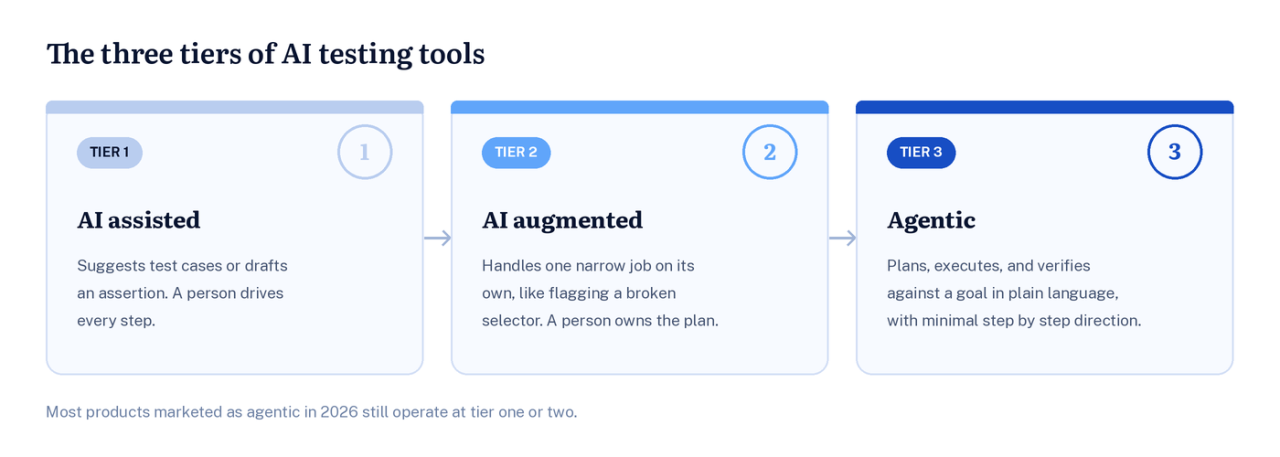
Most industry writing splits AI testing tools into three rough tiers. The first assists: it suggests a test case or drafts an assertion, while a person drives every step. The second augments: it handles one narrow job on its own, generating synthetic test data or flagging a broken selector, but a person still owns the overall plan. The third is agentic: given a goal in plain language, the system plans a sequence of actions, carries them out against a real application, checks whether the outcome matches intent, and adjusts if it does not.
Playwright, the browser automation framework most SDETs already use, gives a concrete look at that third tier in production rather than in a pitch deck. Since version 1.56, Playwright ships three built in test agents that install with a single command. The planner explores the application and produces a Markdown test plan, the generator turns that plan into real Playwright test files, and the healer runs the suite and repairs tests when the interface changes. RCV Academy's Playwright with AI powered testing course covers all three agents in detail if you want a guided walkthrough.
Why the shift is happening now
Three numbers explain why 2026 is the year this stopped being a demo and started showing up in production pipelines.
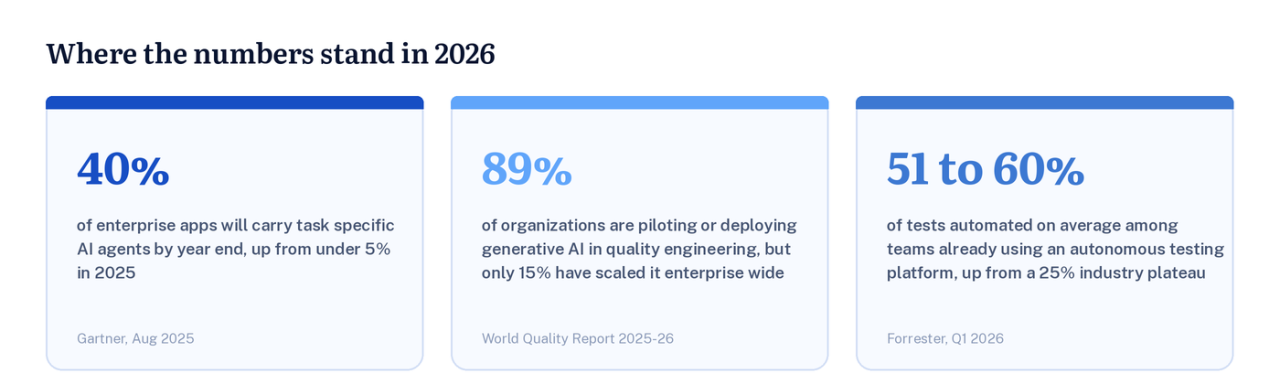
Gartner expects forty percent of enterprise applications to include task specific AI agents by the end of 2026, up from less than five percent in 2025, one of the fastest technology adoption curves the firm has tracked.
Forrester made the shift official for testing specifically, renaming its category from continuous automation testing platforms to autonomous testing platforms after concluding that scripted automation had plateaued at roughly a quarter of test coverage for most organizations. Customers who have already adopted an autonomous platform report 51 to 60 percent of their tests automated on average, a real jump from that plateau.
The Capgemini and Sogeti World Quality Report backs this up from the practitioner side. Its latest edition found that 89 percent of organizations are piloting or deploying generative AI in quality engineering, though only 15 percent have reached enterprise wide scale. Where it has scaled, teams report an average productivity gain of 19 percent, alongside a note that a third of teams saw minimal gains, so results are not automatic just because the tool is installed.
What the loop looks like inside a real test run
Strip away the marketing language and an autonomous testing agent runs roughly the same loop every time: perceive the current state of the application, plan what to check next, act on that plan, and verify whether the result matches expectation. Playwright's three agents map cleanly onto that loop. The planner perceives the app by exploring it directly rather than reading a static spec someone wrote weeks ago. The generator acts by writing and running real test code against the live UI. The healer verifies, and when a check fails because a selector moved rather than because the feature broke, it repairs the test instead of just reporting a red build.
That last point is the one QA teams tend to underestimate. A large share of the maintenance burden in any automation suite has nothing to do with writing new tests, it is fixing tests that broke for reasons unrelated to the feature under test. An agent that can tell a genuine regression apart from a shifted button id removes exactly the kind of toil that burns out automation engineers.
Where a human still needs to be in the loop
None of this means a QA team hands over judgment along with the keyboard. Ambiguous requirements remain a human problem. If a ticket does not say what should happen when a discount code and a loyalty credit are both applied at checkout, an agent will generate a test that reflects that ambiguity rather than resolving it, because resolving it is a product decision.
The same caution applies to anything with an audit trail attached: compliance critical flows, financial calculations, anything where an auditor will eventually ask why a test passed. Teams getting the most value from agentic tools right now run them for broad, high churn coverage, exploratory paths, regression suites on UI that changes every sprint, while keeping deterministic, human reviewed tests for the flows where a wrong assumption is expensive. RCV Academy's Agentic AI for QA and SDET course builds this exact hybrid pattern with the Microsoft Agent Framework, with a human approval gate placed between code generation and execution.
You do not need an enterprise platform budget to feel this firsthand. If you already run Playwright, install the built in agents and run the planner against a feature you know well, then compare its plan to what you would have written yourself. That comparison teaches you more about where agent judgment holds up than any article can, this one included.
Common questions about agentic AI testing
Is agentic AI testing the same as self healing tests?
No. Self healing is one capability an agentic system can have, not the whole thing. A tool that only repairs broken locators is still tier two, augmented, since it does not decide what to test on its own. Agentic systems combine planning, execution, and verification, self healing included, into one loop with far less step by step direction.
Will agentic AI replace manual and automation testers?
The data above points toward reallocation rather than replacement. Teams report the tools remove repetitive test writing and locator maintenance, freeing testers for exploratory testing and judgment calls agents still cannot make reliably. Only 15 percent of organizations have reached enterprise scale despite 89 percent piloting, which suggests this transition is slower than the boldest predictions suggest.
What should I try first if I already use Playwright?
Install the built in agents with the init agents command and run the planner against a page you already have coverage for, so you can compare its output against something familiar first.
Do I need to learn Python to work with agentic testing tools?
Not to start. Playwright's agents work inside the JavaScript or TypeScript project you already have. Frameworks like Microsoft's Agent Framework, which some custom multi agent QA pipelines are built on, do use Python, so it matters more once you move from ready made agents to designing your own pipeline.
Agentic AI testing is young enough that the label gets stretched over products that do not really earn it, so the more useful skill right now is being able to tell the difference. RCV Academy's Generative AI and AI Agents for QA Automation masterclass covers the broader toolkit, Copilot, Claude Code, and MCP included, for testers who want the daily workflow gains without building a pipeline from scratch.
Categories: : Agentic AI, AI, AI Tools, Automation