Agentic Testing vs Agentic Engineering: Why QA Needs Its Own Definition
 Software Testing Mentor and RCV Academy
Agentic AI, agentic engineering, and agentic testing are three different things. Here is what ISTQB, Karpathy, and new research actually say.
Two people can say "we are doing agentic testing" in the same meeting and mean two completely different things. One means their developers are using coding agents and QA needs to catch up. The other means their test suite now has agents that generate, run, and analyze tests on their own. Both are real. Neither is what the other person heard.
Three ideas hiding under one adjective
The word agentic is doing too much work right now, and it is worth separating what it actually attaches to.
Agentic AI is a property of a system: software built with autonomous agents that plan, reason, and act with limited human input. ISTQB's Certified Tester AI Testing (CT-AI) v2.0 syllabus, released in 2026, defines it plainly as AI that uses autonomous agents to plan, reason, and act independently in dynamic environments. That is something you test.
Agentic engineering is a discipline developers practice while building software with AI. Andrej Karpathy, who coined the earlier term vibe coding, introduced this one at Sequoia's AI Ascent event in 2026 and described it on his own blog as the professional discipline of coordinating fallible agents while preserving correctness, security, and maintainability. That is something developers do.
Agentic testing is a method QA teams use. A recent academic framework published on arXiv, The Rise of Agentic Testing, describes it as a closed loop system where separate agents generate tests, execute them, analyze the results, and refine the suite until it converges on good coverage, rather than a single AI producing a static list of test cases once. That is something testers do.
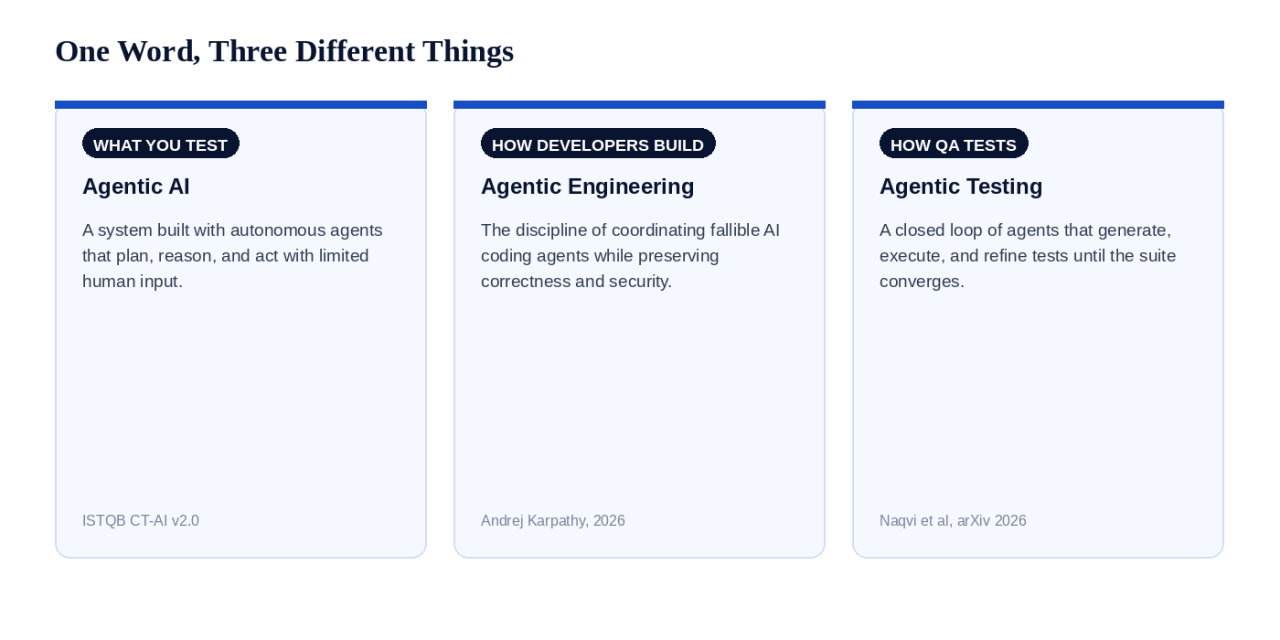
Same root word, three different roles in the same sentence. Mixing them up is not just a semantic annoyance. It changes what a meeting is actually about.
What agentic engineering actually asks of developers
Karpathy's framing is specific and worth understanding on its own terms, since QA teams are downstream of whatever their developers decide it means. He describes agentic engineering as raising the ceiling on professional software, in contrast to vibe coding, which he says only raises the floor for casual projects. The distinction matters for testers because it implies developers using agentic engineering practices are supposed to be reviewing diffs, writing specs before prompting, and maintaining ownership of the system's correctness, not accepting agent output blind. Whether a given team actually does that consistently is exactly the kind of thing a test strategy should verify rather than assume.
What agentic testing actually gives QA teams
The arXiv framework is useful because it describes a real architecture rather than a vague pitch. A generation agent produces candidate tests. An execution agent runs them and reports what happened. A review agent evaluates whether the results are actually useful and asks the generation agent to try again where they are not. The loop repeats until the suite reaches a defined quality bar, with a human able to intervene at any point.
That is a meaningfully different claim than a single AI assistant that writes a batch of test cases from a prompt and hands them back. The multi agent version is closer to a self correcting pipeline than a one shot generator, which is also why it needs more oversight design, not less, before a team trusts its output on anything that matters.
Why the confusion has a real cost
Gartner's own research gives a reason to care about getting these definitions straight rather than treating it as pedantry. In a June 2025 press release, Gartner predicted that over 40 percent of agentic AI projects will be canceled by the end of 2027 due to escalating costs, unclear business value, or inadequate risk controls, even as it projects that a third of enterprise software will include agentic AI by 2028. Projects get canceled for unclear value most often when nobody agreed on what the project was actually trying to do. A QA team that cannot distinguish testing an agentic system from using agentic tools to test is not well positioned to define what success looks like for either one.
A working definition to bring into your next planning meeting
Keep the three ideas separate in how you talk about them, not just in your head. When someone says agentic, ask whether they mean the system under test, the way it was built, or the way you are testing it. RCV Academy's ISTQB AI Testing (CT-AI) Masterclass covers the formal CT-AI v2.0 definitions in detail, including how agentic AI differs from other AI system types you are expected to test differently.
If your interest is specifically in building the agentic testing side, multi agent pipelines that generate, run, and refine tests themselves, RCV Academy's Agentic AI for QA and SDET course walks through building those autonomous workflows directly.
Frequently asked questions
Is agentic testing the same thing as AI testing?
No. AI testing is the broader discipline of testing any AI based system, including simple models with no autonomy at all. Agentic testing specifically refers to using autonomous, often multi agent, systems to perform the testing itself.
Do I need to test differently if my developers are doing agentic engineering?
Not necessarily differently in technique, but differently in emphasis. If developers claim they are reviewing every agent generated diff and maintaining ownership of the system, your test strategy should include ways to verify that claim rather than take it on faith.
Is agentic AI just another name for AI agents?
Close, but ISTQB's definition specifically ties agentic AI to autonomous planning and acting in dynamic environments, not simply any software that calls itself an agent. A chatbot that answers one question at a time is not automatically agentic in this sense.
Should QA get involved before development starts using agentic engineering practices?
Earlier involvement tends to help with any significant process change, and this is a big one. Understanding what oversight developers are committing to before code starts shipping gives QA a much better basis for designing tests that check whether that oversight actually happened.
Precision about which agentic you mean will not fix a bad agentic AI project on its own, but it makes the difference between a QA team that can define what it is testing and one that is guessing. RCV Academy's ISTQB CT-AI Masterclass is a solid place to build that vocabulary before your next agentic conversation happens without you in the room.
Categories: : Agentic AI, AI, AI SDET, qa