AI Literacy Is Now a QA Job Requirement: The Skills That Pay More
 Software Testing Mentor and RCV Academy
Real 2026 job posting data on how AI skills are reshaping QA hiring, which specific skills show up most, and the salary gap behind them.
Thirty nine thousand three hundred dollars. That is the gap in 2026 between the median US base salary for QA Engineer postings that explicitly ask for AI skills and ones that do not, according to an analysis of over 17,000 live job postings. The number is specific enough to feel like clickbait, and it comes with real caveats worth understanding before you change how you spend your next six months. Here is what the data actually shows, and what it does not.
What the job posting data actually shows
InterviewStack.io analyzed 17,007 active QA Engineer postings as of May 2026, tagging each one for explicit AI skill requirements. 4.4 percent explicitly required new wave generative AI skills, things like LLMs, AI Agents, or Prompt Engineering. A further 3.0 percent asked for traditional machine learning skills. That leaves roughly 93 percent of postings with no explicit AI requirement at all.
Read that carefully before drawing the wrong conclusion. It does not mean AI is irrelevant to the other 93 percent. It means most employers have not yet written an explicit AI clause into the posting, even though using an AI coding assistant day to day is now assumed at most companies the same way internet access was assumed by 2005. The postings that do mention AI explicitly are asking for something more specific, the ability to test AI powered products themselves, not just use AI tools while testing conventional ones.
The skills actually showing up in postings
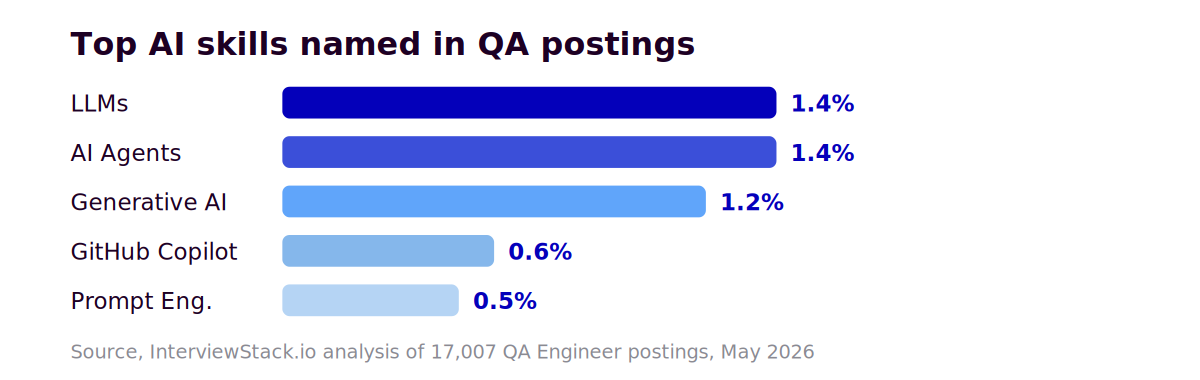
Two distinct categories show up in the data. LLMs, AI Agents, and Generative AI lead the list, reflecting QA teams being pulled directly into testing chatbots, autonomous agents, and generative features. Prompt Engineering shows up alongside these for a specific reason, understanding how prompts actually work is what lets you construct the adversarial inputs that surface a model's failure modes.
A second category, GitHub Copilot, ChatGPT, and general AI assisted development, reflects postings that expect you to use AI tools in your own testing workflow, separate from testing AI itself. Machine Learning appears in 2.8 percent of postings, the single most common AI related term, mostly for roles testing ML pipelines for edge cases and data drift rather than training models directly.
The salary premium, and why the number deserves a caveat
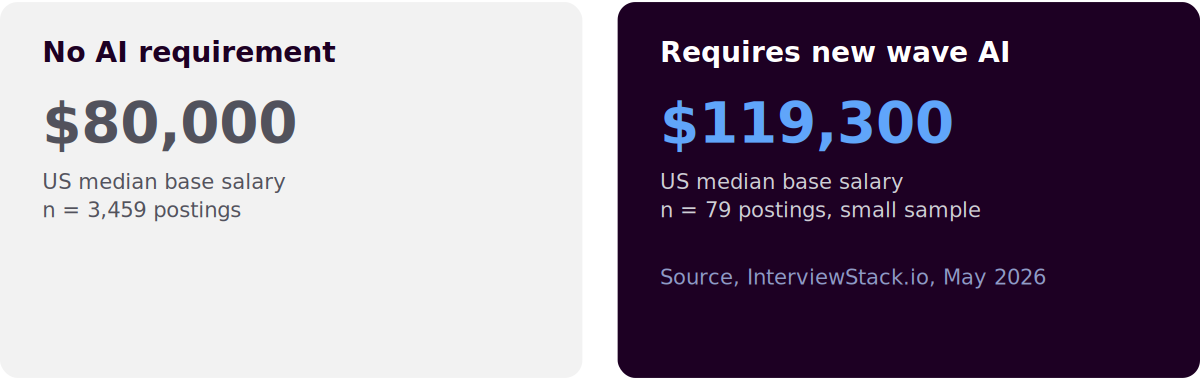
The $39,300 gap is real in the data, but the sample behind it is small, 79 AI required postings against 3,459 without. InterviewStack's own analysis flags this directly, noting the premium almost certainly reflects a talent scarcity effect rather than proof that adding "LLMs" to a resume adds $39,000 to any single offer. Employers hiring for this specific combination are competing in a genuinely thin candidate pool right now, and thin pools bid salaries up fast.
That scarcity read lines up with the broader labor market too. PwC's 2026 Global AI Jobs Barometer, based on more than one billion job advertisements across 27 countries, found a 62 percent average wage premium for roles requiring AI skills generally, up from 56 percent the year before. QA is not an outlier here, it is following the same repricing happening across the labor market broadly.
Where the demand actually concentrates
Staff level QA engineers show the highest explicit AI adoption in postings at 7.2 percent, followed by senior at 4.9 percent, with mid level and entry both trailing around 3.7 percent. Companies are placing this bet on experienced engineers who already understand testing fundamentals well enough to extend that judgment to a genuinely different failure mode, not on candidates still building core automation skills.
By industry, professional services, technology, and software companies show the highest explicit AI adoption in QA postings, all in the 10 to 13 percent range, since these are the industries shipping AI powered products fastest and therefore need testers who can evaluate them soonest.
How to actually use this if you are job hunting
Build genuine competence testing non deterministic systems first, writing evaluation criteria instead of fixed expected outputs, constructing adversarial prompts, and designing checks for autonomous agent behavior. DeepEval, an open source framework built specifically for this kind of testing, is a reasonable place to start practicing that skill concretely rather than abstractly. That is where the premium actually concentrates, not in listing a tool name on a resume without being able to explain how you have used it.
If you already work in conventional automation, adding an AI coding assistant to your daily workflow is a low cost, high visibility upgrade, since most interviewers will now ask about it directly even when the job posting never mentions AI explicitly. RCV Academy's Playwright course covers exactly that combination, conventional automation fundamentals alongside the AI assisted layer.
Frequently asked questions
Does this mean traditional QA automation skills are becoming less valuable? No. The data shows AI testing skills as an addition on top of automation fundamentals, not a replacement for them. Staff and senior engineers, who already have the deepest automation experience, show the highest AI adoption rates, not the least.
Is a 4.4 percent explicit requirement rate actually significant? It undercounts the real shift, since it only captures postings that state an AI requirement outright. The much larger group of postings that assume AI tool fluency without stating it is not reflected in that number at all.
Should I list every AI tool I have touched on my resume to chase this premium? No. The premium tracks genuine ability to test AI powered systems, not keyword presence. An interviewer who asks you to walk through how you would test an LLM feature will find a superficial keyword list quickly.
RCV Academy's ISTQB Generative AI certification course and Generative AI and AI Agents for QA course build exactly the evaluation skills this data shows employers are paying for, not just tool familiarity.
Categories: : AI, AI Roadmap, AI SDET, AI Tools