The AI Testing Tools That Quietly Failed: What Vendor Benchmarks Don't Show You
 Software Testing Mentor and RCV Academy
"AI testing tools score well on the benchmarks vendors publish and worse on real, unfamiliar code. Here is what the research actually shows."
Nobody publishes a case study titled "we tried this and it did not work." The tools that quietly get uninstalled after a six week pilot leave no press release behind. What gets published is the benchmark, the demo, and the testimonial from the team that got lucky with a use case the tool happened to be good at. None of that is dishonest exactly. It is just a filtered picture, and the research on the unfiltered one tells a less flattering story.
The gap that keeps showing up in the research
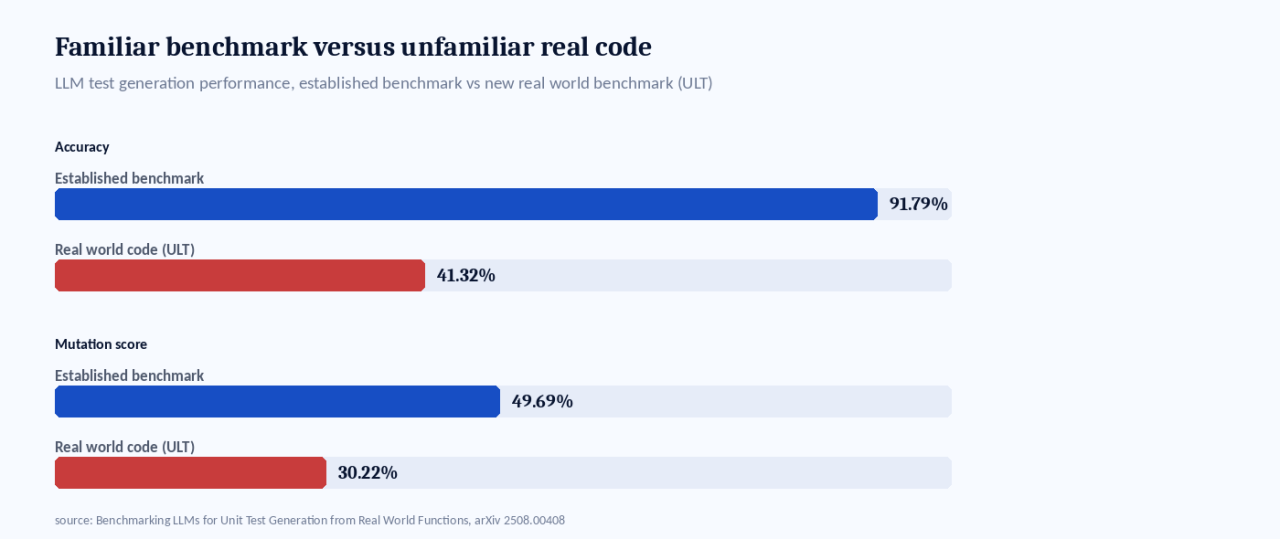
A recent benchmark specifically built to test this found something worth taking seriously. Researchers evaluating large language models on unit test generation compared performance on established benchmarks, code the models likely encountered during training, against a new benchmark built from real world functions the models had not seen before. The results, published in a 2025 paper on arXiv, were stark: average accuracy on the new, unfamiliar benchmark was 41.32 percent, compared to 91.79 percent on an existing benchmark. Mutation score, a measure of how well generated tests actually catch real defects, dropped from 49.69 percent to 30.22 percent on the unfamiliar code.
That gap matters for anyone evaluating a testing tool based on a vendor's published benchmark. A benchmark score is only informative if the code it was measured on resembles the code you will actually run the tool against. A model or tool that performs well on popular, well documented, frequently referenced code is not automatically going to perform the same way on your internal, unfamiliar, unglamorous codebase, and this research is a rare case where someone actually measured that gap directly instead of assuming it away.
Why "our developers feel faster" is not evidence
Vendor testimonials lean heavily on how a tool felt to use, and feeling faster is measurably unreliable as a proxy for actually being faster. METR's randomized controlled trial, a nonprofit AI research organization, recruited sixteen experienced open source developers to complete 246 real tasks in codebases they knew well, randomly assigning AI tool use on a per task basis. Before starting, developers forecast that AI would cut their completion time by 24 percent. Measured results showed the opposite: AI tool use increased completion time by 19 percent. Even after finishing the tasks, developers still estimated AI had made them roughly 20 percent faster, a nearly forty percentage point gap between what actually happened and what participants believed had happened.
That specific study measured general coding tasks, not testing tools directly, and METR itself has since noted the result reflects a specific snapshot of early 2025 tools rather than a permanent verdict on AI assistance. But the underlying mechanism, that a person's felt sense of speed is a poor substitute for a timed measurement, applies just as much to a tester judging whether an AI powered test generator saved time as it does to a developer judging whether an AI coding assistant did. A testimonial describing how much faster a team felt is describing the same unreliable signal this study measured directly, and found pointed the wrong way.
The gap between a pilot and a scaled rollout
A tool can pass every internal evaluation and still quietly fail to earn a permanent place in the workflow. Capgemini's World Quality Report 2025 26 found that 43 percent of organizations are experimenting with generative AI in quality engineering, but only 15 percent have scaled it enterprise wide. That is not a small gap. It means the large majority of pilots that get started do not become the tool a team actually depends on a year later, and a pilot that quietly gets shelved rarely generates a public postmortem explaining why. The published success stories come disproportionately from the minority that made it through scaling, which skews the visible evidence toward the tools that worked and away from the much larger set that did not.
What to actually check before trusting a benchmark claim
Ask what the benchmark code looked like. A tool tested against popular open source repositories or textbook style problems is being tested on code an LLM plausibly saw during training, which inflates the score relative to your own unfamiliar codebase. If your team is learning to build and evaluate this kind of pipeline directly rather than relying on a vendor's number, the Generative AI and AI Agents for QA and SDETs masterclass covers setting up evaluation against your own code rather than someone else's benchmark.
Ask whether a speed claim was measured or self reported. A timed, controlled comparison and a survey asking "did this feel faster" produce very different kinds of evidence, and the METR result shows those two things can point in opposite directions on the same task.
Ask how many pilots preceded the case study you are reading. A single glowing example says little about the base rate of success, especially in a category where, per Capgemini's numbers, most pilots do not make it to scaled use.
Frequently asked questions
Does this mean AI testing tools do not work at all?
No. The research points to a gap between benchmark conditions and real, unfamiliar work, not to categorical failure. Tools clearly help in specific, measured cases. The point is that a benchmark number alone does not tell you which category your use case falls into.
Why would a vendor publish a benchmark that does not reflect real use?
It is rarely intentional deception. Benchmarks like the established ones referenced in this research were built before this specific overlap problem was well understood, and a vendor citing them is often citing the best available number, not a chosen distortion.
How can a team test a tool honestly before committing to it?
Run it against your own unfamiliar, undocumented code rather than a demo repository, and measure completion time or defect detection directly instead of relying on how the pilot team says it felt.
Is a 15 percent scaled adoption rate actually bad?
Not necessarily. Some of that gap reflects normal caution rather than failed tools. But it does mean most pilots are not evidence of success yet, and treating an early pilot as proof a tool works skips the step where most pilots actually stall.
If you want to build the skills to evaluate an AI testing tool on your own code instead of taking a vendor benchmark at face value, the ISTQB CT-GenAI certification course covers the evaluation methods this kind of honest assessment actually depends on.
Categories: : AI, AI Roadmap, AI Tools, Automation