API First Testing: Why Contract Tests Now Come Before the UI Does
 Software Testing Mentor and RCV Academy
82 percent of organizations are API first, but contract testing sits at 17 percent adoption. Here is what that gap means for how testing gets ordered.
A UI test needs a UI. A contract test needs an agreement about what the API returns, and that agreement can exist before a single screen gets built. That ordering used to be backwards in most testing strategies. It is starting to flip.
The gap sitting inside Postman's own numbers
Postman's 2025 State of the API Report, based on a survey of more than 5,700 developers, architects, and executives, found that 82 percent of organizations have adopted some level of an API first approach, with 25 percent now fully API first, a twelve point increase from the year before. Testing is the single most common API related activity, reported by 81 percent of respondents, ahead of development at 73 percent and documentation at 58 percent.
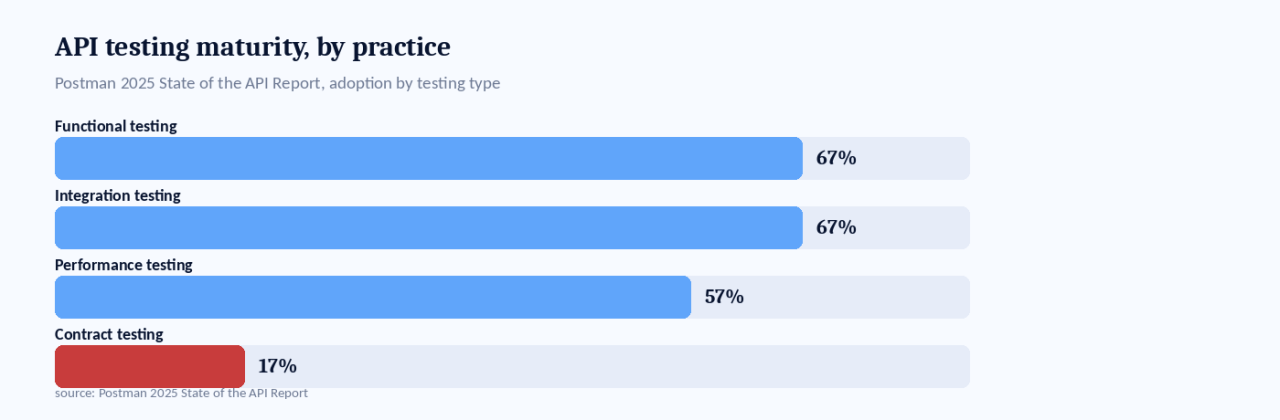
Buried inside that same testing data is the gap that makes this post worth writing. Functional and integration testing both sit at 67 percent adoption. Contract testing sits at 17 percent. Teams have overwhelmingly adopted the API first mindset and are testing constantly, but the specific practice built to verify that an API keeps its promises to the things calling it remains a minority practice, even among teams who would tell you they take API quality seriously.
What a contract test actually checks
A contract test is not a smaller integration test. It checks something narrower and more specific: that a provider's actual behavior matches what a consumer expects, independent of whether both sides are running at the same time. Pact's own documentation describes this as consumer driven contract testing, where the consumer, often a front end application or another service, writes a test that records its expectations of the provider as a contract file. The provider then verifies independently that it satisfies that contract, without needing the consumer's code running anywhere nearby.
That independence is the entire point. A traditional end to end test needs every service in a chain deployed and healthy at once, which makes it slow, flaky, and expensive to maintain as a system grows. Pact's documentation is direct about the tradeoff: contract tests replace an integration test that gives slow feedback with two fast unit style tests, one for the consumer against a mock provider, one for the provider against a mock consumer, kept in sync by the contract file itself.
Why API first makes this testable before a UI exists
None of this works without something to write the contract against, and that is where the API first part of the story actually matters. The OpenAPI Specification, maintained by the OpenAPI Initiative under the Linux Foundation, defines a standard, language agnostic way to describe an HTTP API's behavior so that both humans and machines can understand it without reading the implementation. When a team designs the API description before writing the backend or the frontend, that description becomes something a consumer team can write contract tests against immediately, using a mock server generated straight from the spec.
This is the actual mechanism behind "contract tests before the UI." A frontend team does not need a working backend to start testing what they expect from it. They need an agreed API description and a contract that encodes it. The backend team builds toward that same contract independently. Both sides move in parallel instead of the frontend waiting on a backend that is waiting on requirements that are still being figured out live in a shared environment.
What this changes for the person writing the tests
The order of operations moves earlier. Instead of writing UI tests once a working frontend exists and then discovering an API mismatch during manual testing, a contract test can catch a broken assumption the day the API description changes, before any UI code touches it. If your team is building this kind of workflow around a specification first process, the Postman API testing course covers writing and automating the API level checks that a contract testing practice depends on.
This also changes what a tester needs to know how to read. A contract test failure points at a specific, narrow claim: this field was renamed, this status code changed, this response no longer includes a field the consumer relies on. That is a more useful failure message than a UI test failing somewhere downstream with no clear indication of which layer actually broke.
Frequently asked questions
Does contract testing replace end to end testing entirely?
No. It replaces the portion of end to end testing that exists only to check whether two services agree with each other. End to end tests still have a role for verifying complete user journeys, just fewer of them are needed once contract tests catch integration mismatches earlier and faster.
Why does contract testing lag so far behind functional and integration testing?
It requires coordination between teams that traditional testing does not, since a contract has to be agreed on and maintained by both a consumer and a provider. That coordination cost is likely why adoption trails simpler practices a single team can adopt on its own.
Do we need Pact specifically, or does any API testing tool work?
Pact is the most established consumer driven contract testing tool, but the underlying practice, a consumer recorded expectation verified independently by a provider, is a pattern, not a single product. Some teams achieve a similar outcome using OpenAPI validation directly against a live provider.
Is API first only relevant for large organizations with many microservices?
The revenue data in Postman's report suggests otherwise. Fully API first organizations were more than twice as likely to generate over 75 percent of revenue from their APIs compared to less API first peers, a pattern that shows up regardless of company size, not just at enterprise scale.
If your team is deciding how to structure testing around an API first workflow, especially where APIs also need to serve AI agents as consumers, the Agentic AI for QA and SDET course covers building automated checks into a pipeline that treats the API contract as the source of truth.
Categories: : API, API Testing, Automation, Free AI Tools