Avoiding Overfitting in AI Test Automation | RCV Academy
 Software Testing Mentor and RCV Academy

Learn how to detect and prevent benchmark overfitting in AI test automation. Practical strategies backed by peer-reviewed research on data leakage and memorization.
The Model That Aced Every Test
The evaluation numbers looked excellent. The model scored above 90% on the internal benchmark suite. The team ran it in production and watched it fail on real tickets it had never seen. The benchmark had not measured generalization. It had measured how well the model remembered its training data.
That gap between evaluation score and production behavior is the defining problem of overfitting in AI test automation. This post covers how to detect it and what to do about it.
What Overfitting Means in This Context
In AI test automation, overfitting takes several related but distinct forms.
The first is benchmark data leakage. The model’s training corpus contains examples from the evaluation set, or examples so similar to them that the model’s answers are retrieved rather than reasoned. Deng et al. (arXiv:2411.03923, 2024) documented the scale of this in major open models: for Llama 1 at 65 billion parameters, estimated performance gains from contamination were roughly 18 points on HumanEval and roughly 25 points on Big Bench Hard. Eight of the 13 benchmarks they examined had over half their samples flagged as contaminated in the Llama 1 training corpus.
The second form is prompt memorization. The model learns to respond to specific surface features of a prompt rather than to its underlying meaning. A study by Srivastava et al. (arXiv:2502.07445, 2025) tested 26 LLMs on rephrased versions of MMLU questions. The average performance drop under modest rephrasing was 2.15%, and 20 of the 26 models showed statistically significant degradation. Models with higher baseline accuracy showed larger drops, a finding that suggests the performance came partly from recognizing familiar prompt patterns.
The third form is behavioral collapse after model adaptation. Barnett et al. (arXiv:2406.11201, 2024) found that fine tuning language models inside retrieval augmented generation pipelines can reduce overall system performance compared to the unmodified baseline. The adapted model’s changed behavior reduced its ability to use retrieved context. Teams that fine tune a model and evaluate only the fine tuned component in isolation will miss this interaction effect.
Why Evaluation Sets Must Be Isolated First
The most important structural protection against overfitting is separating the evaluation set from all training material before any data selection begins.
This step sounds obvious. In practice, it is skipped or done incompletely more often than not. The reason is that evaluation data and training data often come from the same source: a codebase, a ticket system, internal documentation, a shared test suite. When they do, examples will overlap unless explicit deduplication is enforced between splits.
Lee et al. (arXiv:2107.06499, 2021) found that over 4% of standard validation set examples overlapped with training data in widely used pretraining datasets. For a team building a QA model from internal artifacts, that rate can be higher, because the source distribution is narrower.
The correct sequence is: define the evaluation set first, move those examples to a location training data selection cannot touch, then proceed with training data collection and filtering. Any selection process that sees the evaluation labels before this separation can inadvertently optimize toward them.
Detecting Memorization With Behavioral Tests
An isolated evaluation set eliminates one route to inflated scores. It does not eliminate prompt memorization.
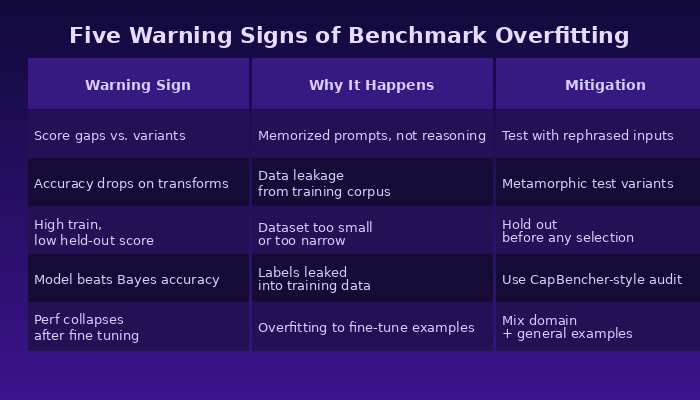
The most practical detection method is metamorphic testing: generate semantically equivalent variants of each benchmark prompt and measure whether the model’s performance holds across them. If a model answers the original correctly but fails on a rephrased version with identical meaning and label, the original answer was likely retrieved rather than reasoned.
Researchers applying this approach to automated program repair (arXiv:2604.21579, 2025) tested seven LLMs on the Defects4J and GitBug-Java benchmarks after applying code transformations that preserved semantics. All models repaired fewer bugs on the transformed versions, with declines ranging from 4.1% for GPT-4o to 15.98% for Llama 3.1. Performance on the original correlated strongly with the model’s likelihood of having memorized those specific examples.
For AI test automation, this means generating paraphrased versions of each test case and measuring whether the model’s responses are consistent. An inconsistency rate above a few percent warrants investigation.
Structural Benchmark Safeguards
Two architectural approaches address benchmark contamination at the design level.
The first is dynamic benchmark construction. Rather than using a fixed evaluation set that can leak into training corpora over time, teams generate new test cases for each evaluation run by sampling from a controlled distribution. Bordt et al. (arXiv:2410.03249, NeurIPS 2024) showed that contamination seen up to 144 times can be forgotten once training data exceeds five times the Chinchilla optimal scale, a regime that characterizes many current large models. The implication is that the window for contamination effects is bounded, but dynamic benchmarks close it entirely.
The second is benchmark design that makes overfitting detectable. The CapBencher framework (arXiv:2505.18102, 2025) publishes benchmarks with multiple logically correct answers per item, only one of which is included. This produces a ceiling on accuracy, called Bayes accuracy, that even a fully capable model should not exceed. Any model that does is a strong signal of leakage or label gaming. The detection requires no access to training data and no assumptions about how the leak occurred.
Avoiding Overfitting During Model Adaptation
When a model is adapted on examples from a narrow task, the adapted version can overfit to those examples in ways that hurt performance on related but distinct tasks.
The most direct mitigation is mixing. Training exclusively on examples from one domain teaches the model a narrow distribution. Including general examples alongside them preserves the model’s ability to handle variation it was not specifically trained on. Lv et al. (arXiv:2504.12687, 2025) found that selecting 40% of a code instruction dataset matched the performance of training on the full dataset while reducing training time by 28% and GPU memory usage by 30%. The selection criteria filtered for diversity as well as quality, which is the key distinction.
Evaluating the adapted model in its actual deployment context is also required. A model that will run inside a pipeline should be evaluated in that pipeline. Evaluating it in isolation overstates its usefulness.
A Pre-Deployment Checklist
Before any AI test automation model reaches production, four checks reduce the risk of shipping an overfit system: the evaluation set was isolated before any data selection; every benchmark item has been tested with at least one rephrased variant; the evaluation pipeline matches the deployment pipeline; and the benchmark scores have been validated against a sample of real production inputs.
The goal is a model whose evaluation score predicts how it behaves on work you have not yet seen.
Teams building toward that standard will find the evaluation design and pipeline integration sections in the Generative AI and AI Agents for QA SDET Masterclass directly applicable to the decisions this post covers.
For teams building the retrieval and context management layers that sit around adapted models, the LangChain for QA: Build RAG, Agentic RAG and AI Chatbots course covers how pipeline structure affects what a model can and cannot do, including the interaction effects that Barnett et al. documented.
Categories: : Agentic AI, AI Roadmap, AI Tools, ISTQB Generative AI