The Human in the Loop Problem: Where AI Testing Agents Still Need You to Sign Off
 Software Testing Mentor and RCV Academy
"Regulators, ISTQB, and the tools themselves agree on one thing: AI testing agents still need a human to approve the risky decisions."
A healer agent can rewrite a failing locator, rerun the test, and post a green check mark in under a minute. None of that tells you whether the thing it just patched over was a real bug. That gap, between an agent that can act and a human who still has to judge whether the action was right, is where a lot of AI testing rollouts quietly stall.
Regulators got here before most testing teams did
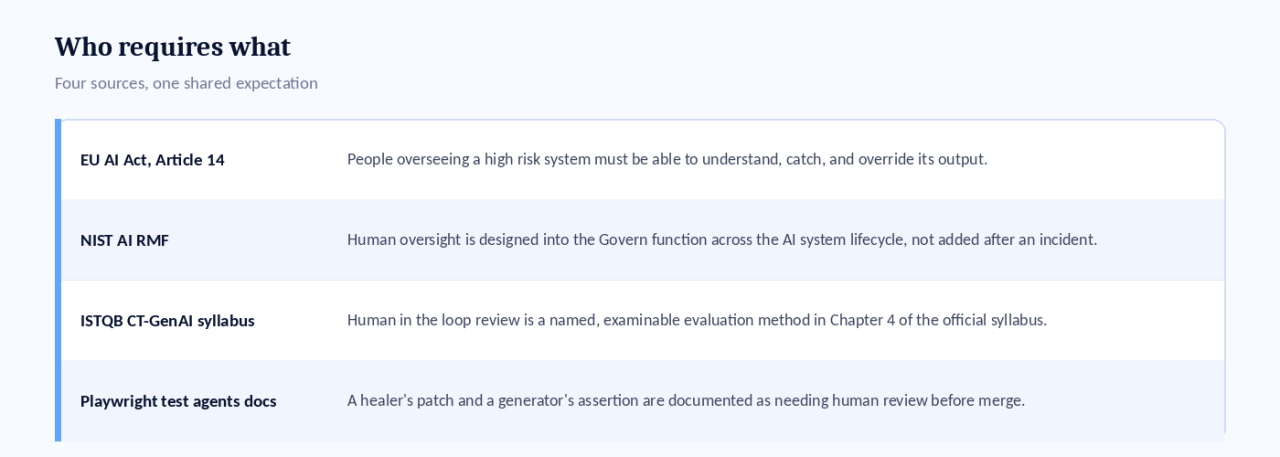
The EU AI Act does not single out test automation, but its human oversight requirement sets the tone for how any serious AI deployment gets governed. Article 14 requires that high risk AI systems be built so people assigned to oversight can understand the system's output, notice when it is behaving strangely, and choose not to use it or to override it in a given situation. The article is written for things like medical devices and hiring systems, not test suites, but the underlying expectation, that a person needs the real ability to catch and stop a bad automated decision, translates directly to a healer agent quietly patching a test at two in the morning.
NIST's AI Risk Management Framework takes a similar position without the legal force. The official framework, built around the Govern, Map, Measure, and Manage functions, treats human oversight as something to be designed into a system's lifecycle rather than bolted on after an incident. Neither document was written with QA in mind, but both describe the same failure mode: a human who is nominally responsible but has no real chance to catch a problem before it ships.
Where sign off already lives inside the tools you use
This is not just theory arriving late to testing. It is already built into the products. Playwright's own documentation for its test agents describes the healer as capable of proposing a repair and rerunning a test, but stops short of claiming the repair is automatically safe to merge. The docs are direct about the risk: a generator can encode a false assertion that still passes, and a healer can find a workaround that hides a real defect instead of catching one. Human review after planning, after generation, and after healing is part of the documented workflow, not an optional add on.
Tricentis builds the same idea into its AI Workspace at the platform level, with approval gates and a decision log recorded on every agent run so a person can see why an agent did what it did before that action becomes permanent. And the ISTQB has folded the skill itself into certification. Chapter 4 of the CT-GenAI syllabus covers evaluation methods including human in the loop review alongside graded rubrics and LLM assisted scoring, which means judging AI output is now a testable, examinable skill rather than a vague best practice.
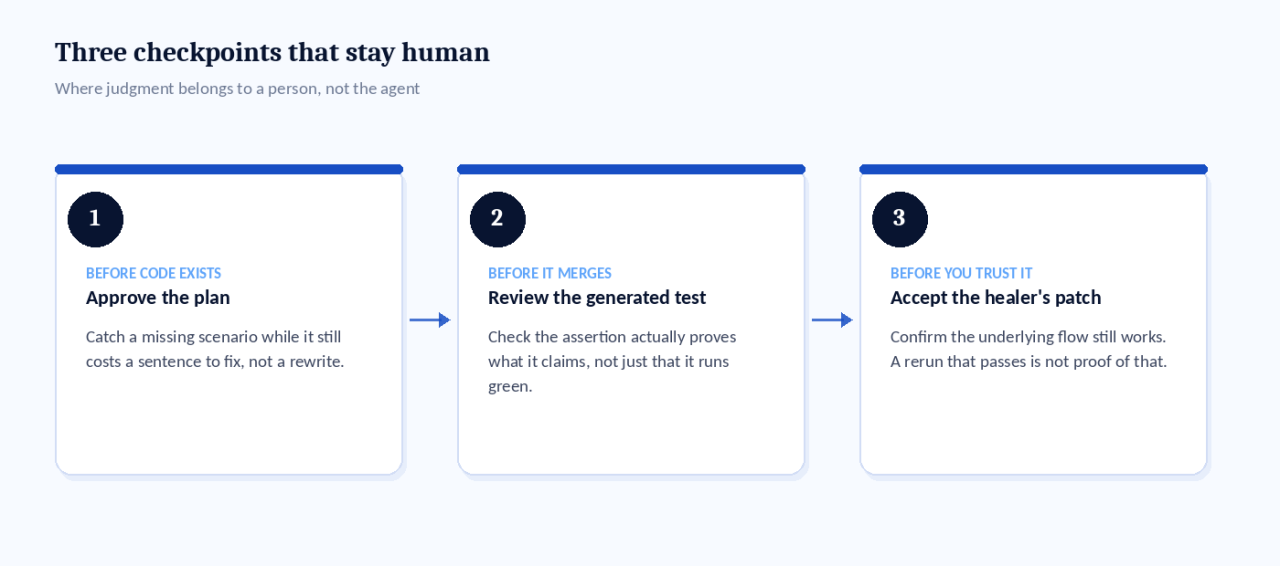
The three decisions that should not be automated away
Approving scope before any code exists. A planner's markdown plan is the cheapest place to catch a missing scenario. Once a generator has turned that plan into fifty lines of Playwright, fixing a gap costs a lot more than it would have at the plan stage.
Merging generated code. A generator can write a test that runs green while asserting the wrong thing, especially when a locator resolves to the right element for the wrong reason. Reading the diff before merge is still the job of the person who owns the suite, not the agent that wrote it.
Accepting a healer's patch. This is the highest stakes moment of the three. A patched locator or an extended timeout can turn a real regression into a silent false pass. Treat every automated patch as a proposal, not a fact, until someone confirms the underlying flow still works the way it should.
What signing off actually looks like day to day
None of this means reading every line an agent produces. It means putting a checkpoint at each of the three decisions above and actually using it, instead of letting green checkmarks accumulate unread. A few habits make the difference:
Track override and rejection rates the way you would track flaky test rates. A team that never rejects a generated plan or a healer patch is not necessarily working with a flawless agent. It is more likely a sign that review has quietly turned into a rubber stamp, which is exactly the automation bias regulators keep warning about.
Log the reasoning, not just the outcome. When a healer changes a locator, the commit message should say what changed and why, so the next person reviewing a failure has context instead of a mystery diff.
Match the depth of review to the blast radius. A locator fix on an internal admin page does not need the same scrutiny as a healer patch on a payment flow. Spending equal attention everywhere just means less attention where it actually matters.
Frequently asked questions
Does human in the loop mean reviewing every AI generated test line by line?
No. It means having a real checkpoint at the decisions that matter, plan approval, code merge, and patch acceptance, and treating those checkpoints as more than a formality. Low stakes changes can move fast. High stakes ones should not.
Is human oversight only a legal requirement for regulated industries?
The EU AI Act's binding rules apply to systems classified as high risk, which most internal test suites are not. But the reasoning behind the requirement, that automation bias creeps in whenever review becomes routine and unquestioned, applies to any team running agents against production adjacent code.
How do I know if a team has quietly stopped reviewing agent output?
Watch the override rate. If nobody has rejected a plan, a generated test, or a healer patch in weeks, that is worth investigating rather than celebrating. It usually means review turned into a formality somewhere along the way.
Can the review step itself be handled by another AI agent?
Partially. A second agent can flag likely issues, unusual diffs, or a locator change on a sensitive flow, and that is useful triage. But the ISTQB syllabus and the EU AI Act both frame final judgment as something a person exercises, not something a review agent can sign off on in place of one.
If you want a structured way to build these checkpoints into your own pipeline instead of figuring it out mid incident, the ISTQB CT-GenAI certification course covers the evaluation methods this post touches on, and the Agentic AI for QA and SDET course walks through wiring approval gates into a real multi agent workflow rather than bolting them on afterward.
Categories: : AI, AI Roadmap, AI Tools, Automation