Human-in-the-Loop Testing for AI-Generated Test Cases
 Software Testing Mentor and RCV Academy

Learn how to build a human review process for AI-generated tests. Research-backed patterns for catching wrong assertions, brittle mocks, and flaky tests before they enter production.
The Confidence Problem With AI-Generated Tests
A test that passes is not a test that protects. When a language model generates test cases, it produces syntactically correct, structured output that looks exactly like good test coverage. The gap between looking correct and being correct is where the risk lives.
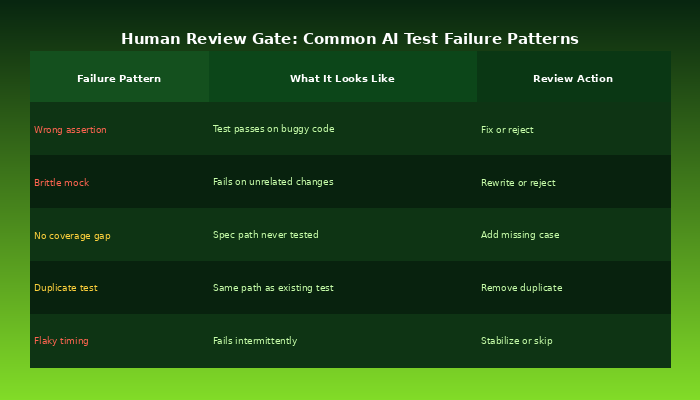
Research on test suites generated by large language models found that most suites contained at least one error or test smell. Error rates varied from around 7% to 29% depending on the model and prompt context, with incorrect assertions accounting for roughly 65% of all errors. A test with a wrong assertion passes on buggy code. It provides false assurance and will not catch the defect it appears to cover (Alves et al., “Quality Assessment of Python Tests Generated by Large Language Models,” arXiv:2506.14297).
A second study found that when LLMs generated tests against incorrect code, bug detection on production code dropped by 47% compared to generating against correct code. Adding natural language descriptions of the code under test improved bug detection by 34%, but the underlying quality gap persisted (Huang et al., “Measuring the Influence of Incorrect Code on Test Generation,” arXiv:2409.09464, 2024).
These numbers explain why a human review step is not optional overhead. It is a quality gate with a measurable return.
What the Review Gate Catches
At Meta, a production AI test generation pipeline at scale automatically flagged candidate tests for engineer review. Of 41 tests escalated for human judgment, 17 to 19% were confirmed true positives, meaning actual bugs that would have caused production failures. The engineers reported that dismissing a false positive took only a few minutes each. The cost of missing a true positive was a production failure (Becker et al., “Just-in-Time Catching Test Generation at Meta,” arXiv:2601.22832, FSE 2026).
The paper also identified the most common false positive patterns in tests generated by the AI system. Brittle reflection use appeared frequently, as did incorrect mocks and incorrect data providers. These patterns share a structure: the test exercises the implementation details rather than the behavior. It will fail on unrelated code changes and will not reliably catch the defect it targets.
Understanding these categories matters because a reviewer who knows what to look for moves faster. The review is not a full rereading of every test. It is a targeted check for a known set of failure modes.
Building the Review Process
An effective review process for tests generated by AI has three components: a checklist, a triage rule, and a feedback loop.
The checklist. For each generated test, reviewers should confirm: does the assertion test the behavior described in the specification, or an implementation detail? Would this test pass on a version of the code that fails the requirement? Does it duplicate an existing test? Does the mock represent realistic behavior? These four questions catch the majority of failure patterns identified in the research above.
The triage rule. Not every test needs the same depth of review. A test for a payment calculation or a security boundary needs careful human judgment. A test for a display formatting function can be reviewed more quickly. Prioritize depth of review by the cost of a missed defect, not by the complexity of the generated code.
The feedback loop. Patterns that appear repeatedly in failed tests are signal. If incorrect mocks appear in 30% of reviewed tests, that pattern belongs in the prompt. Adding a description of the mocking conventions your codebase uses will improve the next generation run. The review step and the generation step should inform each other in every cycle.
Review Depth and Automation Assist
The Meta research introduced another finding worth noting: a combination of rule assessors and model assessors reduced the human review load by about 70%. The automation did not replace judgment. It triaged. Engineers received a smaller, higher quality set of candidates to review, rather than every generated test.
This pattern scales. A team that generates 500 test cases per sprint does not need 500 human reviews. It needs automation that filters the obvious false positives and surfaces the uncertain cases for human judgment. The result is a review workload proportional to the complexity of the output, not its volume.
The automated triage layer can be built from the same tools used for generation. A second prompt asking whether a test exercises the specified behavior, whether the mock matches real API contracts, and whether the assertion would fail on a buggy implementation catches a meaningful share of failures before a human sees the test.
Scaling the Process Without Losing Oversight
As AI test generation moves from experiment to standard practice in a team, the review process needs to scale with it. A few structural choices make that manageable.
Ownership should be explicit. Each generated test set should have a named reviewer who is accountable for the suite before it enters the regression baseline. Diffuse ownership means review gets skipped under deadline pressure.
Metrics should be tracked. Teams that measure the rate of tests rejected at review, the categories of failure most often found, and the confirmed true positive rate will accumulate data that drives both process improvement and prompt refinement.
Review is not a single event. A test that passes review today may become incorrect when the code it covers changes. The same judgment that went into the initial review should apply when a previously generated test begins to fail unexpectedly. The question is always: is this test failing because of the defect it was designed to catch, or for an unrelated reason?
For teams building structured AI workflows that include generation, triage, and review steps, the Generative AI and AI Agents for QA SDET Masterclass covers the full pipeline from prompt design through output validation.
Teams looking to automate the triage layer and route flagged tests to human reviewers as part of an agentic workflow will find the architecture in Agentic AI for QA and SDET: Build Autonomous Test Automation.
Categories: : Agentic AI, AI Roadmap, AI Tools, ISTQB Generative AI