ISTQB CT-AI vs CT-GenAI: Which AI Testing Certification Should You Take First
 Software Testing Mentor and RCV Academy
The real difference between ISTQB CT-AI and CT-GenAI, verified exam details for both, and a clear rule for which to take first.
Two ISTQB certifications now have AI in the name, and the overlap in the acronyms causes more confusion than it should. CT-AI and CT-GenAI sound like versions of the same thing. They are not. One certifies that you can test an AI system. The other certifies that you can use AI to test anything. Getting that distinction backwards is the single most common reason people pick the wrong one first.
What each certification actually certifies
CT-AI, Certified Tester AI Testing, is about testing AI based systems themselves, machine learning models and generative AI applications like the ones built on large language models. It covers input data testing, model testing, and the specific quality characteristics that matter for systems with probabilistic, non deterministic behavior. If your company builds a recommendation engine, a fraud detection model, or an LLM powered feature, and your job is verifying that system works correctly, CT-AI is the credential for that work.
CT-GenAI, Certified Tester Testing with Generative AI, is the opposite direction. It certifies that you know how to use tools like ChatGPT, Claude, or Copilot effectively and safely as part of your own testing work, writing better prompts for test case generation, recognizing hallucinations, and understanding the risks of pasting sensitive data into a public AI tool. You do not need your company to build AI products to benefit from this one. You need to already be using AI tools in your daily testing work, which describes most testers in 2026 whether their job title mentions it or not.
Comparing the two side by side
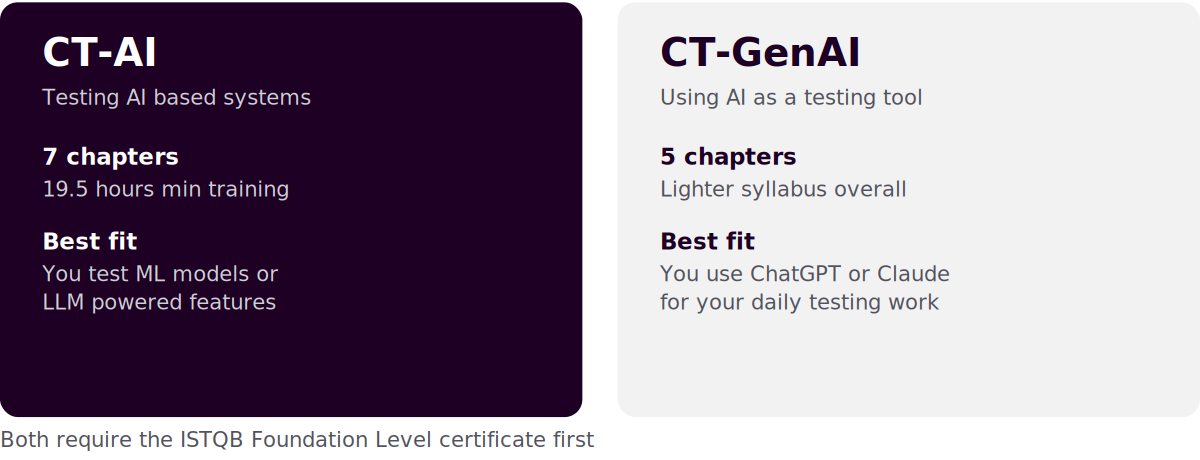
Both share the same mandatory prerequisite, the ISTQB Foundation Level certificate, CTFL. Beyond that, CT-AI is the heavier credential. Its current version 2.0 syllabus, released in 2026, requires a minimum of 19.5 hours of accredited training across seven examinable chapters, down from four days in the retiring version 1.0 but still substantially more than CT-GenAI's lighter five chapter syllabus. CT-AI also recommends, though does not require, at least six months of experience in software testing, data science, or software development, reflecting its more technical, hands on content around machine learning concepts.
Which one actually fits your job first
If you cannot point to a specific AI powered feature your team is responsible for testing, start with CT-GenAI. It applies immediately to work you are almost certainly already doing, using an AI assistant to draft test cases or analyze a failure, and the lighter syllabus gets you certified faster.
Start with CT-AI instead if your actual job involves testing a system built on machine learning or generative AI, evaluating a chatbot's response quality, testing a recommendation engine's accuracy, or validating an LLM powered feature before release. That work requires the deeper technical grounding CT-AI provides, model testing concepts, data quality evaluation, and the specific failure modes of non deterministic systems, none of which CT-GenAI's lighter, tool use focused syllabus covers.
A useful gut check, ask whether you are testing AI or testing with AI. The answer tells you which certification matches the work you actually do. ISTQB's own comparison guidance points to this same split, noting that candidates interested in using generative AI for testing specifically should look at CT-GenAI rather than CT-AI.
Can you take both, and does the order matter
Yes, and many testers eventually do, since the two certifications cover genuinely different territory rather than overlapping content. ISTQB does not impose a required order between them beyond the shared CTFL prerequisite. Taking CT-GenAI first is the more common path in practice, both because it applies more broadly right away and because its shorter syllabus makes it a faster first win, but nothing in the certification structure requires that sequence. If your job already centers on testing AI systems specifically, there is no real reason to delay CT-AI just because CT-GenAI feels like the more popular starting point.
Frequently asked questions
Is CT-AI harder than CT-GenAI? Generally yes, based on the syllabus depth alone, more examinable chapters, more required training hours, and content that assumes some familiarity with how machine learning systems actually work, rather than just how to prompt a chatbot well.
Do both certifications expire? No. Like other ISTQB specialist certifications, both CT-AI and CT-GenAI are lifetime credentials once earned, with no recertification requirement.
I already have CT-AI version 1.0. Do I need to retake it for version 2.0? No retake is required for a certificate you already hold. Version 1.0 is simply being retired for new candidates, with English exams available until April 2027, so anyone not yet certified should study the current version 2.0 syllabus rather than outdated version 1.0 material.
Will one of these become more valuable than the other over time? Both are likely to matter more, not less, as AI involvement in both software products and testing workflows keeps expanding. Which one is more valuable to you specifically depends entirely on whether your role leans toward building AI features or using AI tools, which is exactly the distinction this whole comparison comes down to.
RCV Academy's ISTQB Generative AI certification course and matching CT-GenAI practice test course cover the faster of these two paths in full, and our complete course catalog includes preparation resources for CT-AI as that credential continues to grow alongside it.
Categories: : AI, AI Roadmap, ISTQB, ISTQB Certifications