ISTQB CT-GenAI Exam Guide, Format, Syllabus and How to Pass
 Software Testing Mentor and RCV Academy
A complete guide to the ISTQB CT-GenAI exam in 2026, covering format, chapter weights, prerequisites, and how to prepare and pass.
If you have used ChatGPT or Claude to help write a test case and wondered whether you are actually doing it right, the ISTQB CT-GenAI certification is built for exactly that gap. It is the newest specialist credential from ISTQB, and it validates that you know how to use generative AI in testing safely and effectively, not just that you have poked around with a chatbot.
Below you will find the real exam breakdown, official question counts per chapter, and a study plan that does not waste your limited prep time on the wrong material.
What the certification actually measures
CT-GenAI stands for Certified Tester, Testing with Generative AI. Unlike a tool specific course, it is conceptual and applies across ChatGPT, Claude, Gemini, Copilot, or any other large language model you might use for testing work. The exam checks whether you understand how these models behave, how to prompt them effectively for testing tasks, and where they are likely to mislead you.
Exam format at a glance
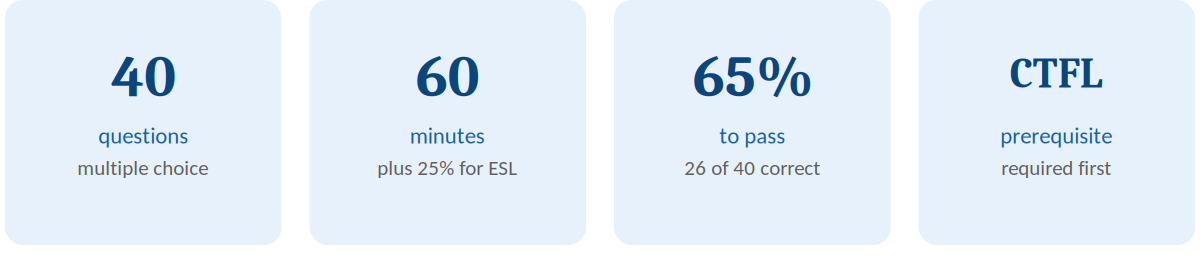
No negative marking applies, so always answer every question even if you are unsure. The exam is delivered online through remote proctoring or at select test centers, and results are typically available shortly after you finish.
The five syllabus chapters and where to focus
The syllabus splits into five chapters, and they are not weighted evenly. The chart below shows the official question count per chapter.
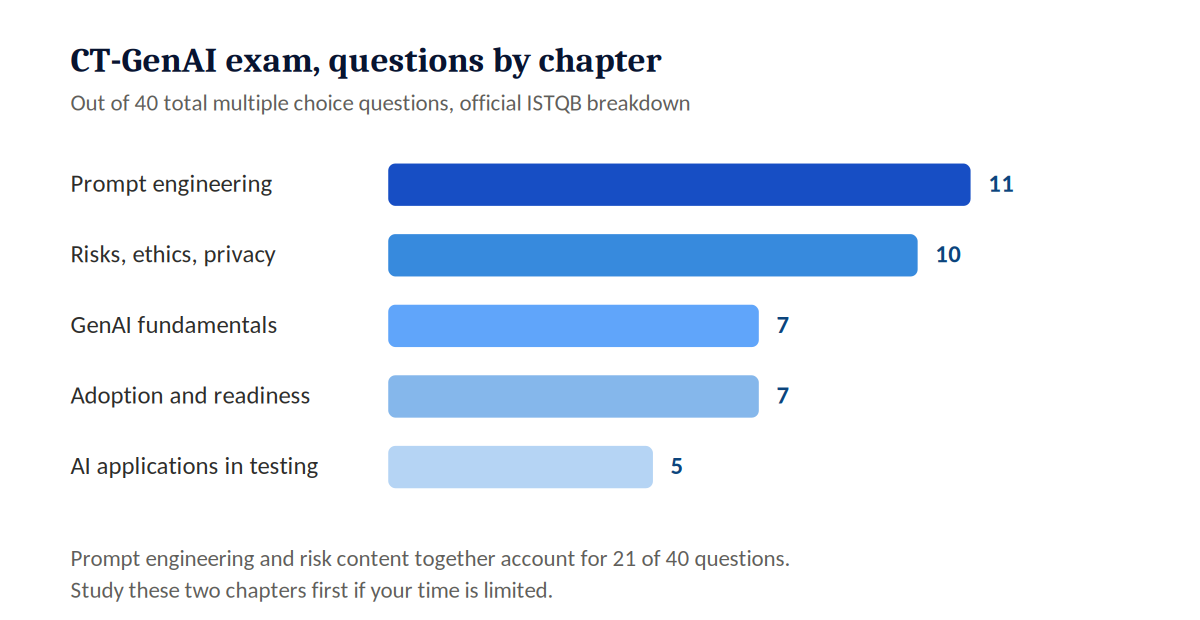
Here is what each chapter actually covers, with the official question count for each:
- Prompt engineering for testing, 11 questions, the heaviest chapter, covering how to structure prompts for test case generation, test data, and defect reports
- Risks, ethics, and data privacy, 10 questions, covering hallucinations, bias, and what you should never paste into a public AI tool
- Generative AI fundamentals, 7 questions, what large language models are and how they generate output
- Adoption and organizational readiness, 7 questions, covering how teams roll out AI tools responsibly
- AI applications across the testing lifecycle, 5 questions, from requirements analysis to automation to reporting
Prompt engineering and risk related content together account for 21 of the 40 questions, just over half the exam, so if your study time is limited, start there rather than spreading yourself evenly across all five chapters. Also worth knowing, prompt engineering is where most of the higher difficulty K3 level questions live, the ones that ask you to apply a technique rather than just recall a definition, so it deserves extra practice time beyond its question count alone.
Three sample style questions
These are original practice style questions modeled on the syllabus, not reproductions of any official exam content.
1. A tester asks an AI assistant to generate test cases for a login API and receives cases referencing a password reset endpoint that does not exist in the actual system. What is this an example of?
The correct concept is a hallucination, where the model generates plausible sounding but factually incorrect output. The right response is to verify every AI generated test case against the actual specification before use.
2. A tester wants to paste a sample of production customer records into a public AI tool to help generate realistic test data. What should they do instead?
Use synthetic or anonymized data rather than real production data, since production and personally identifiable information should never be shared with public AI tools.
3. Which of the following best describes why asking a generative AI tool the same testing question twice can produce two different answers?
Because outputs are non deterministic and probabilistic rather than fixed, which has direct implications for how much you can rely on repeatability from AI generated test artifacts.
How to prepare without overloading yourself
A realistic prep window is two to three weeks of part time study if you already have CTFL and some hands on AI tool experience.
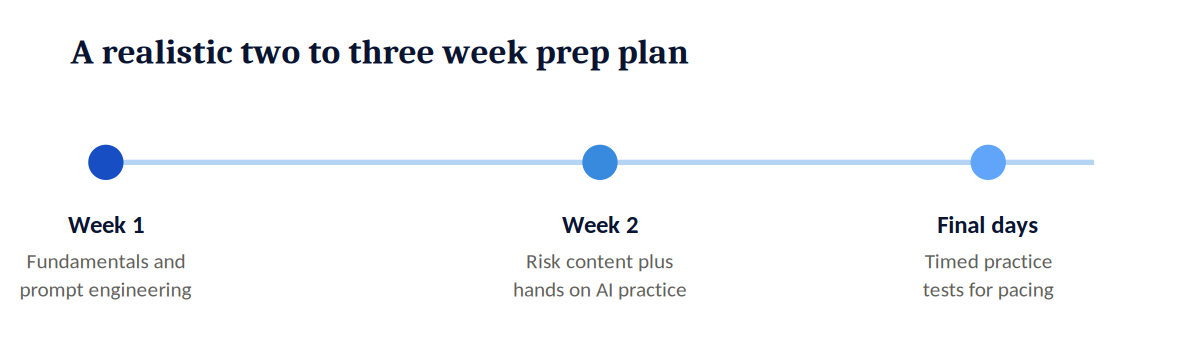
A few habits make the biggest difference during that window:
- Read the official syllabus and glossary from ISTQB directly, since every exam question maps back to it
- Spend real time prompting an AI tool for actual testing tasks rather than only reading theory, since the exam rewards applied understanding over memorized definitions
- Focus disproportionately on prompt engineering and risk content, given their exam weight
- Work through timed practice questions in the final week to build pacing, since 40 questions in 60 minutes leaves little room to overthink
For structured prep beyond this guide, RCV Academy's ISTQB Generative AI certification course walks through all five chapters with practical prompting exercises, and the CT-GenAI practice test course gives you realistic timed simulations before exam day.
Frequently asked questions
Do I need to be technical to pass CT-GenAI?
No. You do not need to understand model architecture or training. You need to understand how to use these tools effectively for testing and where they tend to fail.
Is CT-GenAI the same as CT-AI?
No. CT-AI covers testing AI based systems themselves, such as machine learning models. CT-GenAI covers using generative AI as a tool to help you test. They are complementary, not interchangeable.
How long is the certificate valid?
It does not expire. CT-GenAI is a lifetime credential once earned.
If you are also looking out for a broader AI era QA skill set beyond GenAI certification, Our AI Augmented QA roadmap clearly outlines the sequence in which you should build skills in order to master AI skills for QA/SDETs and succeed in AI era.
Categories: : AI, Generative AI, ISTQB, ISTQB Certifications