Jira Coding Agent Explained: How AI Turns Work Items Into Pull Requests
 Software Testing Mentor and RCV Academy
What the Jira Coding Agent actually does, how it fits into Jira workflows, and what independent research says about AI coding speed.
Atlassian has published a lot of material about the Jira Coding Agent this year: support docs, launch notes, release posts, a company blog series called AI at Work. None of it tells you whether the thing saves your team time once the review queue fills up. That is the question worth answering, so this post skips the marketing framing and goes straight to what the agent does, how it fits into Jira, and what independent research says about AI coding tools generally.
What the Jira Coding Agent Actually Does
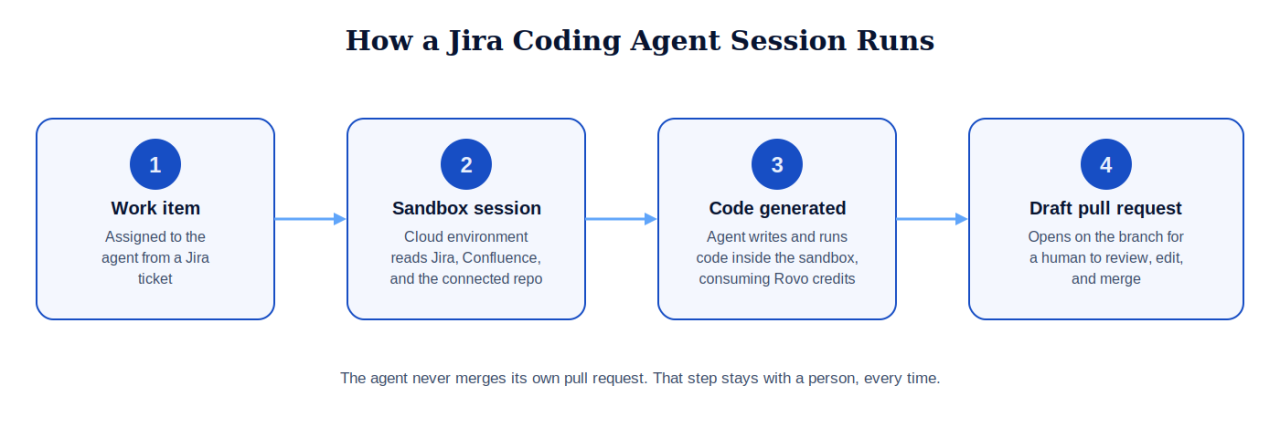
The Jira Coding Agent takes a work item, the ticket you would normally hand to a developer, and generates code for it. According to Atlassian's own documentation, the agent runs in a secure, cloud based sandbox rather than on anyone's laptop. It reads context from the work item itself plus connected Confluence pages and the linked code repository, then writes and tests code inside that sandbox before handing back a draft pull request for a human to review.
It was previously called Rovo Dev internally, and Atlassian's head of engineering for DevAI, Ming Wu, confirmed the rename to The New Stack. The rebrand matters less than the positioning shift behind it. Work items in Jira can now be assigned to a person or an agent, side by side, which is a real change to how a backlog gets triaged.
The agent currently supports GitHub Cloud and Bitbucket Cloud as connected repositories. It is included with paid Jira plans where Rovo is enabled, and every session consumes Rovo credits, so cost is tied to usage rather than a flat license fee. It is not yet available for Enterprise plans or organizations that require HIPAA, BYOK, or data residency compliance, and it does not run in Atlassian Government tenants.
Where It Fits Into a Jira Workflow
You can trigger the agent three ways. Open a session manually from inside a work item. Set up a Jira automation rule so specific conditions, like a label or an issue type, hand work to the agent automatically. Or use the newer automation actions that let third party agents such as GitHub Copilot, Cursor, or the Claude Agent for Jira run against the same event triggers.
The permission model is worth understanding before you turn this on for a team. The agent acts strictly on behalf of the person who started the session or owns the automation connection. It cannot exceed that person's existing Jira and repository permissions. It can read from and write to the one repository selected for that session, and it can run Bash or PowerShell commands inside its own sandbox, but it cannot merge its own pull request. That step stays with a reviewer.
What the Evidence Says About AI Coding Speed
This is the part most vendor content skips entirely, and it matters more than any feature list.
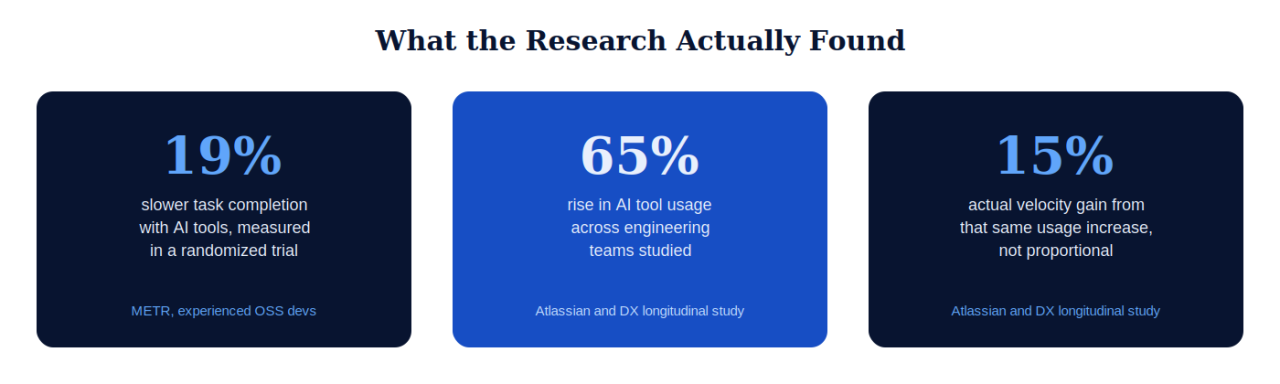
In July 2025, the nonprofit research group METR ran a randomized controlled trial with sixteen experienced open source developers working on repositories they knew well, an average of five years of history and over a million lines of code each. Some of their two hundred and forty six tasks were randomly assigned to allow AI tools, others were not. The developers expected AI to speed them up by roughly a quarter. After finishing the work, they still believed they had been faster. The actual measured result was the opposite: tasks took nineteen percent longer when AI tools were allowed.
Atlassian's own research points in a similar direction, even if the framing is gentler. In a longitudinal study Atlassian ran with DX across professional engineering teams, AI tool usage climbed sixty five percent, but overall developer velocity rose only about fifteen percent. Atlassian's own account of the study describes this as an AI productivity gap, not a failure of the tools, but the arithmetic still lands the same place METR's trial does. More AI usage did not translate into proportional speed.
None of this makes the Jira Coding Agent useless. It means the honest claim is narrower than "AI writes your code now." A coding agent inside Jira removes the friction of cloning a repo and setting up a local environment for a small, well scoped ticket, which is a real convenience. Whether it nets out faster once someone reviews, edits, and merges the resulting pull request is a team by team question, and the research so far suggests the answer is often no for complex or unfamiliar code.
What This Means for QA and Test Automation Teams
For testers, the practical impact shows up in two places. First, automation rules can now route bug fixes and test generation tasks straight to an agent, which changes what a QA engineer's day looks like: less time writing boilerplate fixes, more time reviewing what an agent produced.
Second, someone still has to verify that output. Ming Wu said it plainly to The New Stack: the bottleneck is human, and it comes from the switching between generating code and reviewing it. That review work is a testing skill. Reading a diff critically, spotting an edge case the agent missed, and confirming a fix resolves the reported behavior rather than just making a test pass, all of that is QA work regardless of who or what wrote the code.
Teams adopting Jira Coding Agent without strengthening review discipline are trading one bottleneck for another. Teams that pair it with solid test automation and disciplined code review are more likely to see the productivity gain Atlassian is promising rather than the slowdown METR measured.
If you want to build the automation and review skills that make agent generated code trustworthy rather than risky, our AI Era SDET Roadmap course walks through exactly that shift, and our Agentic AI Testing course covers how to test the outputs of coding agents like this one directly.
Frequently Asked Questions
Does the Jira Coding Agent replace developers?
No. It generates a draft pull request that a human still has to review, edit where needed, and merge. Atlassian's own documentation describes it as a pairing tool, not an autonomous replacement, and the agent cannot merge its own work.
Which repositories does it support?
GitHub Cloud and Bitbucket Cloud, according to Atlassian's supported repositories documentation. You select the repository per session, and the agent creates a separate session for each one if you choose more than one.
How much does it cost to use?
It is included with paid Jira plans that have Rovo enabled, but each session consumes Rovo credits, so the real cost scales with how much you use it rather than being a flat per seat fee.
Is the Jira Coding Agent the same as Rovo Dev?
Functionally, yes. Atlassian's head of engineering for DevAI confirmed to The New Stack that the Jira Coding Agent was previously called Rovo Dev before the current branding.
Is it available on every Jira plan?
It works on paid Cloud plans with Rovo enabled. It is not yet available on Enterprise plans or for organizations that require HIPAA, BYOK, or data residency compliance, per Atlassian's setup documentation.
Categories: : Atlassian Jira, JIRA