Software Testing Mentor and RCV Academy
In August 2025, a security researcher at Zenity Labs showed that a single malicious Jira ticket could hijack an AI coding agent without the victim clicking anything. The ticket just had to exist in a backlog the agent was allowed to read. That finding is almost two years old now, and the setup it describes, an AI tool connected to Jira through the Model Context Protocol, is more common today than it was then. Worth understanding exactly what that connection does before you point one at a test backlog full of tickets anyone outside your company might have filed.
How the Connection Actually Works
Atlassian's own Rovo MCP Server is a cloud hosted bridge between your Atlassian site and external AI tools. It connects Jira, Confluence, Jira Service Management, Bitbucket, and Compass to clients like Claude, Cursor, VS Code, and ChatGPT, and it authenticates through OAuth 2.1 or API tokens so that every action the AI takes respects the permissions of whoever is signed in. According to Atlassian's own documentation, the server does not store or cache your Jira or Confluence data. It acts as a proxy, reading and writing in real time on behalf of the connected user.
That is the pitch, and it is mostly accurate. Once connected, an agent can search your backlog, summarize a set of tickets, pull acceptance criteria into a coding session, or create and update issues from a natural language prompt. For a tester working through a sprint, that means asking an agent to pull every open defect tagged to a component instead of running a JQL query by hand. It is a real convenience, and the permission model genuinely does inherit from your existing Jira access rather than granting the agent something new.
If your team is building custom agent workflows that go beyond what the built in Rovo MCP tools offer, RCV Academy's course on agentic AI for QA and SDET covers how to wire an MCP connection into a multi agent pipeline rather than a single chat session.
The Backlog Is Exactly the Wrong Place to Relax
Here is what the pitch leaves out. A test backlog is one of the most exposed surfaces in your entire Atlassian instance, because bug reports and support tickets routinely come from people outside your organization. Many Jira Service Management portals accept tickets from anyone with a link, no login required. That is by design. It is also exactly the setup a prompt injection attack needs.
The Zenity Labs research demonstrated this directly. An attacker submits a Jira ticket containing hidden instructions. A developer or tester later asks their AI agent, connected through the Jira MCP integration, to look into that ticket. The agent reads the instructions embedded in the ticket text and follows them, potentially exfiltrating credentials or other sensitive data the agent has access to elsewhere in its session. No malicious link, no attachment to open. The ticket itself is the payload.
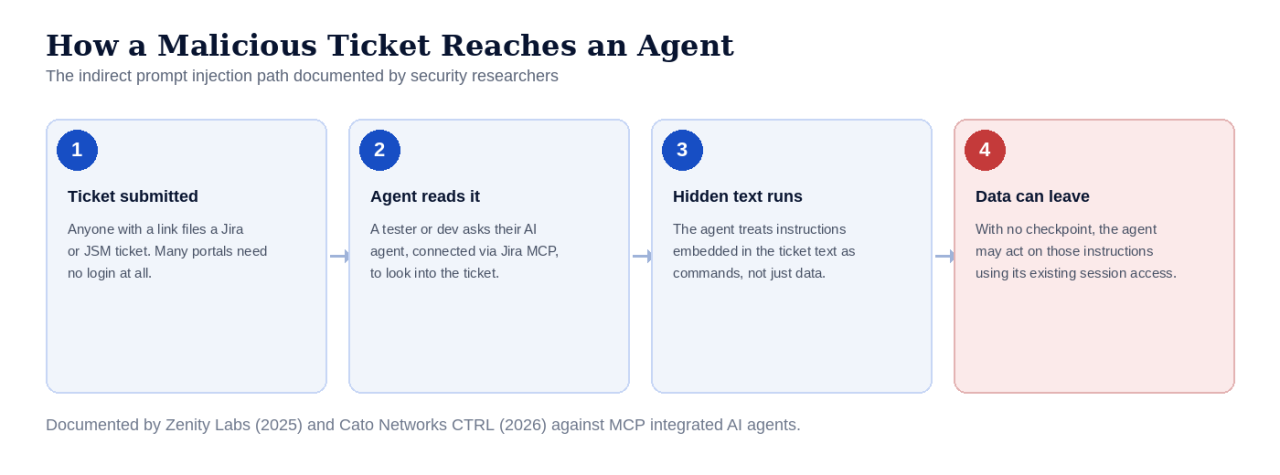
Cato Networks published a related proof of concept in 2026 targeting Atlassian's MCP integration with Jira Service Management directly, which they called a living off AI attack. Their research found that some JSM support portals accept unauthenticated submissions, meaning a prompt injection payload can reach an internal AI agent through a channel that was never meant to carry executable instructions in the first place. Atlassian's own response to that research, given to reporters at the time, encouraged customers to assess the risks specific to their own MCP usage rather than treating the integration as safe by default.
None of this means the Jira MCP Server is broken. It means the server does exactly what it is designed to do: give an AI agent the same access a logged in user would have. The problem is that a logged in user is not supposed to blindly execute instructions written by an anonymous ticket submitter, and an AI agent, without deliberate safeguards, will.
What Admins Can Actually Control
Atlassian's admin settings for the MCP server include a domain allow list, so you can restrict which AI clients are permitted to connect at all. Beyond that, the meaningful controls live in how your team scopes agent permissions and which tickets an agent is allowed to touch. A read only connection for searching and summarizing carries far less risk than one that can also transition tickets or trigger automation rules. Treating every backlog item as untrusted input, the same way a security team treats a file upload from the public internet, is the right mental model here. The content of a bug report is data, not an instruction, and an agent that cannot tell the difference needs a human checkpoint before it acts on anything a ticket asks for.
Frequently Asked Questions
Does the Jira MCP Server give an AI agent more access than a regular user has?
No. Atlassian's documentation states the server respects the signed in user's existing permissions rather than granting new access. The risk is not over permissioning in the traditional sense, it is that the agent may follow instructions hidden inside content it was only supposed to read.
Is this a flaw specific to Jira, or does it apply to other MCP integrations too?
It applies broadly. Indirect prompt injection through untrusted content is a known category of MCP risk, and researchers have demonstrated similar attacks against GitHub issues and other systems where an AI agent reads content that outside parties can submit. Jira Service Management backlogs are a particularly exposed example because many portals accept unauthenticated tickets.
Should QA teams stop connecting AI agents to their test backlog?
Not necessarily, but it is worth scoping the connection carefully. A read only agent used to summarize internally filed tickets carries far less risk than one with write access pointed at a public facing support portal. Match the permission level to how exposed the backlog actually is.
Does Atlassian store or log what the AI agent reads through the MCP connection?
According to Atlassian's own documentation, the Rovo MCP Server does not store or cache Jira or Confluence data. It functions as a real time proxy rather than a data warehouse, though your organization's own audit logging of user actions still applies.
Connecting an AI agent to your test backlog is a reasonable thing to want, but the tickets in that backlog were never written with an AI reader in mind. If your team wants a deeper grounding in how generative AI systems fail, including the kind of untrusted input problems this post covers, RCV Academy's ISTQB Generative AI certification course is a solid place to build that foundation before you widen the connection any further.