Jira Required Fields for Bugs: Repro Steps and Evidence
 Software Testing Mentor and RCV Academy


Make reproduction steps and test evidence mandatory in Jira bugs with field configurations and workflow validators, without filling fields with junk.
Summary: Checkout broken
Description: Doesn't work when I try to pay. Please fix ASAP.
Attachments: none
Every developer has received this bug. Every tester has, at some point, filed something close to it at 6 p.m. on release day. And every team has paid for it the same way: a developer asks which browser, which account, which payment method, the reporter has moved on to something else, and the bug sits in "Needs Info" for three days.
Jira cannot make people write good bug reports. It can make it impossible to submit one without the parts that matter, and it can stop a bug from closing without proof that the fix was actually tested. That is what this post sets up, along with the trap that makes required fields backfire.
What developers actually need in a bug report
This is not a matter of taste. It has been studied.
In What Makes a Good Bug Report?, presented at ACM SIGSOFT FSE 2008, Bettenburg, Zimmermann and colleagues surveyed developers and reporters from the Apache, Eclipse and Mozilla projects, analysing 466 responses in total. Most developers rated steps to reproduce, stack traces and test cases as the most helpful information. The same study found an information mismatch: those were also the items reporters found hardest to provide. The findings appear in the paper's abstract and its survey results sections.
The ISTQB view lines up closely. Section 5.5 of the ISTQB Certified Tester Foundation Level syllabus v4.0.1, on pages 57 and 58, lists what a defect report typically contains. The list includes the test object and test environment, a description of the failure with enough detail to reproduce and resolve it, including test steps and any logs, screenshots or recordings, plus expected and actual results, severity and priority.
So the target is clear. Steps, expected result, actual result, environment and evidence. The question is how to make Jira insist on them without turning bug reporting into a form people hate.
Two ways Jira enforces a required field
In company-managed spaces, Atlassian's knowledge base article on required field errors in Jira Cloud describes two mechanisms, and they behave differently.
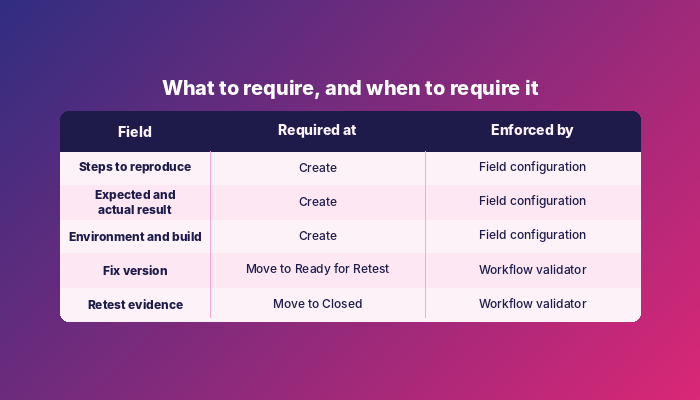
Field configuration. You mark a field as required in the field configuration used by the bug work type. Jira then refuses to create the work item until the field has a value, and the field shows an asterisk on the Create screen. This is the right tool for information that must exist from the moment a bug is logged.
Workflow validator. You add a Field Required validator to a specific transition. The check runs only when someone uses that transition. This is the right tool for information that only exists later, such as a fix version or proof of a retest.
Two warnings from the same article matter in practice. First, a field required by a field configuration must also be on the Create screen, or nobody can create the work item at all. Second, changes to a field configuration affect every space that uses it. If your bug field configuration is shared with ten other teams, making a field required changes their create screen too. Check the scheme before you click Required.
Team-managed spaces set required fields in each space's own settings, and their workflow rules work differently, so check your own space before copying this setup. The rest of this post assumes a company-managed space.
A practical setup for bug reports
Split the requirements by the moment the information becomes available.
At creation, through the field configuration:
- Steps to Reproduce as its own paragraph field, not buried in Description. Separate fields can be searched, reported on and checked for emptiness.
- Expected Result and Actual Result as two separate fields. When they share one box, people write the actual result and skip the expected one.
- Environment, covering the build or version, the test environment and the browser or device.
Later in the workflow, through validators:
- Fix Version required on the transition to Ready for Retest. A tester should never have to guess which build contains the fix.
- Retest Evidence required on the transition to Closed. Make it a short paragraph field where the tester names the build retested and links or describes the evidence, such as a test execution, a screenshot or a log reference.
That last field is the one most teams skip, and it is the one that pays off during audits and incident reviews. When someone asks six months later whether a bug was really verified, the answer is on the ticket instead of in somebody's memory.
If your test executions live in Jira through Xray, that evidence can be a direct link to the execution instead of free text. Master Xray Test Management for Jira Software in 4 Hours shows how executions, test runs and defects connect.
The trap: required fields that collect junk
Required fields fail in one predictable way. People type "N/A", "see description" or a single full stop to get past the check. You then have a required field full of nothing, which is worse than an optional field, because reports now claim every bug has steps.
Four habits keep the data honest.
Require less than you want. Three required fields at creation is a good ceiling. Every extra field raises the odds of junk in all of them.
Give each field a template. A default value or field description such as "1. Log in as... 2. Go to... 3. Click..." shows people the expected shape and makes a real answer faster than a fake one.
Review it in triage. During bug triage, send back any ticket with junk in a required field. Two weeks of consistent pushback changes behaviour more than any validator.
Search for the junk. Run a filter for bugs where Steps to Reproduce is very short or contains "N/A". The size of that list tells you whether the rule is working.
Writing good reproduction steps is itself a testing skill. Isolating the minimum steps, separating expected from actual, and naming the environment precisely are all part of the defect management material in ISTQB Certified Tester Foundation Level (CTFL v4.0.1) Certification Training.
Pull up the last twenty bugs your team closed and count how many a stranger could reproduce from the ticket alone, and how many show what was retested. Those two numbers make the case for this setup better than any policy document. When you are ready to build it, from field configurations and screen schemes to validators and automation, the Jira Masterclass: Agile Project Management, Administration & AI walks through each piece.
Categories: : JIRA, Jira Workflow