Software Testing Mentor and RCV Academy

An Atlassian admin who tested Claude Agent for Jira on his own instance wrote something worth sitting with before anyone on your team assigns a ticket to an AI agent: the moment you do, the work item summary, description, and repository link leave Jira and land on someone else's infrastructure. That is not a criticism of the product. It is just what the integration does, and it applies in some form to all three tools testers are now watching developers use directly inside Jira.
Three separate companies shipped the same basic feature in 2026. Assign a ticket to an agent instead of a person, and it writes code and opens a pull request without anyone touching an IDE. Here is what actually happens when that ticket lands, and what it means for the person who has to decide whether the resulting code is safe to merge.
Three Integrations, One Pattern
Cursor's Jira integration shipped on May 19, 2026. Assign a work item to Cursor, or mention it in a comment, and a cloud agent reads the title, description, comments, and your repository settings, then opens a pull request when it finishes. Jira shows completion updates and a link to review.
GitHub Copilot followed a similar path. Its Jira integration went to public preview in March and reached general availability on June 25, 2026. You assign the issue to Copilot through the assignee field, it works in an isolated GitHub Actions environment, and it can ask clarifying questions in Jira before opening a draft PR.
Claude Agent for Jira arrived on June 19, 2026, built by Atlassian and Anthropic together on what Atlassian calls Claude Managed Agents infrastructure. Same assignment pattern, same draft PR outcome. One difference worth knowing: this route runs on your own Anthropic API key rather than your Jira Rovo allowance, and it needs a paid API plan since the free tier does not support Managed Agents.
All three need Jira Cloud with Rovo activated as a baseline, then their own separate setup on top. None of them merge their own code. A human still approves the pull request in every case.
Where Your Ticket and Code Actually Go
This is the part that gets skipped in the demo. Each of these agents runs in a sandbox that belongs to the vendor, not to you. For Claude Agent for Jira, Atlassian's own Marketplace listing states plainly that ticket data is sent to Anthropic's managed infrastructure and that zero data retention is not currently supported for this integration. Cursor and Copilot both work the same way in principle. Your code gets cloned into a cloud environment you do not control while the agent works.
For most feature tickets that is a non issue. For a ticket that references a client name, an unreleased pricing model, or a security fix for a vulnerability that has not shipped yet, it is worth a pause. If your organization has a rule about what kind of information can leave your environment, someone needs to check whether that rule accounts for AI agents assigned through Jira before your team starts using the assignee dropdown as a routing mechanism.
If your team is exploring where AI agents genuinely fit into a testing workflow versus where the risk outweighs the convenience, RCV Academy's Generative AI and AI Agents for QA and SDET course walks through the tradeoffs with the same kind of practical detail these Jira integrations skip.
What the Data Says About the Code You Will Be Reviewing
Two numbers matter more than anything in a vendor changelog. Veracode's 2025 GenAI Code Security Report tested output from more than 100 large language models across 80 coding tasks in Java, JavaScript, Python, and C#, and found that 45 percent of the code samples introduced a known OWASP Top 10 vulnerability. That number held steady across model generations, so a newer model behind Claude Code, Cursor, or Copilot is not a reason to assume the risk has gone down.
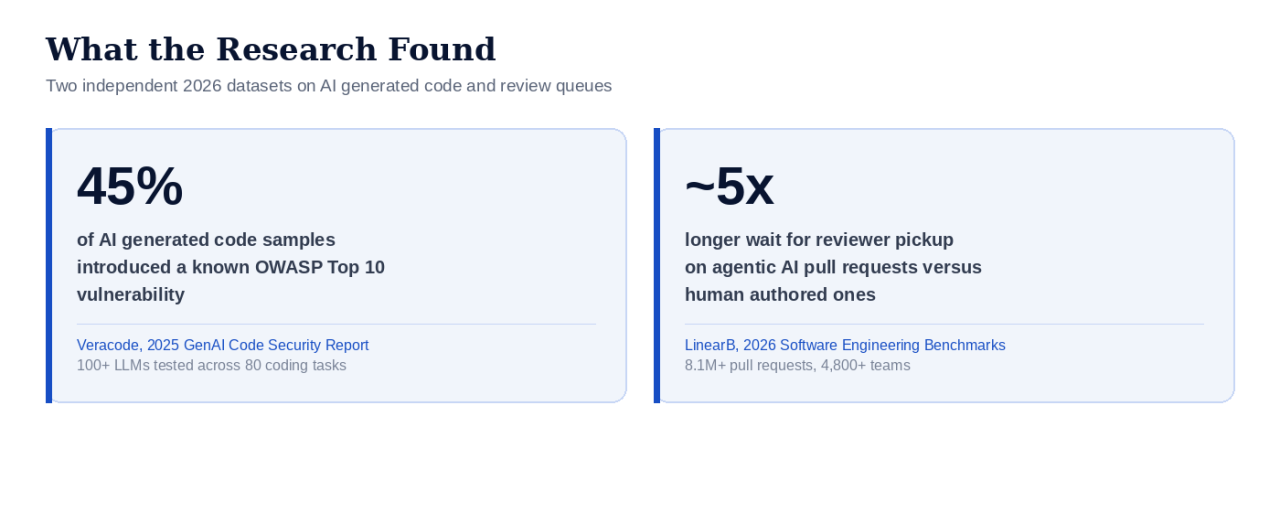
The second number is about your queue, not the code itself. LinearB's 2026 Software Engineering Benchmarks Report, built from more than 8.1 million pull requests across 4,800 teams, found that agentic AI pull requests wait roughly five times longer for a reviewer to pick them up than human authored ones, and review time across AI adopting teams rose 91 percent. Put those two together and the picture is not "AI writes the code, humans just approve it." It is closer to "AI writes more code that needs more scrutiny, and the queue for that scrutiny is already backing up."
What This Actually Changes for Testers
A draft pull request from an agent is not evidence that the ticket was tested. It is evidence that code exists which matches the ticket description well enough to compile and pass whatever checks ran in CI. Those are different things, and the gap between them is exactly where a tester's judgment still matters.
Practically, that means treating agent assigned tickets the same way you would treat a junior contractor's first PR on an unfamiliar codebase. Check that the acceptance criteria were actually addressed, not just referenced. Look for the edge cases the ticket did not spell out, since the agent only worked from what was written down. And do not let ticket volume push you into rubber stamping, since a faster path from ticket to PR does not shrink the amount of testing a change actually needs.
Frequently Asked Questions
Do Claude Code, Cursor, and Copilot write their own tests when they open a PR?
Sometimes, depending on the ticket and the repository's existing test setup, but this is not guaranteed and varies by task. None of the three integrations document test coverage as a required output of the agent run, so verify what tests exist in the PR rather than assuming they do.
Can a tester assign a ticket to one of these agents, or is this a developer only feature?
Assignment works the same way for anyone with permission to change the assignee field in Jira. The more relevant question is whether your team's workflow treats an agent authored PR as ready for QA the moment it opens, which it should not be without a human developer review first.
Do these three integrations cost extra on top of Jira?
Cursor and GitHub Copilot both require their own paid plans on top of Jira Cloud with Rovo enabled. Claude Agent for Jira requires a separate paid Anthropic API key, since ticket assignment runs on Claude Managed Agents infrastructure rather than your existing Rovo credit allowance.
What happens if the ticket description is vague?
GitHub Copilot's integration can ask clarifying questions directly in the Jira comment thread. Cursor and Claude Agent for Jira generally proceed with their best interpretation of the ticket as written, which is one more reason a well written acceptance criteria section matters more now than it used to.
None of these three tools change what testing actually requires, they just change where the code comes from and how fast it shows up. If you want to build the automated coverage that catches what these agents miss before it reaches a reviewer, RCV Academy's Playwright course covering AI powered testing is built for exactly that gap.