From Prompt to Action: Inside the LLM Agent Test Loop
 Software Testing Mentor and RCV Academy

Learn how the LLM agent loop works — perceive, memory, think, act — and how to test each stage structurally with OpenTelemetry traces and cut-point replay.
What Happens During One Turn
Pick any moment in a running test agent session. The agent has just received an instruction. In the next fraction of a second, four things happen in sequence before any test action is taken.
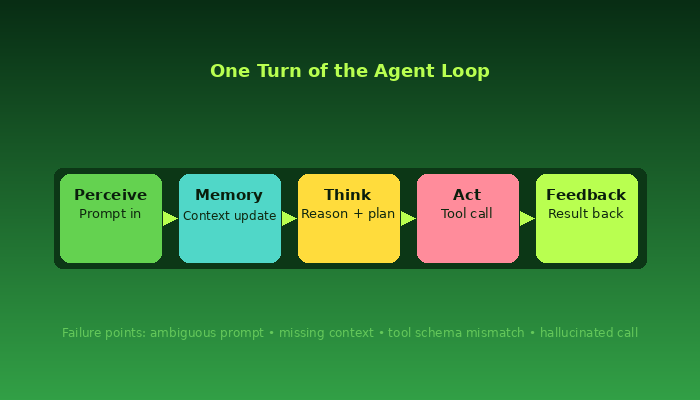
First, the agent perceives its observation: the raw text of the instruction, the result of the previous tool call, whatever system context sits in the prompt window. Second, it updates its working memory, pulling in any relevant stored context. Third, it runs a reasoning step, producing a plan or a chain of thought that conditions what comes next. Fourth, it selects an action from its available tool set and calls it.
This is the agent loop. It runs once per turn, and every turn produces exactly one action or a decision to stop.
Understanding this cycle matters because most of the things that go wrong in LLM-based test automation trace back to something failing inside one of its four stages. A 2026 survey by Arunkumar, Gangadharan, and Buyya formalizes this as a partial observable Markov decision process: the agent receives a partial observation of the environment state, updates memory, produces a latent reasoning step, and samples an action conditioned on both (Arunkumar et al., “Agentic Artificial Intelligence: Architectures, Taxonomies, and Evaluation of Large Language Model Agents,” arXiv:2601.12560, 2026). The loop is not a metaphor: it is the literal execution model.
The Four Stages in a Test Context
Perceive. The agent does not see the full state of your application. It sees the current instruction, previous tool results, system prompt constraints, and any injected DOM or API fragments. If the test step refers to a component not in that context, the agent has no way to ground its action to the right element.
Update memory. Between perceive and think, the agent may retrieve additional context from stored memory: prior test results, known application structure, recent conversation history. In a retrieval-augmented setup, this is where DOM documentation or API specs get pulled in. If retrieval is absent or poorly configured, the reasoning step works only from what arrived in the raw prompt.
Think. The reasoning step is where intent is resolved. The agent interprets what the test step is asking, infers what tool should satisfy it, and constructs the parameters for that call. ReAct-style agents interleave reasoning and acting in a trajectory of alternating thought-action-observation steps, so the quality of the thought token directly shapes the action that follows (Arunkumar et al., 2026).
Act. The action is a structured tool call: a Playwright command, a REST request, an assertion function, or a file write. The action space used by the agent matters. The survey distinguishes three action paradigms: predefined API calls with fixed schemas, executable code such as Python scripts run in a sandbox, and agent-computer interface actions using curated shell or IDE toolsets. Each has different failure modes. Script-based execution risks sandbox errors and runtime exceptions. Schema-bound calls fail when the expected tool does not match the schema the agent was given.
Where the Loop Breaks Down
A 2025 study by Bouzenia and Pradel analyzed 120 agent trajectories and 2,822 LLM interactions across three software engineering agents, looking for structural patterns that separate successful runs from failed ones (Bouzenia and Pradel, “Understanding Software Engineering Agents: A Study of Thought-Action-Result Trajectories,” arXiv:2506.18824, 2025). They found recurring failure patterns in the thought-action-result sequences of failed runs, distinct from the patterns of successful ones.
The practical translation for QA teams: a failing agent run is not a random event. It has a structure. The reasoning step produces a plausible thought that leads to a wrong or hallucinated action. That action returns an error or an unexpected result. The next reasoning step tries to recover but has already accumulated a corrupted context.
The study also found that iteration counts and token consumption differ systematically between success and failure. Longer trajectories are not reliably better outcomes. An agent that loops many times is often stuck in a recovery pattern, not making progress.
For teams building CI pipelines around LLM agents, this means trajectory length is a signal worth tracking. An agent that exceeds a reasonable step count on a task it normally completes in two or three actions is very likely in a degraded state, not a slow success.
Making the Loop Testable
The loop itself can be tested. A 2026 paper by Kohl et al. proposes structural testing of LLM agents using OpenTelemetry traces to record each trajectory, with mocked LLM behavior to make runs reproducible (Kohl et al., “Automated Structural Testing of LLM-Based Agents: Methods, Framework, and Case Studies,” arXiv:2601.18827, 2026). The approach applies the test automation pyramid: unit tests for individual components like tools and memory stores, integration tests for component interactions with the LLM mocked, and acceptance tests from the user’s perspective.
Assertions verify which tool was called and with which parameters, rather than the final text output alone. For a QA team, this means you can write a test that says: given this instruction, the agent must call the Playwright click action with selector matching this pattern. That assertion passes or fails deterministically regardless of what the LLM says in its reasoning trace.
The paper reports a case study where a driver assistance agent achieved 96% statement coverage in CI, with assertions running on each release triggered by changes to prompts, model versions, or application data.
A complementary approach from Chawla and Koul addresses regression: Chronicle records agent runs at their stochastic boundaries and uses cut-point replay to run new code against stored model responses (Chawla and Koul, “Chronicle: Cut-Point Replay for Regression Testing of LLM Agents,” arXiv:2609.20625, 2026). Recording overhead is about 23 microseconds per boundary crossing. On six stored failure scenarios, cut-point tests caught every mutant that allowed the unsafe action through. A baseline that stubbed every boundary caught none of them.
Writing Instructions That Survive the Loop
Most prompt engineering advice for agents focuses on clarity. The loop model suggests a more precise goal: write instructions that can complete the full cycle without requiring information that is not in scope at any stage.
This means keeping steps atomic. The think stage handles one intent well. Instructions that chain conditions force the reasoning step to resolve multiple states, and the later ones receive less attention weight. It means including exact identifiers. The think stage cannot infer a component name it has not seen; if the name is not in the context, the action stage will guess and will often guess wrong.
It also means treating recovery trajectories as test failures to diagnose, not retry. When an agent produces multiple iterations on a step that should resolve in one, the loop is signaling that something in the perceive or memory stage was insufficient. Rerunning with a higher temperature or a longer timeout does not fix a context gap.
For practical coverage of how LLM agents structure their loops, the Agentic AI for QA and SDET: Build Autonomous Test Automation course covers the full agent architecture from prompt to action, including tool calling patterns and failure recovery.
Teams wanting to combine the agent loop with retrieval to close the context gap will find the implementation patterns in LangChain for QA: Build RAG, Agentic RAG and AI Chatbots, which covers vector search, document ingestion, and how RAG connects to the memory update step.
Categories: : Agentic AI, AI, AI Tools, Generative AI, ISTQB Generative AI