From Manual Tester to AI Augmented SDET: A Career Roadmap
 Software Testing Mentor and RCV Academy
A career roadmap for manual testers moving into AI augmented SDET roles, built around portfolio projects and interview readiness, not tools.
A hiring manager does not read your certificate list before your GitHub. They read your GitHub before your resume. That single fact changes how this transition should actually be planned, and most advice online skips straight past it to argue about which programming language to learn first.
This roadmap is built around the two things that actually get someone hired into an SDET role, a portfolio that proves you can do the work, and interview readiness that lets you explain it convincingly. Tools matter, but they are the means, not the plan itself.
Why the portfolio comes before the tool list
GitHub's own guidance for job seekers is direct about this, a profile with a clear bio, a few well documented projects, and a README that explains your thinking gives a hiring manager evidence instead of a claim. A resume says you know Playwright. A repository with a working test suite, a CI pipeline, and a README explaining your design decisions shows it.
This matters more now than it did five years ago, because AI adoption on GitHub has grown fast enough that a passive profile reads as stale. GitHub's 2025 Octoverse report recorded more than one new developer joining the platform every second over the year, alongside record levels of repository and commit activity. Standing out in that volume means your few pinned projects have to do real work explaining themselves, not just exist.
The shape of a realistic twelve month plan
Rather than a month by month tool checklist, think in three phases with different goals.
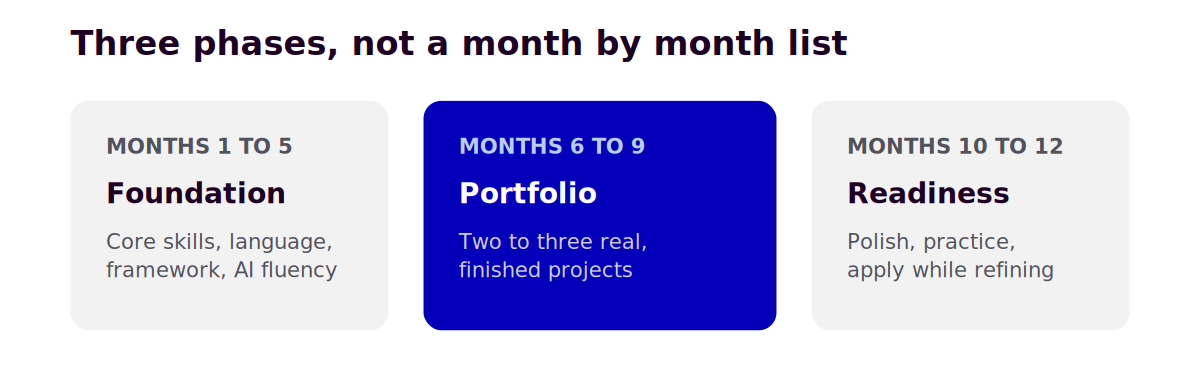
Phase one, months one through five, foundation. This is where you build the actual skills, a programming language, an automation framework like Playwright, API testing, and enough AI tool fluency to use an assistant well. If you already have manual testing experience, you are not starting from zero here, you already understand what needs testing, which is the harder half of the job.
Phase two, months six through nine, portfolio. Stop learning in isolation and start building two or three real projects. A UI automation suite against a public demo application with a real CI pipeline. An API test suite with authentication, pagination, and error case coverage. If you are comfortable with it, one project that uses AI meaningfully, generating test data, evaluating an LLM response, or driving a browser through an agent, since that signals you have engaged with current tooling rather than avoided it. RCV Academy's Generative AI and AI Agents for QA course is a natural fit for that third project specifically.
Phase three, months ten through twelve, readiness. Polish your GitHub profile and READMEs, rehearse walking through each project out loud, and start applying while you refine. Waiting until everything feels perfect before applying is the single most common way this phase drags on far longer than it needs to.
What actually belongs in a portfolio project
Depth beats breadth consistently. Two fully finished, well documented projects outperform ten abandoned repositories every time a hiring manager actually looks. Each project should be able to answer three questions on its own, without you standing there to explain it, what problem does this solve, what decisions did you make and why, and how do I run it myself.
A project without a README explaining those three things is asking a stranger to reverse engineer your thinking, and most will not bother.
Interview prep that actually reflects the job
SDET interviews typically mix three things, a coding or automation exercise, a system or framework design discussion, and questions about how you approach testing strategy generally. The most common mistake is treating this like a pure coding interview and under preparing for the design conversation, walking through why you structured a framework a certain way, what tradeoffs you made, and how you would extend it. That conversation is where your portfolio projects earn their keep, since you can point directly at a decision you already made and explain it, rather than reasoning through a hypothetical on the spot.
The stakes are real enough to justify the preparation. Glassdoor's SDET salary data puts the gap between entry level and senior SDET compensation at tens of thousands of dollars a year, and portfolio quality is one of the few levers a candidate fully controls in that jump, unlike years of tenure or which company happens to be hiring.
Frequently asked questions
Do I need to finish all three phases before applying anywhere? No. Start applying once phase two produces your first real project, even before phase three formally begins. Interview feedback itself becomes useful information for what to polish next, rather than something to avoid until you feel fully ready.
What if I only have time for one portfolio project, not two or three? One genuinely complete, well documented project beats two rushed ones. Depth is what a hiring manager is actually evaluating, so a single strong project with a clear README and thoughtful test coverage is a reasonable minimum bar.
Should my portfolio projects use AI tools, or will that look like I did not do the work myself? Using AI tools thoughtfully and being able to explain your role in the process reads as current, not as a shortcut. Being unable to explain a design decision because an AI made it for you is the actual problem, not the tool itself.
Once your foundation phase is underway, RCV Academy's Playwright course and API Testing Mastery course with Postman give you the exact building blocks phase two's portfolio projects are built from.
Categories: : AI, AI Roadmap, AI SDET, AI Tools