Manual tester to AI era SDET, a realistic six month roadmap
 Software Testing Mentor and RCV Academy
Somewhere between a job posting asking for Python and a LinkedIn feed full of people announcing they just "made the jump," it starts to feel like everyone else already knows the plan except you. There isn't a secret plan. There's just an order that works better than others, and most people skip straight to the hard parts before they've built the foundation underneath them.
Six months is enough time to go from manual testing to a genuinely employable AI era SDET, provided the months are spent in the right order. Here's that order, along with what to actually skip.
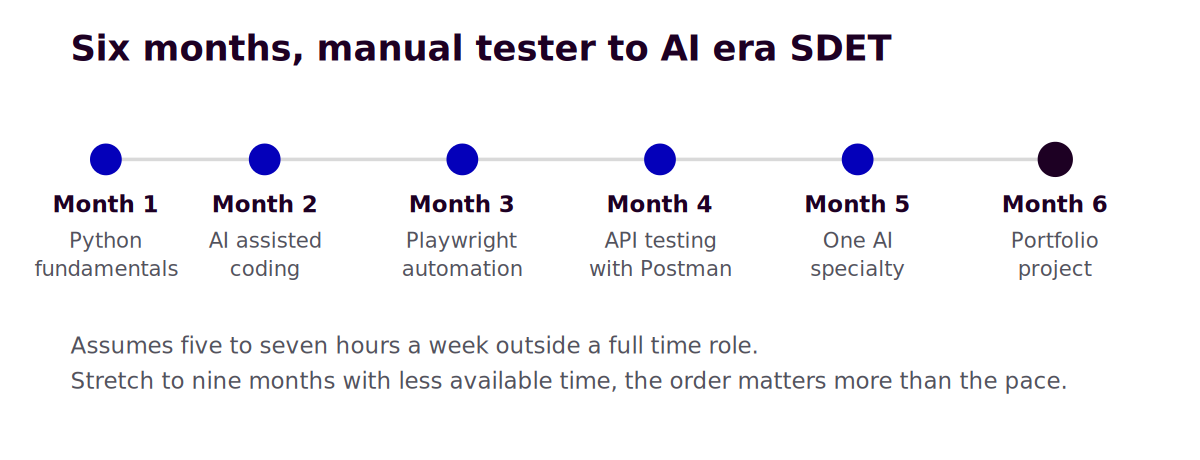
Month one, stop avoiding code
Every roadmap says "learn Python" and then leaves you to figure out what that means. Concretely, you need enough Python to read a script someone else wrote, write a simple function, work with lists and dictionaries, and understand what a loop does when it breaks. That's it. You are not becoming a software engineer in month one, you are becoming someone who can follow along.
Skip anything that starts with data structures and algorithms interview prep. That's a different job.
Month two, pair Python with an AI coding assistant immediately
This is the part most roadmaps get backwards. They teach Python for months before introducing AI tools, as if the tools are a shortcut you earn later. Flip that. An AI coding assistant like Claude Code or GitHub Copilot is genuinely one of the fastest ways to learn Python, since you can ask it to explain any line of code you don't understand, and it will.
Start using an assistant from day one of month two, not after you feel ready. Ask it to review code you write and explain what it would do differently. That feedback loop teaches faster than a course does.
Month three, learn one automation framework properly
Pick Playwright. Not because Selenium is bad, but because Playwright has become the default for new projects and pairs naturally with the AI assisted testing workflows that are now standard in job postings. Learn to write a test by hand first, locators, assertions, waits, the whole thing, before letting an AI agent generate one for you. You need to be able to read and fix what the tool produces, and that requires understanding the fundamentals underneath it.
By the end of month three you should have a small personal project, three or four tests against a real site, sitting in a GitHub repository you can point to.
Month four, add API testing to your toolkit
UI automation alone leaves a gap that interviewers notice quickly. Spend this month learning Postman, REST fundamentals, and how to write assertions against JSON responses. This is also a good point to start using AI features inside Postman to speed up writing test cases, since you already understand the fundamentals well enough to judge whether the AI generated assertion is actually correct.
Month five, pick one AI specific skill and go deep
This is where people scatter their attention across ten tools and end up mediocre at all of them. Pick one.
- If you're drawn to career security through certification, go deep on the ISTQB CT-GenAI syllabus and sit the exam
- If you're drawn to hands on building, learn how to connect Playwright to the Model Context Protocol and build an agent driven testing workflow
- If your target companies are shipping AI features, learn DeepEval and how to evaluate LLM output quality
Any of these three makes a real difference on a resume. Doing a shallow version of all three does not.
Month six, build something real and tell people about it
Take everything from the previous five months and build one project that shows it off, an automation suite with both UI and API coverage, a short writeup explaining your design decisions, and evidence of the AI specific skill you chose in month five. Post about it. Apply. The project matters less as a technical artifact and more as proof you can finish something and explain your choices, which is what interviews actually test for.
A note on pace
Six months assumes roughly five to seven hours a week outside a full time job. If you have more time, you'll move faster, if less, stretch it to nine months rather than cramming and burning out halfway through. The order matters more than the speed.
Some common questions and doubts
Do I need a computer science degree to make this transition?
No. Most people making this move successfully come from manual testing backgrounds without a CS degree. What matters is demonstrated ability, the project from month six, not a credential.
Should I quit my manual testing job to focus on this full time?
Generally no. Keep the income and the domain knowledge from your current role while building these skills on the side. Manual testing experience is a genuine asset once you can also automate, not something to discard.
Is it too late to make this change if I've been in manual testing for ten years?
No. Senior manual testers who add automation and AI skills are often more valuable than junior SDETs with neither, since they already understand what actually needs testing, which is half the job.
Our course catalog maps directly onto this roadmap, with dedicated tracks for Playwright automation, API testing with Postman, and the ISTQB Generative AI certification, so you can follow this exact sequence with structured lessons instead of piecing it together from scattered tutorials.
Categories: : AI, SDET, AI SDET, AI Roadmap