Cross-Checking AI Outputs Across Multiple Platforms
 Software Testing Mentor and RCV Academy
Learn how comparing outputs across multiple AI models catches errors single models miss, with peer-reviewed research and a practical QA workflow.
When One Model Is Not Enough
Two colleagues review the same document independently. They notice different things. Not because one is better, but because attention is finite and blind spots are real. You get a better result when both perspectives land on the same desk before anything ships.
The same logic applies to AI outputs. A single language model produces fluent, confident text. That confidence does not correlate reliably with accuracy. The model fills gaps with plausible content, and it does so without signaling that it has done so. Running a second model over the same output is one of the most practical quality controls available to a QA team working with generative AI today.
What Research Says About Model Disagreement
The case for comparing models is not intuition. A 2026 paper from Columbia University introduced cross model perplexity as a correctness signal that requires no ground truth labels. The verifier model reads the generating model’s answer and measures how surprised it is by each token. When the verifier is surprised, the answer is more likely to be wrong. On the MMLU benchmark, this approach achieved a mean AUROC of 0.75, versus 0.59 for within model entropy baselines. The key finding is that a model’s uncertainty about its own outputs is a weaker signal than a second model’s uncertainty about those same outputs (Gorbett and Jana, “Cross-Model Disagreement as a Label-Free Correctness Signal,” arXiv:2603.25450, 2026).
Ensemble methods take the same insight further. A 2024 paper tested a probabilistic consensus framework where multiple models validate each other’s outputs across 78 complex cases requiring factual accuracy and causal consistency. Precision rose from 73.1% with a single model to 93.9% with two validators and 95.6% with three. Error rates fell from 26.9% to 4.4% with three validators in the loop (Baba, “Probabilistic Consensus through Ensemble Validation,” arXiv:2411.06535, 2024).
Applied work on medical question answering shows similar patterns. A 2026 study used five models in a peer review structure: each model generated reasoning, then reviewed the others’ reasoning for factual accuracy and logical soundness. The best model combination reached an average accuracy of 0.820 across three benchmarks. The best individual model with chain of thought reasoning scored 0.777, and majority voting reached 0.789. The structured review across models outperformed both (Zhan et al., “Let LLMs Judge Each Other,” arXiv:2606.15419, 2026).
Why Single-Model Confidence Misleads
The failure mode has a name: the confident error. A model produces an answer that is wrong but grammatically perfect, internally consistent, and stated without hedging. Self consistency methods, which check whether the same model gives the same answer across repeated queries, catch some of these, but they hit a ceiling: a model that is consistently wrong in the same way will agree with itself every time.
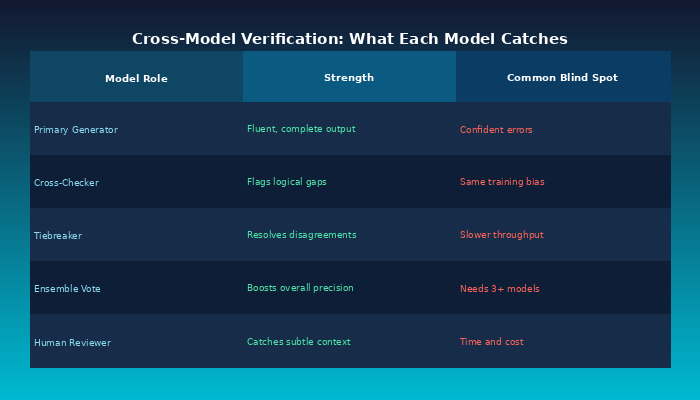
A different model trained on different data, with different architecture choices, tends to fail in different places. When two models agree, that agreement is a meaningful signal. When they disagree, that disagreement is an equally meaningful signal, and it is the disagreement that matters most in a QA context because it marks exactly the outputs that need a second look.
The practical implication is that model disagreement functions as a triage filter. You do not need to manually review every output. You review the ones where models diverge.
A Practical Workflow for QA Teams
Comparing models does not require infrastructure changes to get started. The minimum viable version is two browser tabs and a structured comparison habit.
Step one: generate with your primary model. Use whichever model your team has standardized on. Produce the output normally.
Step two: paste the prompt and output into a second model. Ask the second model to review the first model’s response for factual accuracy, logical consistency, and any claims that cannot be verified from the provided context. Keep this prompt simple. A review prompt that asks three specific questions gets more useful output than one that asks for general feedback.
Step three: record where they disagree. The disagreements are your defect list. Each one is a candidate for human review. Agreement without any caveat from the second model is a reasonable signal to move forward quickly.
Step four: add a tiebreaker when disagreements are consequential. For high stakes outputs such as test acceptance criteria, compliance language, or specifications that will drive test case generation, a third model resolves the open questions. The three-model structure that Baba (2024) tested showed an incremental precision gain from two models to three, with diminishing returns beyond that point.
This workflow is not about outsourcing judgment to models. It is about using model disagreement as a structured signal the same way a test run uses a failing assertion as a signal: something needs attention here before this moves forward.
Fitting Model Comparison Into a Testing Workflow
The outputs most worth reviewing across models in a QA context are the ones with the highest cost of error. Test acceptance criteria derived from a specification. Edge cases generated from a requirements document. Risk assessments used to prioritize regression scope.
For teams generating test cases with generative AI, running a second model over the generated cases adds a layer of verification that is difficult to replicate with static analysis alone. Ask the second model: does each test case follow from the specification provided? Are there scenarios in the spec that no test case covers? Are any of the assertions testing something other than what they claim?
These questions are easy to answer with a language model review prompt. They are time intensive to answer manually across hundreds of generated cases. The combination of scale from the generating model and verification from the second model is where the practical value appears.
For teams building this pattern into structured pipelines, the Generative AI and AI Agents for QA SDET Masterclass covers prompt design for test generation and output verification across the full SDET workflow.
Teams looking to build these verification steps into autonomous pipelines will find the architecture patterns in Agentic AI for QA and SDET: Build Autonomous Test Automation, including how to wire a verifier model into an agentic loop and route outputs for human review when models disagree.
Categories: : AI, AI Tools, Generative AI, ISTQB Generative AI