Multi-Agent Systems in QA: AI Orchestration Guide
 Software Testing Mentor and RCV Academy

Learn how coordinated AI agent systems outperform solo agents in QA. Research-backed results on architecture patterns, test generation, and regression detection.
From One Agent to Many
A single AI agent can write a test, run it, and report what happened. That is useful. It is also the ceiling for anything a solo agent can reliably do. When the task involves writing tests across multiple services, handling failures in one component while proceeding with others, and verifying the output quality before a human sees it, a single agent runs into structural limits. It has no way to parallelize, no internal reviewer, and no mechanism to catch its own planning errors before they propagate.
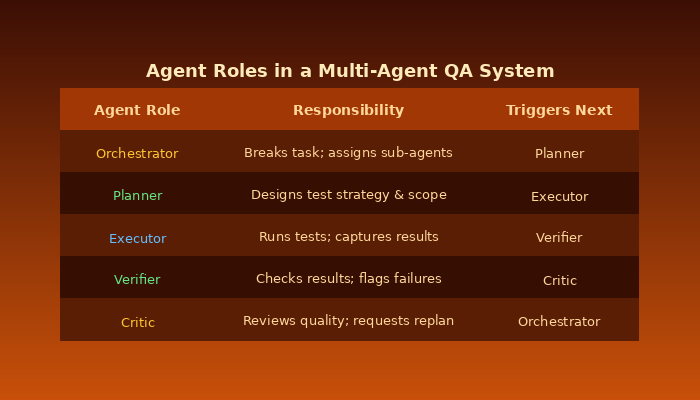
Systems that use multiple coordinated agents address this by distributing work across specialized roles. Each agent does one thing well. An orchestrator breaks the task into pieces. A planner designs the test strategy. Executors run the tests. A verifier checks the results. A critic evaluates overall quality and requests a replan when something is wrong. The roles form a loop rather than a pipeline, and that loop is what makes the system capable of correcting itself rather than just running sequentially.
What the Research Shows About Why It Works
The performance gap between solo agents and coordinated committees is measurable and consistent across recent studies.
A December 2025 paper proposed a committee of diverse agents with vision capabilities that vote across three rounds to choose each testing action for a web application (Karanam and Kennady, “Multi-Agent LLM Committees for Autonomous Software Beta Testing,” arXiv:2512.21352, 2025). Committees of two to four agents reached 91.7% to 100% task success, compared with 78.0% for solo agent baselines. On 20 injected regressions, the committee achieved an F1 score of 0.91 against 0.78 for solo agents. The authors attribute the gain to model diversity and persona variation: agents approach the same task differently, so the vote surfaces paths that any one agent would not take.
The MetaGPT framework encodes the structure of a software company into agent roles: Product Manager, Architect, Project Manager, Engineer, and QA Engineer. Agents communicate through structured documents, which gives the QA Engineer agent a concrete artifact to review rather than an informal output. On the SoftwareDev benchmark, MetaGPT scored 3.75 out of 4.0 on code quality, against 2.25 for ChatDev, and reached Pass@1 of 85.9% on HumanEval (Hong et al., “MetaGPT: Meta Programming for a Multi-Agent Collaborative Framework,” arXiv:2308.00352, ICLR 2024). The human revision cost dropped to 0.83 compared with 2.5 for approaches using a single model.
A system built around a feedback loop specifically for test generation proposed three cooperating agents: one that generates tests, one that executes them and analyzes results, and one that reviews and optimizes (Naqvi, Baqar, and Mohammad, “The Rise of Agentic Testing: Multi-Agent Systems for Robust Software Quality Assurance,” arXiv:2601.02454, 2026). On microservice applications, the system achieved up to a 60% reduction in invalid tests and up to a 30% improvement in coverage relative to generation from a single model.
The Architecture Question That Gets Overlooked
Most teams designing these systems focus on what each agent does. The architecture question that receives less attention is how agents coordinate without creating bottlenecks.
A 2026 Chalmers master’s thesis compared three architectures on unit test generation using the TestEval benchmark: a baseline running a single agent, a sequential architecture, and a hierarchical architecture with a supervisor (Agha and Miqdad, “An Empirical Comparison of Multi-Agent LLM Architectural Patterns for Automated Unit Test Generation,” Chalmers University of Technology, 2026). The hierarchical pattern performed worst, with a 54.4% success rate against 92.2% for sequential and 81.1% for the solo agent baseline. The cause appeared in 100% of its failing tasks: a supervisor information bottleneck. The supervisor received partial context from each worker and could not make sound routing decisions.
The lesson is that hierarchy adds overhead without adding value unless the supervisor has full context and a narrow enough decision space to act reliably. Sequential patterns, where each agent hands off to the next with the full accumulated context, outperformed the hierarchical model at lower cost.
Verified orchestration adds one more layer: a verifier agent that checks whether the full set of outputs satisfies the original goal before the result is returned. Zhang et al. introduced a plan, execute, verify, and replan loop where the verifier triggers replanning when coverage gaps remain (Zhang et al., “Verified Multi-Agent Orchestration: A Plan-Execute-Verify-Replan Framework for Complex Query Resolution,” arXiv:2603.11445, ICLR 2026 Workshop). Answer completeness improved from 3.1 to 4.2 on a 5-point scale, and source quality from 2.6 to 4.1, compared with a solo agent baseline.
Where QA Teams Can Apply This Now
These patterns are available in practical form across several levels of QA work, without building a framework from scratch.
For test generation at scale, a loop with three agents works: one agent reads the application’s API contracts or DOM documentation, one generates tests grounded in that context, and one reviews the output for selector validity and assertion completeness before anything runs. This pattern directly addresses the selector hallucination problem that makes generation from a single model unreliable.
For CI/CD integration, a committee approach on regression detection reduces the false positive rate that makes test runners disruptive to ship cycles. Different agents using different personas and models surface regressions that any individual model would miss or misclassify.
For incident triage, a chain of planner, executor, and verifier agents can take a failing test report, propose three candidate root causes, run diagnostic queries against each, and return a ranked assessment rather than a single guess. The verifier checks that the diagnostic steps covered each hypothesis before reporting.
The coordination overhead is real. Runs with multiple agents cost more per task and take longer. The Chalmers benchmark found the hierarchical architecture cost 0.308 USD per task against 0.083 USD for the solo agent baseline. Teams should match the architecture complexity to the task complexity. A bounded test generation task does not justify a full committee. An end to end regression suite across a distributed system does.
Getting Started With Agent Orchestration for QA
The practical starting point is understanding the roles well enough to recognize when a workflow would benefit from splitting them apart. Most teams already do this informally: one person writes the tests, another reviews them, a third handles the CI configuration. Agent orchestration formalizes that division and runs it at machine speed.
For teams who want to build this using LangChain for orchestration, including agent graphs, tool routing, and shared memory across agents, the LangChain for QA: Build RAG, Agentic RAG and AI Chatbots course covers the core patterns directly applicable to QA pipelines.
Teams building toward full autonomous test pipelines with orchestrated agent workflows will find the architecture, tool use, and human handoff design covered in the Agentic AI for QA and SDET: Build Autonomous Test Automation course.
Categories: : AI, AI Tools, Generative AI, ISTQB Generative AI