No Code AI Testing: A Beginner Friendly Path into Automation for Non-Coders
 Software Testing Mentor and RCV Academy
A practical, tool verified guide to no code AI testing for manual testers with zero coding background, from first project to career path.
A manual tester with ten years of exploratory testing experience does not need to learn Selenium to build a working regression suite anymore. That sentence would have gotten you laughed out of a QA meeting five years ago. Today it describes how a growing share of test suites actually get built.
No code is not one thing
"No code testing" covers a wider range of tools than the label suggests, and lumping them together leads to the wrong expectations.
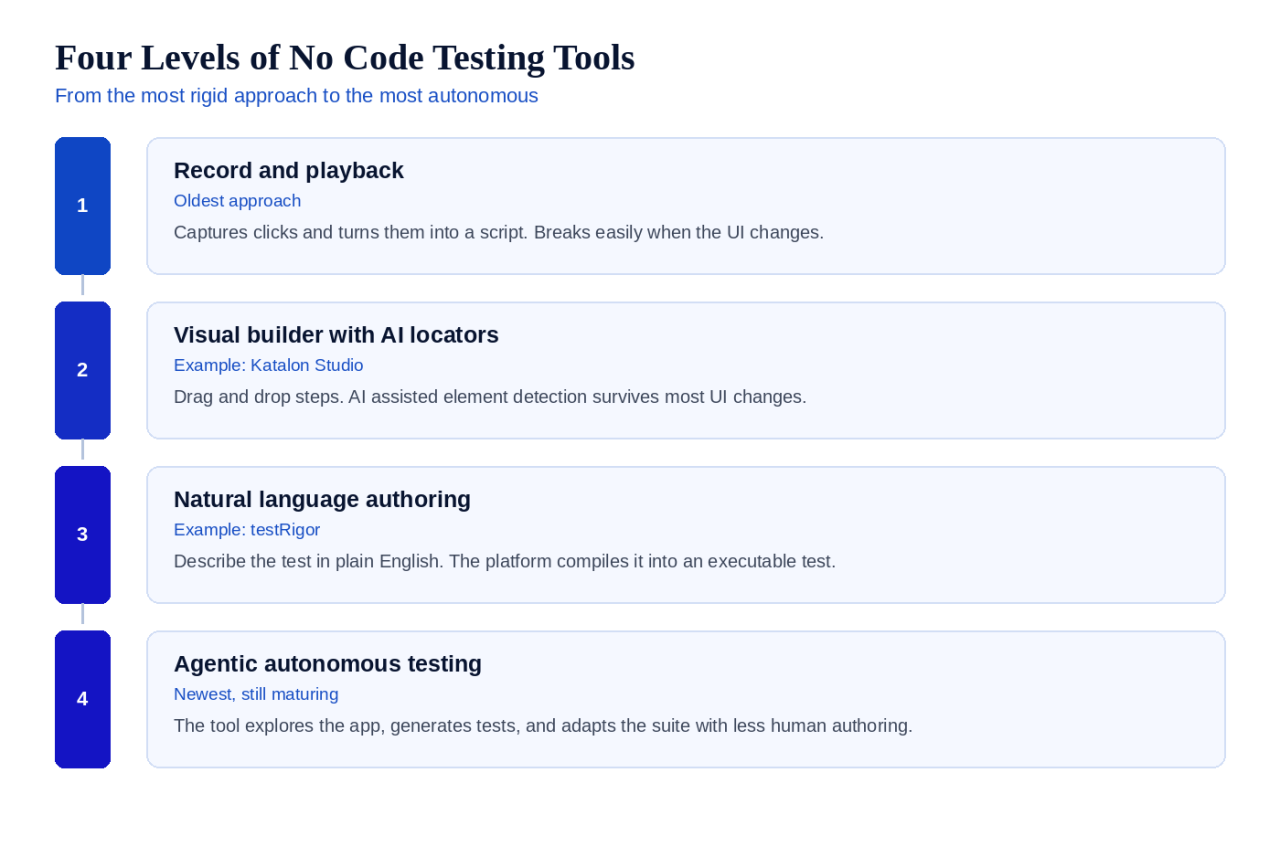
At the simplest end sits record and playback, where the tool watches you click through the application and turns those actions into a repeatable script. It is the oldest approach and the most fragile, since a script tied to exact clicks breaks the moment a button moves.
A step up from that is the visual builder with AI assisted element detection. Katalon Studio is a good example. You drag steps into a flow, and its AI locators try to find the right element even after the underlying code changes, rather than relying on a fixed selector that snaps the moment a developer renames a CSS class. Katalon's own documentation describes this self healing behavior alongside StudioAssist, an AI chat assistant built into the tool that can generate and explain test steps from a plain description.
The newest layer is natural language authoring, where you write what should happen in plain English and the platform compiles that into an executable test. testRigor is built entirely around this idea. Its documentation shows commands like click "Login" and check that page contains "Dashboard", written the way a person would describe the steps out loud, with no CSS selectors or XPath involved.
None of these replace understanding what a good test actually checks. They replace the syntax you used to need to express it.
Where these tools genuinely save time, and where they do not
No code tools are strongest on stable, well defined flows: login, search, checkout, form submission. A tester who has never written a line of code can describe those flows accurately because they already know the application from manual testing.
They struggle more with complex conditional logic, tightly chained API sequences, and applications that change their structure daily. Self healing reduces maintenance, but it does not eliminate the judgment call of whether a healed test is still checking the right thing.
It is also worth being honest about where the industry actually stands. Capgemini's World Quality Report 2025 to 2026 found that automation coverage across surveyed organizations still averages only about a third of test suites, with close to half of organizations still in the planning stage rather than execution. No code tools have lowered the barrier to entry, but most teams, technical or not, are still building coverage gradually rather than automating everything overnight. Anyone starting out should expect the same pace, not a shortcut around it.
Your first project
Pick one flow you already know well as a manual tester, ideally something stable that does not change every sprint. Login screens and search bars are common starting points for a reason: they are well understood and rarely redesigned.
Write the steps the way you would explain them to a new teammate. Run the test, watch where it breaks, and adjust the wording rather than fighting with technical configuration. Most no code platforms are built so that fixing a broken step looks like editing a sentence, not debugging code.
Resist the urge to automate everything in week one. A handful of stable, well chosen tests that run reliably in your pipeline are worth more than a large suite that nobody trusts. If you want the underlying testing fundamentals that make this judgment call easier, regardless of which tool you end up using, RCV Academy's ISTQB Certified Tester Foundation Level (CTFL) Training covers test design and prioritization from the ground up.
The testing skills the tool cannot replace
A no code tool changes how you express a test. It does not decide what to test, how much risk a given feature carries, or whether a passing script is actually checking something meaningful. Those are testing skills, not coding skills, and they transfer across every tool you will ever use.
This is also where a no code background can become a career advantage rather than a limitation. Testers who start here and later want to add coding, prompt based test generation, or AI assisted automation to their toolkit have a full path to do that. RCV Academy's full course catalog includes tracks that build from foundational testing straight through to AI powered automation for testers who want to keep growing.
Frequently asked questions
Do no code testing tools require zero technical knowledge at all?
For authoring, mostly yes. You will get further faster if you understand basic web concepts like what an element or a page load actually is, since that helps you debug when a step fails, but you do not need to write code to use these platforms.
Are no code tests as reliable as coded ones?
It depends more on test design than on the tool. A poorly designed test is unreliable whether it is written in Java or plain English. Self healing features in tools like Katalon and testRigor reduce one common source of flakiness, broken locators, but they do not fix a test that was checking the wrong thing to begin with.
Which no code tool should a complete beginner start with?
There is no single right answer, since it depends on your application and team. testRigor's plain English approach suits teams with no coding background at all, while Katalon's free tier gives you a visual builder with room to add scripting later if you need it. Try the free tier or trial of each directly against your own application before committing.
Can no code testing lead to a full SDET career?
Yes, and it is a common path. Many testers start with no code tools to prove automation value quickly, then add scripting, API testing, and CI/CD skills once they see where the no code tool hits its limits.
No code testing will not turn a first week beginner into a senior automation engineer, and it is not supposed to. What it does is remove the syntax barrier that used to keep manual testers out of automation entirely. If you want a structured foundation to build on before or alongside a no code tool, RCV Academy's CTFL Foundation Level course is a practical place to start.
Categories: : AI, AI SDET, AI Tools, Automation