Observability for Test Agents: Logging AI Decisions So You Can Trust Them
 Software Testing Mentor and RCV Academy
A traditional test either passes or fails, and the log tells you which. An AI test agent can pass, fail, or quietly decide to patch, skip, or reinterpret something on its own, and a bare pass or fail tells you nothing about which of those actually happened. Trusting the agent means being able to answer a harder question than pass or fail: what did it decide, and why.
Observability was built for services, not decisions
Traditional observability answers questions like how long a request took and whether it errored. Those questions assume the system's behavior is mechanical: given this input, the code does a fixed thing. An AI agent breaks that assumption. Given the same failing test, a healer agent might patch a locator, extend a wait, or flag the test for a human, and the choice depends on reasoning that happened inside the model, not a fixed code path you can read in a diff.
This is why watching CPU and latency dashboards tells you almost nothing about whether to trust an agent's output. The question that matters is not whether the agent ran successfully. It is what the agent decided and on what basis, and that requires logging a different category of information than a service ever needed to expose.
A shared vocabulary is emerging for this exact problem
Until recently, every team invented its own format for this. One service logged a field called model_name, another called it llm.model, and dashboards from different tools could never be compared. The OpenTelemetry GenAI Semantic Conventions, maintained as a dedicated project under the OpenTelemetry organization, exist to fix exactly that fragmentation. The project defines standard span names, attributes, and events for model calls, tool executions, and agent runs, using a shared gen_ai namespace so a trace produced by one framework lines up with a trace produced by a completely different one.
That standardization matters more for test agents than for most other AI systems, because a test agent's output is itself a decision about your product's correctness. If a healer's patch, a planner's scope decision, or a generator's assertion cannot be traced back to what the agent saw and concluded, there is no way to audit whether that decision deserved to be trusted, only a green checkmark asking you to take it on faith.
What actually needs to be in the log for a test agent
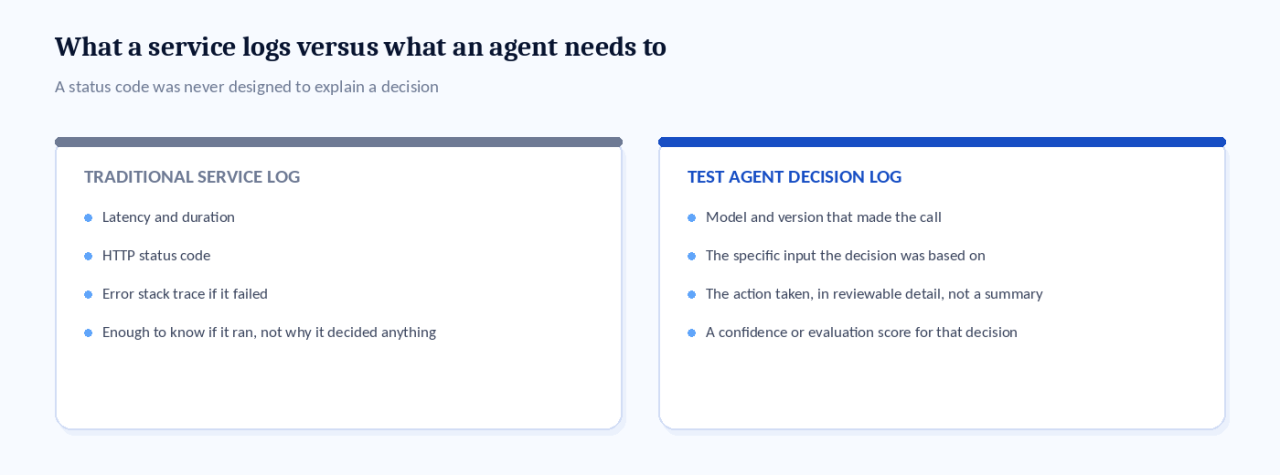
Four things turn a bare pass or fail into something you can actually audit. The model and version that made the call, since a provider side update can change behavior with no code change on your end to point to. The specific input the decision was based on, the failing test output a healer saw, or the requirement a planner read, not just the final action taken. The action itself in enough detail to review, the actual locator diff, the actual new assertion, not a one line summary that hides what changed. And a confidence or evaluation score attached to that specific decision, so a low confidence patch and a high confidence one do not get the same blind trust.
None of this is optional once an agent's output ships without a human rewriting it first. Playwright's own documentation for its test agents is explicit that a healer's patch is a proposal, not a guarantee, precisely because the healer cannot always tell whether it repaired a real problem or found a workaround around one. A log that only shows before and after states, without the reasoning that connected them, leaves a reviewer no way to tell the difference.
Where this plugs into evaluation tooling you may already use
Tracing and evaluation are increasingly built to work together rather than as separate concerns. DeepEval's tracing documentation describes wrapping an agent function so every step it takes gets captured as a span, then attaching evaluation metrics to that same trace so a reviewer can see not just what the agent did but how well it scored against defined criteria at each step. That pairing, a structured log plus a score attached to it, is what actually lets a team calibrate how much a given agent or a given category of decision can be trusted over time. If your team is building this kind of pipeline, the Agentic AI for QA and SDET course covers wiring tracing and evaluation into a multi agent testing workflow from the start, rather than adding it after an incident makes the gap obvious.
Frequently asked questions
Isn't logging every agent decision going to generate an overwhelming amount of data?
Not if you scope what gets fully logged. Structural information, which agent ran, what action it took, its confidence score, can be logged cheaply on every run. Full reasoning traces and raw prompts are more expensive and are usually captured selectively, for low confidence decisions or ones touching sensitive parts of the system.
Does this replace the human review checkpoints teams already use?
No. It makes those checkpoints actually usable. A reviewer approving or rejecting a healer's patch needs to see the reasoning behind it to make a real judgment, not just a diff with no context for why the agent thought it was correct.
Do we need a dedicated observability platform to do this, or can we build it ourselves?
Standard formats like the OpenTelemetry GenAI conventions mean you are not locked into one vendor either way. A team can start by logging structured spans to whatever backend it already uses and adopt a dedicated platform later without reinstrumenting everything from scratch.
How is this different from just logging the agent's final output?
The final output tells you what happened. It does not tell you whether the agent's reasoning was sound or lucky. Two agents can produce the identical patch, one after correctly diagnosing the failure and one by coincidence, and only a decision log with reasoning attached can tell those apart.
If you are setting up tracing and evaluation for AI agents in your own test suite for the first time, the Generative AI and AI Agents for QA and SDETs masterclass covers building that observability layer alongside the agents themselves.
Categories: : AI