Prompt Chaining for Quality: Break AI Tasks Into Steps
 Software Testing Mentor and RCV Academy
How breaking complex testing tasks into chained prompts reduces errors, improves verifiability, and makes AI output easier to debug. Research and practical QA workflow patterns.
One Prompt Is Often the Wrong Unit of Work
Ask a language model to write a full regression test suite in a single prompt and you will usually get something that looks complete but falls apart on inspection. Endpoint names that do not match the spec. Assertions that test the wrong thing. Edge cases skipped entirely because the model filled the space with plausible content instead of accurate content.
The problem is not that the model is incapable. It is that you handed it a task with too many decisions bundled together, and the model made all of them at once with no checkpoints in between.
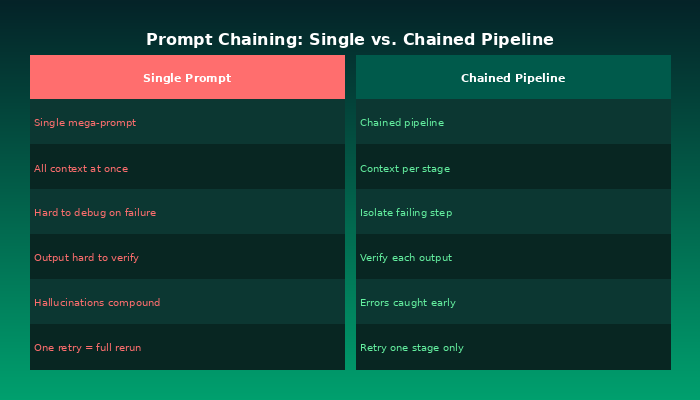
Prompt chaining solves this by treating each decision as its own stage. The output of one prompt becomes the input to the next. Each stage is narrower, easier to verify, and easier to fix when something goes wrong.
What the Research Shows
The mechanics behind chaining are well documented. A 2022 paper from Google Research on incremental prompting showed that decomposing a problem into subproblems and solving them in sequence produces substantially better results than presenting the full problem at once. On the SCAN compositional generalization benchmark, the incremental approach reached 99% accuracy with 14 prompt examples. Standard chain of thought prompting reached 16% on the same task (Zhou et al., “Least-to-Most Prompting Enables Complex Reasoning in Large Language Models,” arXiv:2205.10625, ICLR 2023).
A complementary approach appeared in “Decomposed Prompting: A Modular Approach for Solving Complex Tasks” (Khot et al., arXiv:2210.02406, ICLR 2023). DECOMP breaks complex tasks into smaller tasks and routes each to a dedicated prompted handler. The modular structure allows individual stage prompts to be optimized, swapped, or replaced with symbolic tools independently, without rewriting the full pipeline.
The controllability dimension was addressed in “AI Chains: Transparent and Controllable Human and AI Interaction by Chaining Large Language Model Prompts” (Wu et al., CHI 2022, arXiv:2110.01691). A 20-person user study found that chaining significantly enhanced system transparency, controllability, and users’ sense of collaboration. Participants debugged unexpected outputs by testing individual chain components in isolation, exactly the way a tester would isolate a failing test case.
More recent applied work corroborates the reliability advantage. Lazarev (2026, arXiv:2607.27210) compared prompt chaining against an optimized monolithic baseline for document synthesis tasks. The chained system completed every run successfully. The monolithic baseline failed on 50 percent of runs. Quality scores measured by ROUGE-L F1 were also higher for the chained approach (0.507 vs. 0.486).
How to Structure a Chained Test Pipeline
The chain structure maps naturally onto the stages of test design work.
Stage 1: Scope and extract. Feed the model the specification or API contract. Ask it to list all the endpoints, parameters, and business rules it can confirm from the provided text only. Flag anything missing. Do not ask for test cases yet. This stage produces a structured inventory you can review before any test writing begins.
Stage 2: Classify and prioritize. Pass the inventory from Stage 1 to a second prompt. Ask the model to group items by risk level and identify which scenarios need positive tests, negative tests, and boundary tests. The output is a test plan outline, not test cases.
Stage 3: Generate test cases. For each category from Stage 2, run a focused prompt that generates test cases only for that category. Smaller scope means the model stays on target and hallucinated details are easier to catch, because the context is narrow enough for a reviewer to spot a wrong endpoint name or a fabricated status code.
Stage 4: Format and validate. Pass the generated test cases to a final prompt that converts them into the format your test runner expects. Separating formatting from generation avoids the accuracy penalty that comes from imposing strict output structure constraints too early. A 2024 study confirmed this: requiring strict JSON or XML output during reasoning reduces accuracy, with tighter constraints causing larger drops (Tam et al., arXiv:2408.02442).
Making Chaining Practical in a QA Workflow
The benefits show up most clearly when tasks have natural decision points that a person would normally treat as separate steps.
Test data generation is one example. A single prompt asking for “realistic test data for a checkout flow” will produce something plausible. A chained approach extracts the required fields from the schema first, then generates values per field type, then assembles valid and invalid combinations as separate stages. Each intermediate output is checkable, and a bad data type in Stage 2 can be corrected before it propagates through the whole set.
Regression impact analysis is another. When a code change lands, a chained pipeline can: extract the changed functions from the diff in one stage, map those functions to existing test coverage in a second stage, then produce a prioritized list of tests to run or update in a third stage. Each step is narrow enough that the model has a clear task and a defined output format.
The debugging benefit mirrors what Wu et al. observed in their user study. When a monolithic prompt produces bad output, you face a full rerun with adjustments made on intuition. When a chained approach produces bad output, you can test the specific stage that went wrong in isolation, adjust only that prompt, and continue from the last good checkpoint. This is the same reason test suites are organized into focused unit tests rather than one monolithic script.
Getting Started
The practical entry point is to take one complex prompt you currently use and split it at its most obvious decision boundary. If it asks the model to “analyze this spec and generate test cases,” split that into two prompts: one that analyzes and produces an outline, one that takes the outline and generates cases. Review the intermediate output before passing it forward.
That pattern scales. Each stage you add gives you another checkpoint and another place to catch errors before they compound.
For teams building structured prompt pipelines into their test automation workflows, the Agentic AI for QA and SDET: Build Autonomous Test Automation course covers sequential prompt design in depth, including how to wire stages together in an agentic loop and handle failures at each step.
The Generative AI and AI Agents for QA SDET Masterclass covers the foundational patterns for test generation with generative AI, including prompt structure, grounding techniques, and output verification across the full SDET workflow.
Categories: : Agentic AI, AI, AI Tools, ISTQB Generative AI