Prompt Engineering for QA Testers: A Practical Guide
 Software Testing Mentor and RCV Academy
A practical, ISTQB based framework for writing AI prompts that generate usable test cases, bug reports, and automation scripts.
Most testers write prompts the way they write search queries. They type a short request, skim what comes back, and move on. That works for finding a restaurant. It does not work for generating test cases you can actually use, because the AI model has no idea what your application does, who uses it, or what "done" looks like for your team.
The one line prompt problem
Type "write test cases for a login page" into any AI tool and you will get a generic list back. Username field, password field, forgot password link, maybe a captcha. None of it references your actual application. The model does not know if you support single sign on, if there is a lockout policy after failed attempts, or if the login page also handles a two factor code. It filled in the blanks with the most common pattern it has seen, which is rarely the pattern your product follows.
This is not a model problem. It is an input problem. Every output an AI tool gives you is only as specific as the prompt that produced it.
A structure that actually holds up
ISTQB built an entire specialist certification around this idea. The Certified Tester Testing with Generative AI (CT-GenAI) syllabus, formally approved by the ISTQB General Assembly in July 2025, breaks a usable testing prompt into six parts: role, context, instruction, input data, constraints, and output format. You do not need the certification to use the framework, though if you want the structured version with practice exams, RCV Academy's ISTQB Generative AI (CT-GenAI) Certification Exam Prep course walks through each part with testing specific examples.
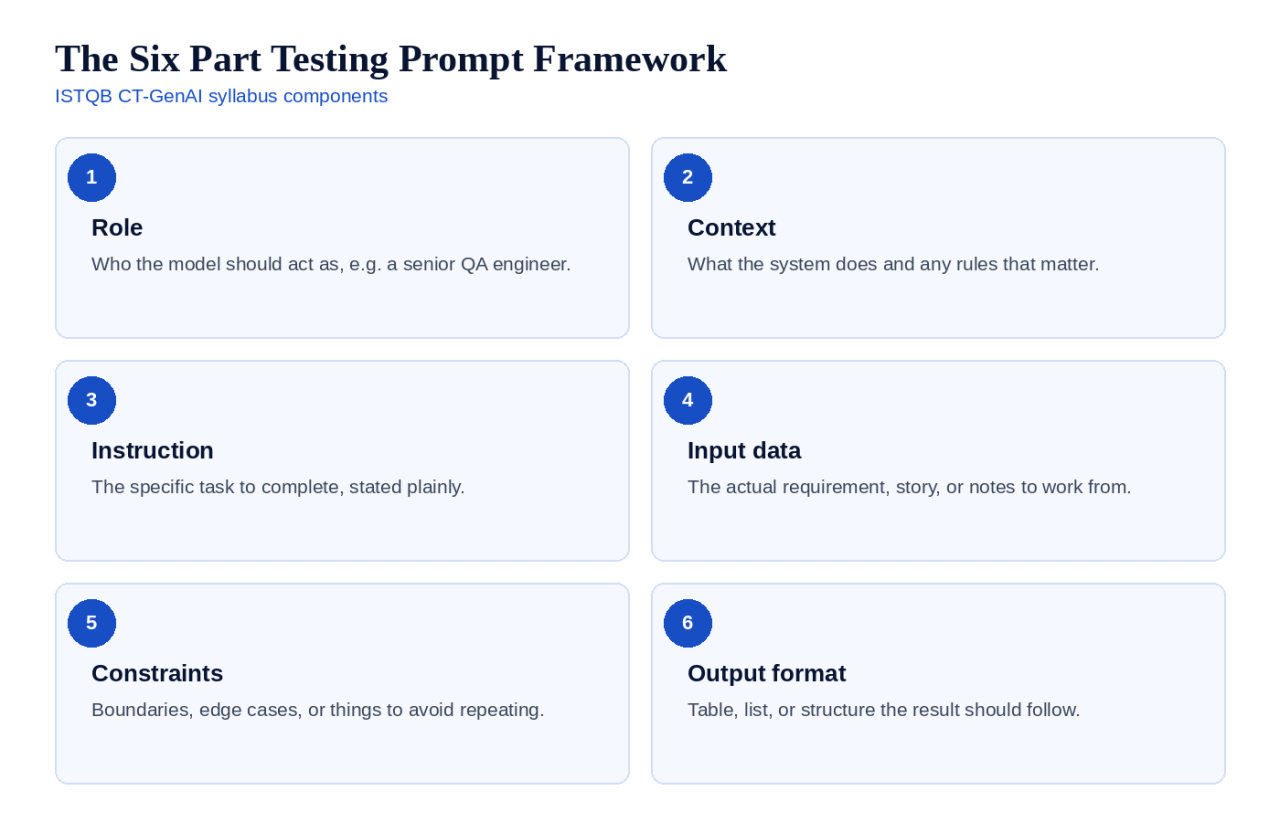
Here is what those six parts look like in practice for a test case request.
- Role: "You are a senior QA engineer reviewing requirements for edge cases."
- Context: "This is a checkout flow for an ecommerce site. Customers can pay by credit card, PayPal, or store credit. Orders under twenty dollars are exempt from shipping fees."
- Instruction: "Generate test cases covering the payment method selection step."
- Input data: paste the actual acceptance criteria or user story text.
- Constraints: "Cover boundary values around the twenty dollar threshold. Do not repeat scenarios already listed in the regression suite below."
- Output format: "Return a table with columns for test case ID, precondition, steps, and expected result."
That prompt takes two minutes to write and produces something you can drop straight into your test management tool, instead of a generic list you have to rewrite anyway.
Prompts for tasks beyond test case generation
The same structure works for other testing tasks once you swap out the instruction and input data.
For bug report analysis, give the model your raw exploratory testing notes as input data, ask it to group findings by severity, and constrain the output to match your team's Jira template. For automation scaffolding, describe the framework you use, paste an existing test as a style example, and ask for a new test that follows the same pattern instead of generating one from scratch in an unfamiliar style. If your team is building AI assisted automation workflows with tools like Playwright, GitHub Copilot, or Claude Code, RCV Academy's full course catalog has hands on tracks for exactly that combination.
For requirements review, ask the model to list ambiguous statements in a user story rather than asking it to write test cases directly. This catches gaps before they turn into missed scenarios, and it keeps a human making the actual test design decisions.
Where prompts stop being enough
None of this replaces verification. Generative AI adoption in quality engineering has moved fast. Capgemini's World Quality Report 2025 to 2026 found that 89 percent of organizations are now piloting or running generative AI in their quality engineering practices, with an average productivity gain of 19 percent among adopters. That gain only shows up when someone checks the output. A model can generate a test case for a payment flow that does not exist in your product, or miss a regulatory requirement it was never told about. Treat every AI generated test case, script, or bug summary as a first draft from a fast but uninformed colleague, not as a finished deliverable.
Frequently asked questions
Do I need to learn a specific AI tool to use these prompts?
No. The role, context, instruction, input data, constraints, and output format structure works across ChatGPT, Claude, Gemini, and Copilot. The wording of your prompt matters more than which tool you paste it into.
How is prompting for testing AI systems different from prompting AI tools to help with testing?
They are related but separate skills. Prompting AI tools to generate test artifacts is what CT-GenAI covers. Testing AI based systems themselves, including checking for bias, data drift, and non deterministic behavior, is covered under the ISTQB Certified Tester AI Testing (CT-AI) v2.0 syllabus. RCV Academy's ISTQB AI Testing (CT-AI) Masterclass covers that side specifically.
Should I paste confidential requirements or customer data into a public AI chat tool?
Check your company's data policy first. Many organizations restrict what can go into public AI tools, and some provide an enterprise version with different data handling terms. When in doubt, anonymize identifiers before you paste anything in.
Will better prompts make manual testers redundant?
Not based on current data. AI accelerates drafting and analysis, but someone still has to define what correct behavior means, decide what risk to test for, and judge whether an output is trustworthy. Those are the skills prompt engineering assumes you already have.
Prompt engineering will not turn a vague requirement into a complete test suite by itself. What it does is cut the back and forth between what you meant and what the model produced, and that alone saves real time on every ticket. If you want a structured path through this, including the full ISTQB syllabus and graded practice exams, RCV Academy's CT-GenAI exam prep course is built specifically for testers making this shift.
Categories: : AI, AI Tools, Generative AI, qa