The QA Orchestrator: A New Job Description Nobody Agreed On Yet
 Software Testing Mentor and RCV Academy
"QA orchestrator is not a job title on any board yet, but survey data shows the job itself already changing under existing titles."
Search any job board for "QA orchestrator" and you will find almost nothing. Search for what QA leaders are actually being asked to do this year, and you will find the job that title describes, just filed under a dozen other names. The role is changing faster than the title for it is settling.
A title with no job posting to match it
The phrase itself traces to vendor conference commentary rather than a job classification body. Tricentis, writing about its own Transform conference, which drew over a thousand quality engineering leaders and practitioners in October 2025, put it directly: "Today's QA leaders are becoming orchestrators, defining quality objectives and overseeing AI driven outcomes rather than executing every test themselves." That framing has since shown up across other vendor commentary and QA conference talks throughout 2026, but no standards body, job board taxonomy, or salary survey currently tracks "QA orchestrator" as a distinct title. It describes a shift in responsibility, not a role anyone has formally defined yet.
That gap matters. A title that spreads through conference keynotes before it spreads through job postings tends to mean different things to different people, and right now it does. Some use it to describe a senior IC who reviews AI generated test plans. Others use it for a manager coordinating multiple AI agents across a pipeline. A few use it as a rebrand for what was already a QA lead role, with no actual change in duties.
What the survey data actually shows changing
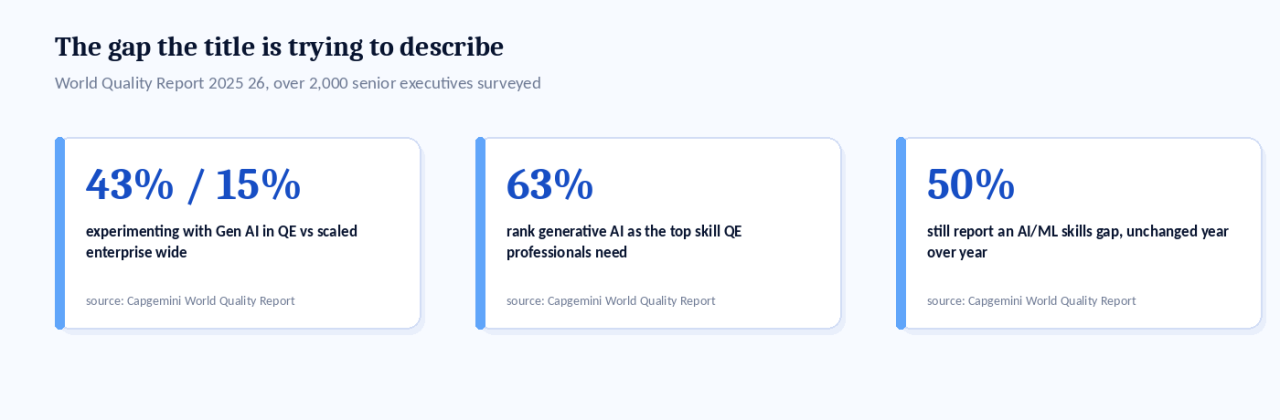
Set the label aside and the underlying shift is real and measurable. Capgemini's World Quality Report 2025 26, based on a survey of more than 2,000 senior executives across 22 countries, found that 43 percent of organizations are experimenting with generative AI in quality engineering, but only 15 percent have scaled it enterprise wide. That gap between experimentation and adoption is exactly where a lot of the ambiguity about the orchestrator role sits: teams are handing more decisions to AI tools before anyone has settled what the human job around those tools should look like. The same report found generative AI is now the top ranked skill quality engineers say they need, cited by 63 percent of respondents, just ahead of core quality engineering skills at 60 percent. And half of organizations report they still lack AI and machine learning expertise internally, a figure unchanged from the year before.
This is not unique to testing. The World Economic Forum's Future of Jobs Report 2025, drawn from over a thousand employers representing more than 14 million workers, projects that 39 percent of core workplace skills will change by 2030 across the economy generally. QA is going through a sharper, faster version of a shift happening broadly, which is part of why the vocabulary for describing it has not caught up yet.
Three duties that already look like orchestration
Whatever it ends up called, the actual work has three recognizable pieces already showing up in job descriptions that still say "QA Lead" or "Senior SDET" on the label. Reviewing an AI generated test plan before any code exists, catching a missing edge case while it is still a sentence to fix rather than a rewrite. Approving or rejecting a generated test or a healer's patch rather than writing every line by hand, which shifts the core skill from typing code to judging code someone or something else produced. And defining what quality actually means for a feature in the first place, since an AI agent can execute against almost any criteria you give it, but somebody still has to decide which criteria matter.
None of these are new tasks invented by AI tooling. Reviewing, approving, and defining scope were always part of a senior tester's job. What has changed is the ratio: less time spent producing the artifact, more time spent judging whether the artifact produced by something else is right.
Why the title has not settled yet
Certification bodies move slower than vendor marketing, and that lag is part of why no title has stuck. The closest thing to a standardized skill baseline for this shift is the ISTQB's CT-GenAI syllabus, which covers evaluation methods, human oversight, and nondeterminism testing as examinable content, but it certifies a skill set, not a job title. Until a comparable body of consensus forms around what an orchestrator role actually owns day to day, expect the title to keep showing up in conference slides faster than it shows up in a job requisition.
Frequently asked questions
Is QA orchestrator an actual job title I could apply for right now?
Rarely as written. It appears occasionally in forward looking job postings at companies experimenting heavily with agentic testing, but most of the responsibilities it describes currently live inside titles like QA Lead, Senior SDET, or Quality Engineering Manager.
Does this mean traditional QA titles are going away?
Not necessarily the titles themselves, but the day to day content behind them is shifting toward review and oversight work, based on the World Quality Report findings above. A title staying the same does not mean the job behind it has.
Should I put "orchestrator" skills on my resume even without the title?
Yes, if you can back it up. Describing experience reviewing AI generated test plans, setting evaluation criteria, or approving automated patches signals the actual shift hiring managers are looking for, regardless of what your current title says.
Is this shift specific to large enterprises, or does it affect smaller teams too?
The Capgemini data is drawn mostly from larger organizations, but smaller teams adopting AI testing tools face the same shift in duties, often faster, since there are fewer people to split the work of reviewing and judging AI output.
If you want to build the specific skills this shift is asking for, prompt writing, evaluation criteria, and AI output review, rather than wait for a job title to catch up, the Generative AI and AI Agents for QA and SDETs masterclass covers exactly that ground.