Quality Engineering vs QA: What the Shift Really Means for Testers
 Software Testing Mentor and RCV Academy
What quality engineering actually changes versus traditional QA, backed by ISTQB, ISO, and BLS data, plus what testers should do next.
Your title changes from QA Engineer to Quality Engineer and your manager says the job itself has not changed much. Six months later your calendar looks completely different. Meetings about performance budgets and security scans now sit next to the regression testing you used to spend all day on. Nobody explained when that happened.
The term is older than software
Quality engineering did not start in software. The American Society for Quality has certified Quality Engineers since long before continuous delivery existed, and its Certified Quality Engineer credential still covers statistical process control, product design, and compliance auditing, the language of manufacturing floors, not sprint boards. Software borrowed the title and reshaped it around code instead of physical parts.
That borrowed history matters, because it explains why quality engineering was never meant to describe a single job. In manufacturing, quality assurance and quality engineering were already two different functions: assurance verifies the output, engineering builds quality into the process that produces the output. Software teams are still working out where that line sits for them, which is why the same title means different things at different companies.
What actually moves under the new title
The ISTQB Foundation Level syllabus, the most widely used baseline for software testing terminology, splits testing into two roles. A test management role owns planning, monitoring, and control. A testing role, in the syllabus's own words, takes overall responsibility for the engineering, technical, aspect of testing: analysis, design, and execution. Quality engineering leans harder into that second role and pushes it earlier into the process, rather than treating it as a phase that starts once developers are done.
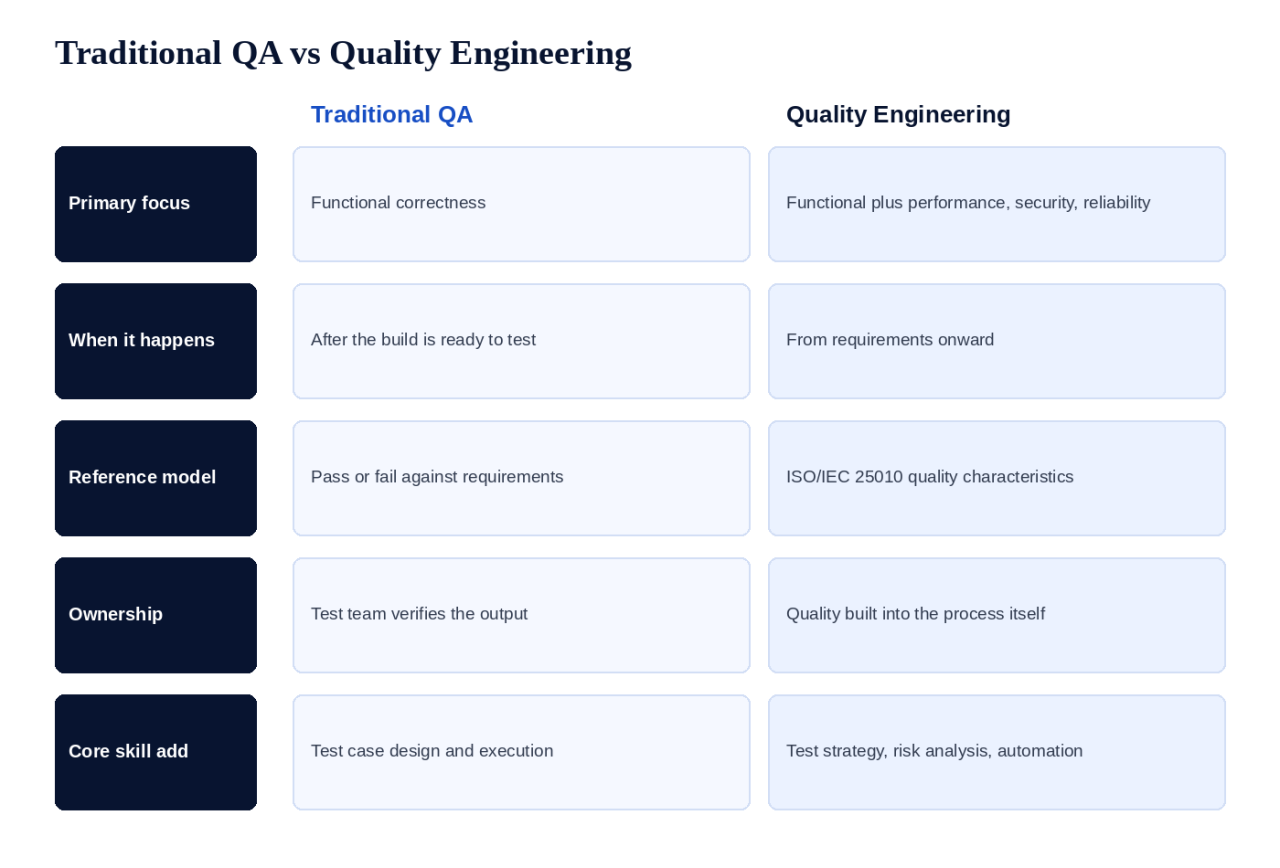
In practice that shows up as broader ownership. Traditional QA checklists tend to center on functional correctness: does the feature do what it is supposed to do. Quality engineering pulls in the wider set of concerns defined in the ISO/IEC 25010:2023 product quality model, the current international standard for software quality characteristics. That model lists nine characteristics including performance efficiency, security, reliability, maintainability, and compatibility, not just functional suitability. A quality engineer is expected to have an opinion on most of those, not just the first one.
The other real change is timing. Quality engineers get involved while requirements are still being written, not after a build lands in a test environment. That is less about new tools and more about being in different meetings earlier.
Does the shift show up in pay and demand
It is a fair question whether any of this is more than a title change on a business card. The U.S. Bureau of Labor Statistics tracks software quality assurance analysts and testers as a distinct occupational category, and its most recent data shows a median annual wage of $102,610 as of May 2024, with employment projected to grow 15 percent from 2024 to 2034, well above the average for all occupations. The BLS category still uses the older QA and tester terminology, but the demand and pay data behind it reflects a role that has clearly expanded in scope, not shrunk.
Job titles lag reality by design. Companies rename roles once the responsibilities have already shifted, not before. If your day to day work already touches performance, security, or reliability concerns beyond pure functional testing, the title change is catching up to something that started earlier.
What to actually do about it
Chasing a title is not a strategy. Building the underlying skills is. Start with solid test design and risk based prioritization, since those fundamentals do not change no matter what the role is called. RCV Academy's ISTQB Certified Tester Foundation Level (CTFL) Training covers exactly that foundation, current with the latest syllabus.
From there, quality engineering roles increasingly expect comfort with test strategy across a whole release, not just execution of assigned cases. RCV Academy's ISTQB Advanced Test Management (CTAL-TM) course is built for testers moving into that kind of ownership, covering planning and risk management at the level quality engineering roles actually operate at.
Frequently asked questions
Is quality engineering just a rebrand of QA?
Sometimes, yes, when a company changes titles without changing responsibilities. Where it is a genuine shift, the difference is scope and timing: broader quality characteristics, involved earlier in the process, rather than a narrower functional check done at the end.
Do I need a new certification to call myself a quality engineer?
No certification legally gates the title. What actually matters to employers is whether you can demonstrate the broader skill set: test strategy, risk analysis, and familiarity with non functional quality characteristics like performance and security, alongside traditional functional testing.
Does quality engineering mean testers have to write more code?
Often, but not always. Many quality engineering roles do expect scripting or automation skills, since building quality into a pipeline usually involves tooling. It is not a universal requirement, and plenty of quality engineering work is strategic rather than hands on code.
Is quality assurance going away as a discipline?
No. Verification and confirmation that requirements are met is still necessary work, whatever it gets called. Quality engineering is better understood as quality assurance plus earlier involvement and broader scope, not a replacement for it.
Titles will keep shifting faster than job descriptions do. What actually carries you from a QA role into a quality engineering one is the underlying skill set, not the label on your business card, and that is exactly what RCV Academy's ISTQB certification pathway is built to strengthen, from foundational testing through advanced test management.
Categories: : AI, AI SDET, AI Tools, Automation, qa