RAG Pipelines Break Differently Than APIs Do: A Tester's Guide to What to Check
 Software Testing Mentor and RCV Academy
"RAG pipelines fail quietly with confident wrong answers instead of error codes. Here is what to check in the retriever and generator separately."
An API test fails loud. A 500 status code, a schema mismatch, a timeout sitting right there in the logs. A RAG pipeline can fail perfectly quietly: a 200 response, a fluent paragraph, an answer built from the wrong document entirely. Nothing in the response tells you that. You have to go looking.
The failure never shows up in a status code
Retrieval augmented generation pipelines have two moving parts working together: a retriever that pulls relevant chunks from a knowledge base, and a generator that turns those chunks into an answer. Either one can fail without the other noticing. The retriever can hand the generator three irrelevant chunks and one perfect one, and the generator can still write a confident, well formatted paragraph, just built on the wrong quarter of the information. There is no exception to catch. The pipeline completed successfully by every technical measure and still gave the user a wrong answer.
That is the core difference from API testing. An API contract defines a shape, and a response either matches it or it does not. A RAG pipeline has no equivalent contract for meaning. Two answers can both be fluent, well structured, and grammatically perfect, and only one of them is actually grounded in what was retrieved.
Two components, two different failure surfaces
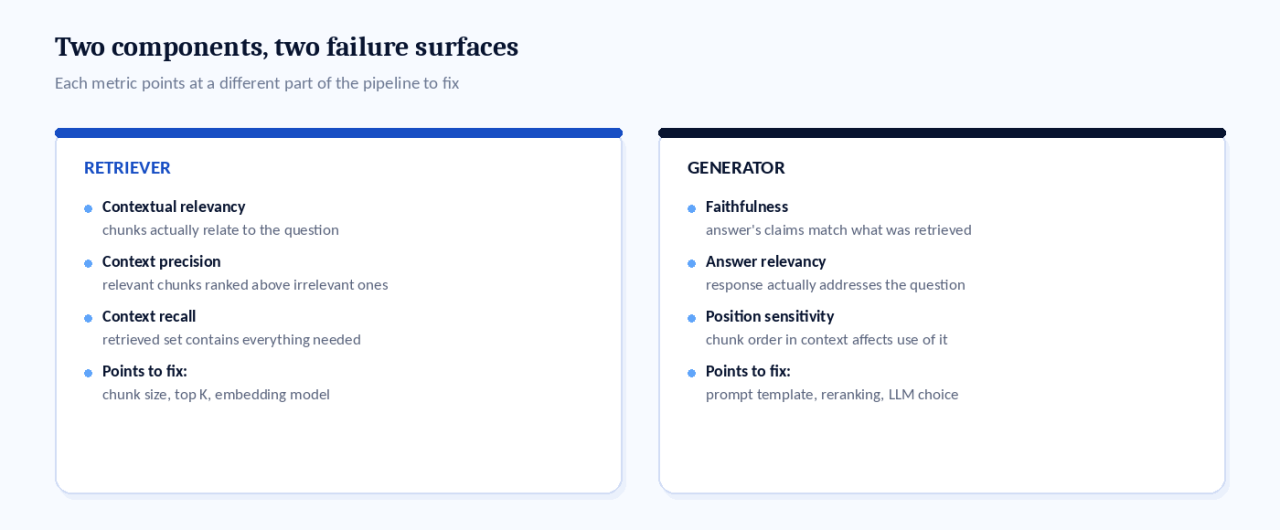
Testing a RAG pipeline as one black box hides which half broke. DeepEval's guide to the RAG triad splits the evaluation into three metrics that map to specific parts of the system: contextual relevancy targets the retriever, checking whether the chunks pulled back actually relate to the question, and it points directly at chunk size, top K, and embedding model choice when it scores low. Faithfulness targets the generator, checking whether the answer's claims are actually supported by what was retrieved, and a low score here means the generator is adding or distorting information, not that retrieval failed. Answer relevancy targets the prompt template, checking whether the response actually addresses what was asked rather than wandering off on tangentially related but unhelpful ground.
RAGAS, a separate open source evaluation framework, splits retrieval further into context precision, whether the useful chunks are ranked above the irrelevant ones, and context recall, whether the retrieved set actually contains everything needed to answer correctly. A pipeline can score well on one and badly on the other. High precision with low recall means what came back was relevant but incomplete. High recall with low precision means the right chunk is buried in noise the generator has to sort through.
Position bugs no API ever has
Even when retrieval pulls back the right chunk, where that chunk lands in the context window changes whether the model actually uses it. A Stanford study on how language models use long context found that model performance was consistently highest when the relevant information sat at the beginning or end of the input, and degraded significantly when that same information was placed in the middle, a pattern the researchers documented across both open and closed models. This holds even for models explicitly built to handle long context windows.
For a RAG pipeline, that means a correct retrieval can still produce a wrong answer purely because of chunk ordering. A reranking step that shuffles the top result into position eight out of twelve can silently degrade answer quality with no change to what was actually retrieved. This is a failure mode with no equivalent in API testing, where a correctly returned field does not become less true depending on where it sits in the JSON body.
A practical checklist for testing a RAG pipeline
Test the retriever and generator as separate systems before testing them together. A generator that is faithful to bad context and a retriever that returns great context to a generator that ignores it produce the same visible symptom, a wrong answer, for opposite reasons.
Build a small set of questions with known correct source documents. Without a reference to check retrieval against, precision and recall are just guesses. If your team is setting up this kind of evaluation dataset for the first time, the ISTQB CT-GenAI certification course covers building reference based test data for exactly this purpose.
Test position sensitivity directly. Take a question your pipeline answers correctly, then rerun it with the same correct chunk deliberately moved to the middle of the retrieved set instead of the top. A meaningful accuracy drop tells you the pipeline is vulnerable to the same effect the Stanford research documented, regardless of retrieval quality.
Recheck after any change to chunking, the embedding model, or the reranker, even a version bump. Each of those changes what the retriever hands the generator, and a small version change in an embedding model can shift which chunks rank highest for the exact same query.
Frequently asked questions
Is RAG testing just prompt testing with extra steps?
No. Prompt testing checks how a model responds to instructions. RAG testing has to check an entire pipeline: whether the right documents get retrieved, whether they get ranked usefully, and whether the generator stays faithful to them. A perfect prompt cannot fix a retriever handing back the wrong chunks.
Can traditional integration tests catch RAG failures?
They catch the infrastructure layer, whether the vector database responds, whether the API returns a 200, whether latency stays within budget. They cannot tell you whether the answer is actually grounded in the right source, which needs the semantic metrics described above instead.
How often should a RAG pipeline be reevaluated once it is in production?
At minimum, after any change to the knowledge base, chunking strategy, embedding model, or underlying LLM. Content in the knowledge base also goes stale, so periodic reevaluation on a fixed schedule, not just after code changes, catches drift that nobody deliberately introduced.
Does a high faithfulness score mean the pipeline is working well?
Not by itself. A faithfulness metric only checks that the answer does not contradict the retrieved context. If the retriever handed back irrelevant chunks, the generator can stay perfectly faithful to the wrong information and still score high on faithfulness while being useless to the user.
If your team is building this kind of evaluation into an AI feature for the first time, the Generative AI and AI Agents for QA and SDETs masterclass covers setting up retriever and generator checks as part of a working test pipeline rather than treating a RAG feature like an ordinary API.
Categories: : AI, API, API Testing, Automation