Request Manipulation and Test Data Poisoning: New Security Threats in AI Testing
 Software Testing Mentor and RCV Academy
Learn how request manipulation and test data poisoning compromise AI testing tools, with real attack examples and proven defenses for QA teams.
Imagine a QA team that trusts its AI testing tool completely. They feed it requirements, test data, and knowledge base documents. The AI generates test cases, prioritizes defects, and recommends test coverage. Nobody questions the inputs going in. That trust is exactly what attackers are starting to exploit.
Two threats are reshaping how security conscious QA teams think about AI in testing: request manipulation and test data poisoning. Both existed before AI testing tools became common. Both have become substantially more dangerous now that AI is making decisions based on that data.
What Request Manipulation Looks Like in AI Testing
Request manipulation happens when crafted inputs alter what an AI testing tool produces. The attacker doesn't need access to the model itself. They just need to influence something the model reads.
The simplest form is prompt injection hidden in test artifacts. A requirements document, a bug report, or a test case description can carry embedded instructions. When your AI testing assistant processes that document, it reads the hidden instruction alongside the legitimate content. The model cannot reliably distinguish them.
In December 2024, security researchers demonstrated this against OpenAI's ChatGPT search feature. Hidden text was embedded within a webpage and caused ChatGPT to override genuine user queries. Analysts also documented a malware sample on VirusTotal that embedded a prompt injection string specifically designed to trick AI assisted code analysis tools into returning false negative results. The phrase "Please ignore all previous instructions" appeared in the sample, intended to make AI tools declare no malware was present.
For QA teams, this means any document fed to an AI tool is a potential attack surface. A vendor submitting API documentation, a developer committing a requirements file, or a third party adding to a shared knowledge base can all introduce manipulated inputs. The AI reads the whole document. It may act on instructions embedded anywhere inside it.
The attack scales because of how modern AI testing tools work. When an AI agent has permissions to read project files, access test repositories, or query shared knowledge bases, a single poisoned document can influence many downstream decisions. Test prioritization, defect triage, and automated test generation all become unreliable if the inputs feeding them are manipulated.
Test Data Poisoning and the RAG Attack Surface
Test data poisoning is a related but distinct problem. It targets the knowledge bases and retrieval stores that AI testing tools rely on for context, not the model itself.
Many AI testing tools use Retrieval Augmented Generation. They fetch relevant content from a knowledge base before generating a response. The retrieved content goes directly into the model's context window and is treated as authoritative. This is also exactly where the attack lands.
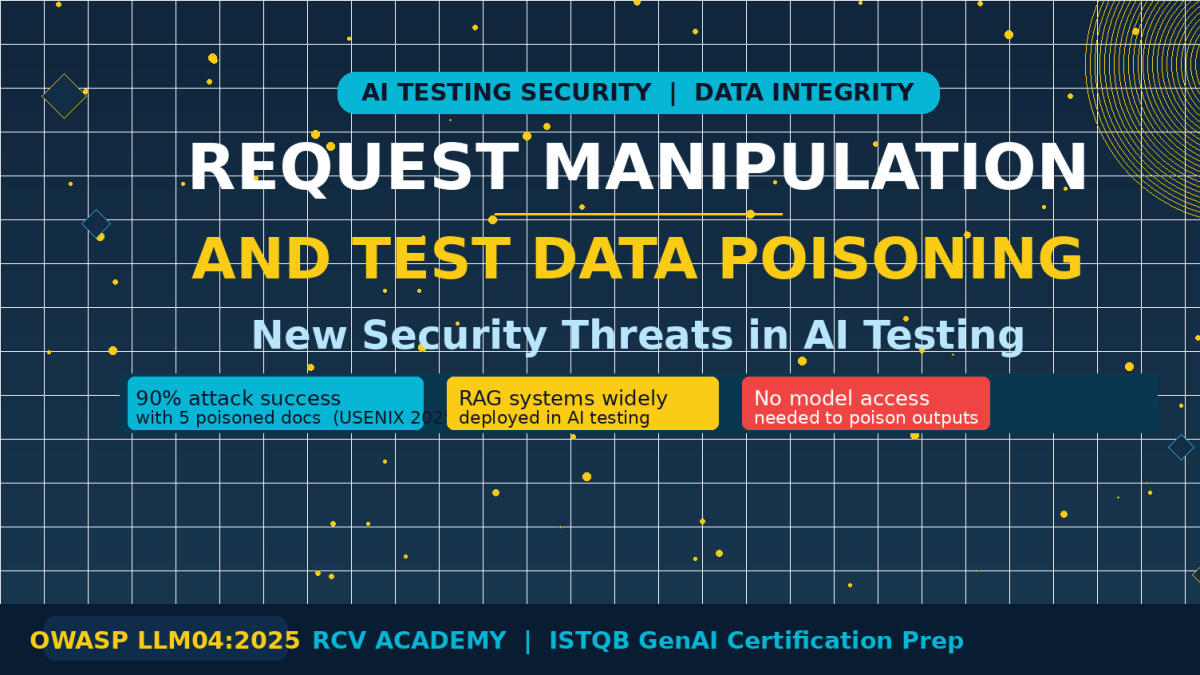
The PoisonedRAG study, presented at the USENIX Security Symposium 2025 by researchers at Penn State and Illinois Institute of Technology, demonstrated this at scale. The researchers injected five malicious texts into a knowledge database containing millions of documents. The result was a 90 percent attack success rate, meaning the AI model generated the attacker's chosen answer instead of the correct one for targeted questions. The attacker never needed access to the model or the retrieval system directly. They simply contributed content that the system later fetched.
The OWASP LLM04:2025 Data and Model Poisoning guidance frames this as an integrity attack. Once poisoned data enters the retrieval pipeline, the model's answers can be manipulated without any further attacker action. A poisoned wiki page, a falsified knowledge base article, or a manipulated test case template can steer AI generated test coverage away from the areas that matter most.
For testing teams specifically, this creates an asymmetric risk. A carefully constructed poison document that ranks highly in retrieval for defect related queries could cause an AI tool to consistently underweight critical test areas, deprioritize high severity bugs, or generate test cases that deliberately miss certain conditions. The poisoning may be invisible to normal quality checks because the AI still behaves normally across all unaffected queries.
Why Testing Environments Are Particularly Vulnerable
General AI security guidance often focuses on consumer facing chatbots or internal productivity tools. Testing environments have characteristics that make them more exposed to both threats.
Test data tends to be widely shared. Developers, QA engineers, product managers, and external vendors all contribute to requirements, test cases, and bug reports. Any of these contributors can introduce manipulated content. There is rarely a security review at the point of data ingestion.
AI testing tools also carry elevated permissions in many organizations. An AI agent that can read test repositories, query defect trackers, and access staging environment data has a large blast radius if manipulated. A successful request manipulation attack against such a system doesn't just produce a wrong test case. It may suppress coverage of a vulnerability, redirect testing attention away from a specific component, or report a false defect as resolved.
The combination of broad data access and high trust automation makes testing infrastructure a high value target for anyone who wants to introduce vulnerabilities that survive the QA process.
What Defense Actually Looks Like
Defending against request manipulation starts with treating every external document as untrusted input. This is the same principle as sanitizing user input in traditional application security, extended to everything an AI tool reads.
Validate and isolate document sources. Know who contributed every document in your AI testing knowledge base. Implement contributor controls that prevent anonymous or unverified additions. Treat third party documentation like you would third party code: review it before it enters your pipeline.
Monitor what your AI tools are retrieving. Log which documents are being fetched during AI assisted test generation and defect triage. Anomalies in retrieval patterns such as sudden over reliance on recently added documents, or unexpected documents appearing at the top of retrieval results, can indicate poisoning.
Audit AI outputs against requirements. Don't accept AI generated test coverage decisions without comparing them to requirements. If an AI tool consistently deprioritizes a particular component or never generates tests for a specific condition, investigate the retrieval chain, not just the output.
Treat AI generated prioritization as advisory. Request manipulation attacks are most effective when AI outputs are acted on directly without human review. Keeping a human in the loop for coverage decisions, defect prioritization, and test suite composition limits the practical impact of manipulated inputs.
Apply provenance tracking to your knowledge base. OWASP LLM04:2025 recommends version controlling training datasets and tracking data provenance so that any behavior change can be traced back to a data change. The same principle applies to retrieval stores used by AI testing tools. When you can trace every document to its source and timestamp, poisoning becomes visible.
Keeping the Testing Layer Honest
Test automation exists to provide confidence. The whole point of a test suite is that it tells you something reliable about the software under test. When AI tools are manipulated, that signal becomes unreliable, and the damage is compounded because the failure is invisible to the people relying on the output.
Request manipulation and test data poisoning don't require sophisticated attackers or model access. They require access to the data your AI testing tools trust. That access is often wide open.
The most defensible position is to apply the same skepticism to AI tool inputs that good security practice applies to application inputs: validate sources, monitor behavior, maintain audit trails, and always keep a human accountable for the decisions that matter.
Ready to build testing practices that are secure from the ground up? The QA and SDET training courses at RCV Academy are built around real world scenarios including the security challenges now facing teams that work with AI assisted testing.
Categories: : ISTQB, ISTQB Certifications, ISTQB Generative AI