Software Testing Mentor and RCV Academy
A tester in an Atlassian community thread described handing a Jira ticket straight to an agent and getting back a first draft of test cases, sourced from the ticket's own description and comments. No copying into ChatGPT, no separate tool, no context switch. That is a genuinely different workflow than eighteen months ago, and it deserves a clear eyed look rather than another feature tour.
Agents in Jira reached general availability at Atlassian Team 26 in Anaheim in May 2026, part of what Atlassian now describes as bringing AI directly into Jira workflows. They can be assigned work, mentioned in comments, and built into automation rules, with every action logged for review. That is the headline. What matters more for a QA team deciding whether to build on this is what the agents are actually good at, what they cost to run, and what breaks when you give them write access to your project.
What Rovo Agents Actually Do Inside Jira
A Rovo agent is not a chatbot bolted onto the sidebar. Atlassian describes them as configurable AI teammates that use a defined prompt and a set of permitted actions to read Jira and Confluence content and, with approval, take steps like organizing, creating, or editing work items. You reach them through Rovo Chat, a slash command inside a ticket, automation rules, or by assigning them work directly.
For testing, the pattern that keeps showing up across QA teams already using this is turning requirements into test drafts. A tester opens a story, invokes an agent, and gets back a structured set of scenarios pulled from the summary, acceptance criteria, and comment history. Several third party test management apps are built specifically for this, generating happy path, negative, and boundary cases from a single ticket. The output is a starting point, not a finished artifact. QA engineers still own accuracy and coverage. Teams using this well treat the agent as a way to surface conflicting requirements and missing edge cases faster than a manual read through would, not as a replacement for test design judgment.
If your team is building actual multi agent pipelines rather than using the built in chat agents, RCV Academy's course on agentic AI for QA and SDET covers the pattern of chaining a requirements agent into a test generation agent, which is close to what Rovo does natively but with more control over the prompts and the model.
The Credit System You Need to Understand Before You Scale This
Rovo is bundled into paid Jira, Confluence, and Jira Service Management plans rather than sold separately, and usage is metered in Rovo credits. According to Atlassian's own usage documentation, Jira, Confluence, and Service Collection editions include 25 credits per user per month on Standard, 70 on Premium, and 150 on Enterprise. Teamwork Collection plans get a larger pool of 250, 700, and 1,500. These allowances are pooled at the organization level and reset monthly with no rollover, so a handful of heavy users can burn through a pool that light users never touch.
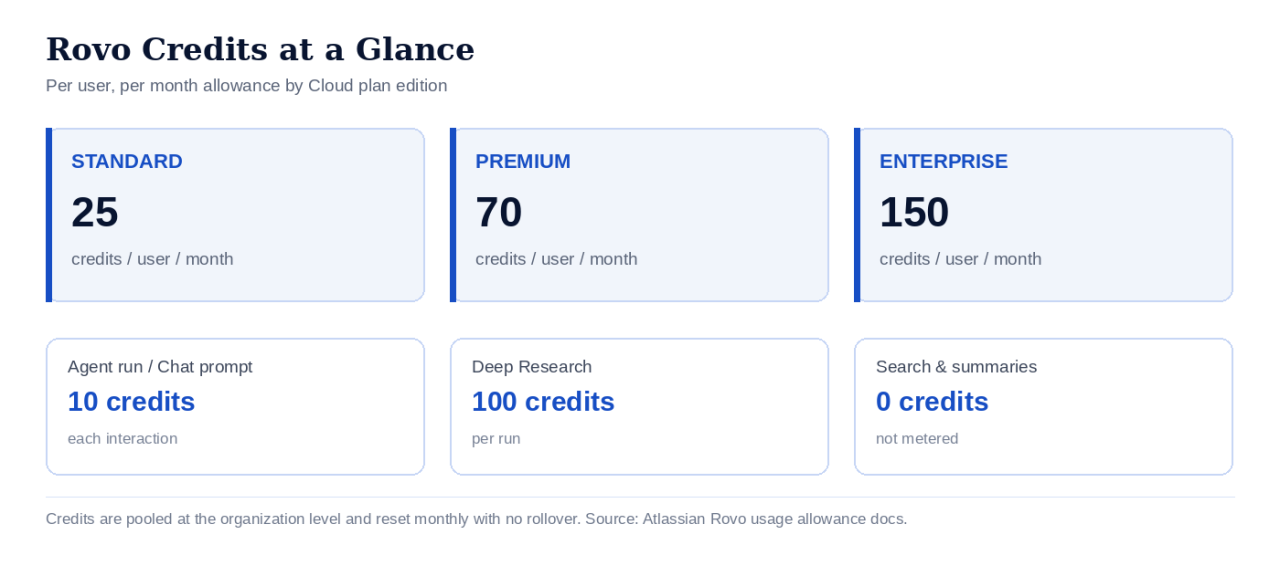
Not every action costs the same. Search, quick summaries, and definitions draw nothing from the pool. Running an agent or sending a Rovo Chat prompt currently costs 10 credits, and Deep Research runs cost 100. Do the arithmetic on a single Standard seat and a person's implied share is about two and a half agent runs a month, though in practice everyone draws from the same shared pool. Atlassian says it is not currently billing for usage above the included allowance and has committed to 90 days' notice before that changes, but that is a policy today, not a permanent guarantee.
Two things worth checking before you plan a workflow around this: your organization needs a verified business domain to turn Rovo on at all, and if your team is currently on a generic email domain for Atlassian admin purposes, that is a blocker you will hit before pricing ever becomes the issue.
What Nobody Puts in the Rovo Demo
Every agentic AI rollout, Rovo included, inherits risks that have nothing to do with how good the model is. The OWASP Gen AI Security Project published its Top 10 for Agentic Applications in December 2025, and the risks it names map onto what happens when you give a Jira agent write permissions across a project. Excessive agency, where an agent has more access than its task requires, sits near the top of that list, alongside identity and privilege abuse. These are not hypothetical categories. The list cites real 2025 incidents, including a coding assistant compromise that affected close to a million installs.
None of that means Rovo agents are unsafe to use. Atlassian logs every agent action and requires permission before an agent edits a work item. It means the governance question is separate from the capability question, and most teams evaluating Rovo skip past it. Worth knowing too that Gartner projects the average large enterprise will run well over a hundred thousand AI agents by 2028, up from a handful today, with only a small fraction reporting real governance for that scale. A QA team adding one more agent should know at minimum which tickets it can touch and who reviews what it changes.
For teams building test coverage for AI features themselves rather than just using AI to write tests, RCV Academy's ISTQB Generative AI certification course covers the testing considerations specific to generative and agentic systems, which is a useful companion to understanding the agents you are now working alongside inside Jira.
Frequently Asked Questions
Does every Jira plan include Rovo Agents?
Rovo is included with paid Standard, Premium, and Enterprise Cloud plans of Jira, Confluence, Jira Service Management, and Teamwork Collection. It is not an unlimited add on to free plans, and your admin needs a verified business domain to enable it.
Can a Rovo agent create or modify test cases without a person approving it?
Agents can perform skills like creating or editing work items, but only with permission granted at setup or confirmed at the point of action. Every action is logged, giving you an audit trail for later review.
How is this different from asking a general AI assistant to write test cases from a ticket?
Mainly context. A Rovo agent inside Jira pulls from linked issues, comment history, and connected Confluence pages without you copying that context in manually. The tradeoff is that it runs on Rovo credits and stays inside the Atlassian ecosystem, so teams wanting a specific model or more prompt control often still build a separate pipeline.
What happens if our organization runs out of Rovo credits for the month?
Today, Atlassian allows usage to continue past the included allowance without an automatic charge, with notifications at 80 and 100 percent of the pool. It has reserved the right to introduce billed overage later with 90 days' notice and an opt in requirement, so this is worth monitoring rather than assuming it stays free.
Rovo Agents are a real capability shift inside Jira, not just another AI wrapper, but the credit math and the permission model deserve as much attention as the demo does. To go deeper into building and testing agentic workflows rather than only consuming the ones Atlassian ships, RCV Academy's Generative AI and AI Agents for QA and SDET course is a solid next step for turning this from a curiosity into a workflow your team controls.