Small Language Models vs Large: Cost-Benefit for Testing
 Software Testing Mentor and RCV Academy

Empirical benchmarks comparing SLMs and LLMs for test generation. When a 7B model is good enough, when 70B earns its cost, and a practical decision framework.
The Size Question Nobody Asks First
Most teams reach for a large language model when they start experimenting with AI assisted testing. The model is available via API, the first results look promising, and the cost does not feel real until the invoice arrives. By then the architecture is set.
The question worth asking before that point is a simpler one: how much model do the tasks actually require? Test generation, assertion writing, and test code review are structured, constrained tasks. They operate on a known codebase, produce output in a defined format, and can be evaluated automatically. That profile does not always require a model with 70 billion parameters.
What the Benchmarks Show
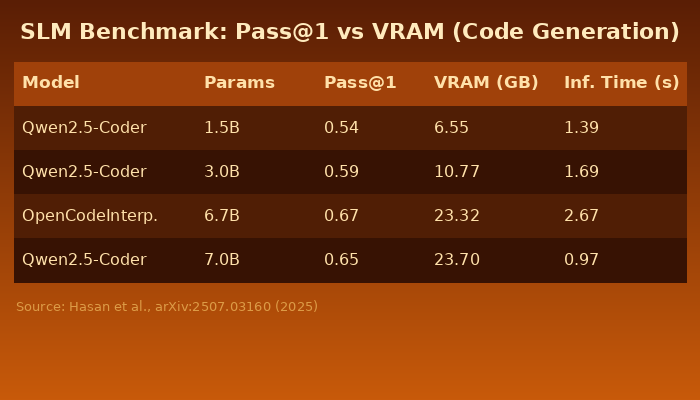
A July 2025 empirical study by Hasan et al. evaluated 20 open source small language models ranging from 0.4B to 10B parameters across five code generation benchmarks: HumanEval, MBPP, Mercury, HumanEvalPack, and CodeXGLUE. The top performers were not the largest models in the set. Qwen2.5-Coder at 1.5B parameters reached a mean pass@1 of 0.54 across benchmarks. Qwen2.5-Coder at 3.0B reached 0.59. OpenCodeInterpreter at 6.7B reached 0.67, and Qwen2.5-Coder at 7.0B reached 0.65 (Hasan et al., “Assessing Small Language Models for Code Generation: An Empirical Study with Benchmarks,” arXiv:2507.03160, 2025).
Those numbers are not as high as GPT-4 class models on the same benchmarks. But the cost picture looks very different. The study found that a 10% improvement in pass@1 can require nearly a 4x increase in VRAM. Moving from Qwen2.5-Coder 1.5B (6.55 GB VRAM, pass@1 of 0.54) to Qwen2.5-Coder 7.0B (23.70 GB VRAM, pass@1 of 0.65) yields a 20% relative gain in accuracy at the cost of a 3.6x increase in memory. Whether that tradeoff makes sense depends entirely on the task.
When Smaller Is Sufficient
The important distinction is between tasks that need broad general reasoning and tasks that need pattern consistency. Large model advantages compound when the model must understand an entirely unfamiliar codebase, reason about edge cases without examples, or synthesize tests from vague natural language requirements. In those situations, additional model capacity genuinely helps.
For teams that have already built a structured context around their requests, passing in class signatures, representative tests, and framework conventions, much of the reasoning load transfers to the context rather than the model weights. A smaller model reading good context can outperform a larger model reading sparse context.
A 2025 study by Jhandi et al. on tool calling in agentic systems found that an OPT-350M model adapted for tool use reached a 77.55% pass rate on ToolBench, compared to 26.00% for ChatGPT-CoT and 30.18% for ToolLLaMA-DFS (Jhandi et al., “Small Language Models for Efficient Agentic Tool Calling: Outperforming Large Models with Targeted Fine-tuning,” arXiv:2512.15943, 2025). The task structure was narrow enough that a small model trained to do it well outperformed large models that were not.
For test automation, the analogy holds when your scaffolding is tight: prompt templates that include the focal method, its class context, and two or three representative tests from your suite give a small model enough information to produce consistent output.
When Larger Is Worth the Cost
There are three situations where the larger model earns its price.
The first is coverage breadth. When you need tests for code paths that lack examples in your existing suite, or for edge cases that require reasoning about failure modes, a larger model’s broader training surface produces better results. The difference between a 7B and a 70B model on novel code paths is larger than the difference on pattern matching tasks.
The second is natural language requirements. When the input to test generation is a user story or a specification rather than existing code, the model needs to interpret ambiguous language, resolve unstated assumptions, and map requirements to test conditions. This is where reasoning capacity matters most.
The third is multistep agentic tasks. A model coordinating test planning, execution, failure diagnosis, and fix suggestion across a long context window benefits from the additional capacity. Shorter, single step tasks are where small models are competitive.
A September 2025 research roadmap for large language models in software testing identified test oracle generation and flaky test repair as two of the areas where model scale continues to provide measurable gains. Both tasks require reasoning about program behavior across multiple states, which pushes past what smaller models handle reliably (Iqbal et al., “Large Language Models for Software Testing: A Research Roadmap,” arXiv:2509.25043, 2025).
The Requirements Classification Case
Not all tasks adjacent to testing are code generation. A 2025 study by Zadenoori et al. compared eight models on requirements classification across three datasets. The large models averaged about 2% higher F1 than the small models, a difference the authors found to be statistically insignificant. The small models were up to 300 times smaller by parameter count and outperformed the large models in recall on one of the three datasets (Zadenoori et al., “Does Model Size Matter? A Comparison of Small and Large Language Models for Requirements Classification,” arXiv:2510.21443, 2025).
For classification tasks with consistent input structure and a defined label set, the data suggests that model size is not the primary driver of quality. The label space is constrained enough that a small model trained or prompted well can match a large one.
A Practical Decision Framework
The question is not which is better in the abstract. It is which fits the task’s actual requirements.
Start by characterizing the task type. Test generation from existing examples is a pattern matching task. Test generation from specifications is a reasoning task. Assertion style enforcement is a consistency task. Classification of failing tests is a structured inference task. The first and third types are strong candidates for smaller models, particularly if the model will be adapted to your codebase. The second and fourth typically benefit from more capacity.
Then account for volume. The cost per query of large models hosted via API becomes significant at scale. A CI pipeline running test generation on every pull request might invoke the model thousands of times per day. At that volume, a self hosted 7B model with a monthly amortized cost becomes competitive even if it produces slightly lower raw accuracy, because the cost savings allow for retry logic, multiple candidates, and automated filtering that recovers much of the accuracy gap.
For teams doing this at the infrastructure level, the recommended path is to run both a small and a large model in parallel on a reserved sample of your test tasks, measure pass@1 and compilation rate for each, and let the numbers decide. The benchmarks give you a prior; your codebase gives you the real answer.
For practical guidance on building the retrieval and generation pipelines that make smaller models more effective, the LangChain for QA: Build RAG, Agentic RAG and AI Chatbots course covers how to structure context to reduce the reasoning load on the model.
Teams who want to understand model architecture and evaluation in depth will find the transformer fundamentals and evaluation sections in the Generative AI and AI Agents for QA SDET Masterclass useful for developing the judgment to make these infrastructure tradeoffs well.
Categories: : Agentic AI, AI, AI Roadmap, ISTQB Generative AI