Software Testing Mentor and RCV Academy
A Futurum Group analyst covering Atlassian's Team 26 announcement wrote a line worth remembering before anyone rebuilds their QA process around this: a single reference customer is positioning, not validation. He was talking about Mercedes Benz, the one named company Atlassian points to when it describes what the Teamwork Graph can do. That is a useful filter for the rest of this announcement too.
What the Teamwork Graph Actually Is
The Teamwork Graph is Atlassian's context layer, a data model that maps the relationships between work items, documents, people, and conversations across Jira, Confluence, Bitbucket, and a long list of connected third party tools. It existed for years as something that powered Rovo behind the scenes. At Team 26 in Anaheim in May 2026, Atlassian opened it up as a platform other tools can query directly, through a new CLI with more than 300 commands and two Rovo MCP Server tools that let any MCP compatible client pull graph context on demand.
Atlassian states the graph now holds more than 150 billion objects and relationships spanning Jira, Confluence, Bitbucket, Loom, Jira Service Management, and more than 75 third party integrations. Every query still runs through what Atlassian calls last mile permission checks, so an agent only sees what the requesting user is already allowed to see. That part is a real, verifiable design choice, not a marketing claim, and it matters if you plan to point an agent at your backlog.
If your team wants to build custom agents on top of this kind of graph rather than just querying it through chat, RCV Academy's course on generative AI and AI agents for QA and SDET covers the underlying patterns for grounding an agent in real context instead of a single prompt.
The Mercedes Benz Case Study Is Carrying a Lot of Weight
Atlassian's own numbers for this launch are notable. The company reports that grounding agent responses in Teamwork Graph data produced 44 percent more accurate results while using 48 percent fewer tokens in its internal benchmarks, and that Rovo saw 14 million assisted actions across its customer base in a single month. Those are Atlassian measuring Atlassian, which does not make them false, but it does mean nobody outside the company has reproduced them.
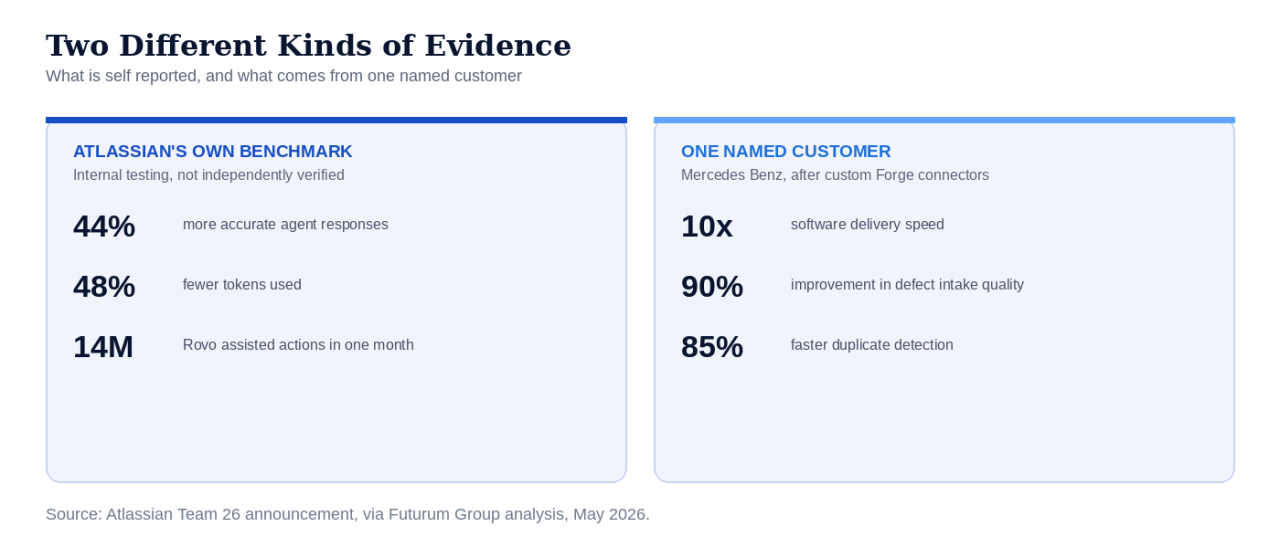
The named customer result comes from one company. Mercedes Benz reports a tenfold increase in software delivery speed, a 90 percent improvement in defect intake quality, and 85 percent faster duplicate detection after building custom Forge connectors against the graph. Defect intake quality and duplicate detection are QA metrics specifically, which makes this the most directly relevant data point in the announcement for a testing team. It is also, as the Futurum analysis points out, one case study standing in for what every customer should expect. A team that has invested heavily in custom connectors and clean data discipline is not the same starting point as a team that has not.
The CLI and MCP Server tools are free right now. Atlassian has said future pricing will tie into Rovo credits, with 90 days of notice before any billing starts. Free today is not the same commitment as free permanently, and it is worth checking back on that pricing page before you build a workflow that assumes it stays this way.
What This Actually Means for a Test Backlog
Here is the part the announcement does not spell out. An agent grounded in the Teamwork Graph can, in principle, connect a bug report to the Confluence spec it violates, the pull request that introduced it, and the Slack thread where someone first flagged it. That only works if those links already exist. The graph reflects the relationships your team actually created, not the relationships that should exist in an ideal world.
A backlog full of defects with no linked requirements, no referenced commits, and no connected discussion gives an agent almost nothing to traverse, no matter how many billions of objects sit elsewhere in the graph. The AI native workflow this announcement describes depends on ticket hygiene that most testing teams have never been disciplined about, because there was never a strong incentive to be. That incentive exists now. Teams that started linking Jira issues to specs and PRs consistently are the ones positioned to get something real out of this. Teams that treat Jira as a flat list of tickets are not, regardless of how good the underlying graph gets.
Frequently Asked Questions
Do I need to migrate to Jira Cloud to use the Teamwork Graph?
Yes. Atlassian's own documentation states the Teamwork Graph is available on Atlassian Cloud only. Organizations still running Jira Server or Data Center need to migrate before any of this applies to them.
Is the Teamwork Graph the same thing as Rovo?
No. Rovo is the assistant and agent layer that sits on top of the graph. The Teamwork Graph is the underlying context model. Before Team 26, the graph powered Rovo internally without being directly queryable by outside tools.
Does opening the graph to external AI clients change who can see my data?
Atlassian states that every query runs through the same permission checks a human user would face, so an AI client cannot see data the querying user was not already entitled to see. That claim is part of Atlassian's own documentation rather than independently audited.
What does grounding an agent in Teamwork Graph data actually improve?
Atlassian's internal benchmark reports 44 percent more accurate agent responses and 48 percent fewer tokens used when responses are grounded in graph context versus not. That figure comes from Atlassian's own testing and has not been independently reproduced.
Teamwork Graph is a real architectural shift, not just a rebrand of search, but what it delivers for your team depends more on your own ticket discipline than on anything Atlassian ships. If you want to build the kind of agentic testing workflows that actually take advantage of connected context, RCV Academy's course on agentic AI for QA and SDET is where to start before you assume the graph will do the linking work for you.