Test Data Is the New Bottleneck: Generating It Safely with AI
 Software Testing Mentor and RCV Academy
"Copying production data into test environments is not anonymization. Here is what generating test data safely with AI actually requires."
A test suite can run in minutes. Finding realistic data to run it against can take days, and increasingly, it is the slower of the two problems. Automation solved execution speed years ago. Nobody solved data.
Why test data became the bottleneck everyone is naming out loud
Capgemini's World Quality Report 2025 26 puts a number on something testers have felt for a while: the use of synthetic data in testing rose from 14 percent in 2024 to an average of 25 percent in 2025, and the same report ranks synthetic data generation as the top generative AI use case in quality engineering right now. That is not a niche practice growing quietly. It is teams admitting that the old approach, copying a slice of production data into a test environment, has stopped being good enough.
The reasons are not mysterious. Production data reflects real customers, and using it in test environments carries real privacy exposure. Synthetic and AI generated data promises a way out: realistic enough to exercise the system properly, without dragging an actual person's records into a QA environment. The promise is real. So is the way teams get the execution wrong.
The naive approach that does not actually work
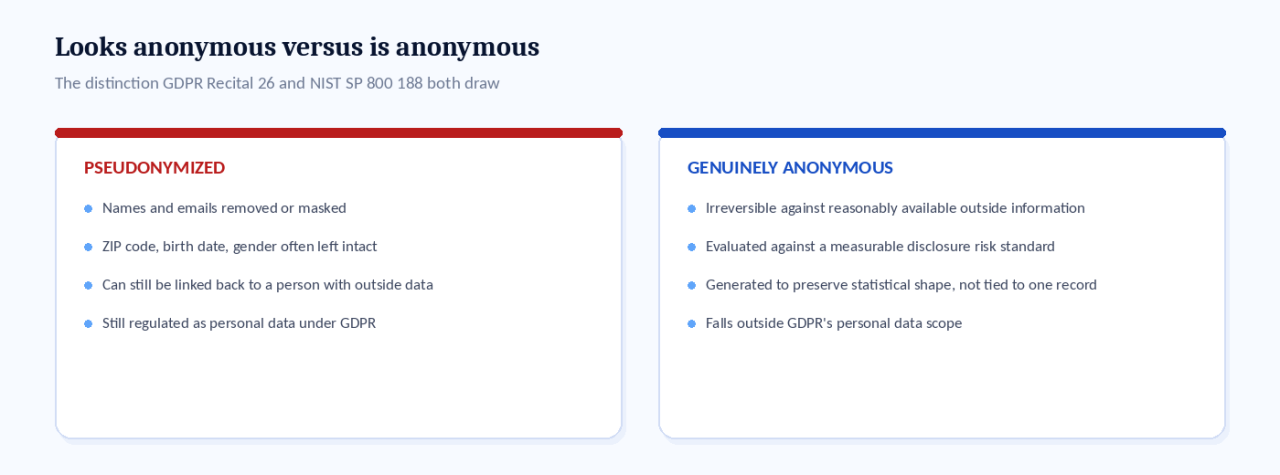
Scrambling names and masking a few obvious fields feels like anonymization. It usually is not. Latanya Sweeney's foundational study on reidentification, based on 1990 US Census data, found that 87 percent of the population could be uniquely identified using nothing more than a five digit ZIP code, gender, and full date of birth, three fields that feel harmless enough to leave untouched in a typical data masking pass. Strip the name and email, keep those three fields intact for testing purposes, and the record is still often traceable back to a real person.
This is exactly the distinction GDPR's Recital 26 draws between pseudonymized and genuinely anonymous data. Data that has been pseudonymized, meaning identifiers were swapped or masked but could still be linked back to a person using other available information, is still considered personal data under the regulation and still carries the same obligations. Anonymization has to be irreversible, accounting for what other information exists in the world that could be combined with your masked dataset to reverse it. A quick find and replace on a production export rarely clears that bar.
What generating test data safely actually requires
NIST Special Publication 800 188, written with the US Census Bureau, treats synthetic data generation as one legitimate deidentification technique among several, not an automatic solution on its own. It recommends agencies evaluate the specific disclosure risk of a release, consider forming a review process to check that risk before data goes out, and choose a deidentification approach with a measurable, testable standard rather than an intuitive one. Applied to a QA context, that means treating "is this test data actually safe" as a question with an answer you can check, not an assumption that generating data with an AI model automatically clears the bar.
AI generated synthetic data can genuinely help here, when it is built to preserve the statistical shape of real data, distributions, correlations, edge cases, without being derived record by record from actual customer data. The risk shows up when a model is trained directly on production data and then used to generate test cases, since a model can memorize and reproduce specific training examples rather than generalizing away from them. The generation method matters as much as the output looking synthetic on the surface.
What this means for a QA team building this pipeline
Treat generated test data the same way you would treat a security control: verify it, do not just trust the label. Check a sample of AI generated records against known quasi identifier combinations, the kind Sweeney's research flags, before assuming a dataset is safe to use outside a locked down environment. If your team is setting up a pipeline that touches real data or generates synthetic data at scale, the Generative AI and AI Agents for QA and SDETs masterclass covers building these generation and evaluation steps into a working workflow rather than treating data generation as a one off script.
Separate the data generation method from the data validation method. The same team should not be the only check on whether output data is actually safe, the same way a developer should not be the only reviewer of their own security sensitive code.
Frequently asked questions
Is AI generated synthetic data always safer than masked production data?
Not automatically. Safety depends on the generation method. Data generated from learned statistical patterns without being tied to specific real records tends to be safer than data a model produces after training directly on unmodified production data, which risks memorization.
Does removing names and emails count as anonymization?
Usually not on its own. As Sweeney's research and GDPR's own definition make clear, indirect identifiers like ZIP code, birth date, and gender can reidentify a large share of a population even when direct identifiers are removed.
How do we know if our synthetic test data is realistic enough to be useful?
Compare the statistical distributions and edge case coverage in the synthetic set against what you know about real data patterns, without needing the synthetic set to contain any actual customer records to make that comparison.
Is this only a concern for companies handling healthcare or financial data?
No. Any test data drawn from or resembling real users carries some reidentification risk once combined with outside information, which is exactly the scenario GDPR's anonymization standard addresses regardless of industry.
If your team wants a structured approach to building and validating a synthetic test data pipeline instead of assembling one from scratch, the Agentic AI for QA and SDET course walks through wiring generation and verification steps into an automated pipeline.
Categories: : AI, AI Tools, API Testing, Generative AI