Testing MCP Servers: A New QA Discipline for the Agentic AI Era
 Software Testing Mentor and RCV Academy
"What testing an MCP server actually involves, the official tooling, and why this is becoming its own QA discipline in 2026."
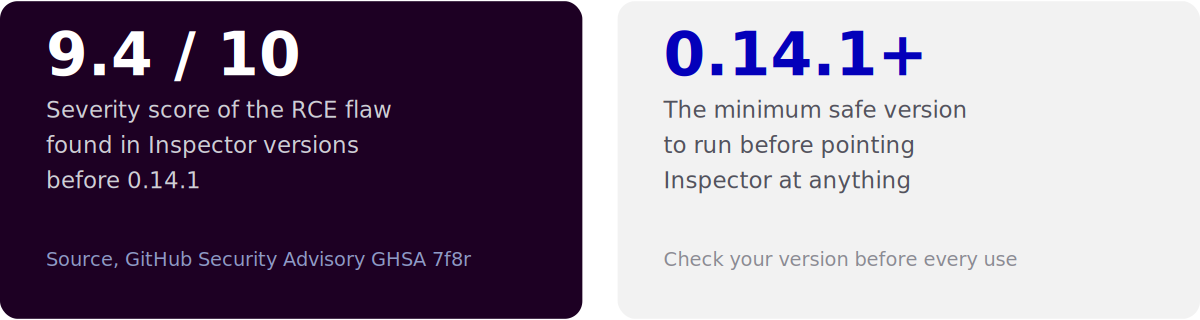
In June 2025, security researchers disclosed a critical vulnerability in Anthropic's own MCP Inspector tool, the official utility developers use to test MCP servers. A malicious website could trick a browser into sending a request to a developer's local machine and run arbitrary code on it, no download and no phishing email required. The flaw scored 9.4 out of 10 on the standard severity scale and was patched in version 0.14.1.
That single incident says everything about why testing MCP servers deserves its own attention right now. This is new infrastructure, the tooling is young, and the failure modes differ enough from a normal API that a QA background in REST testing does not automatically transfer.
What an MCP server actually is, and why testing it differs from API testing
The Model Context Protocol is an open standard that lets an AI model call external tools, read resources, and use prompt templates through a consistent interface. An MCP server is the program exposing those capabilities, tools an agent can invoke, resources it can read, prompts it can request, all communicated through JSON-RPC messages over stdio, Server-Sent Events, or streamable HTTP.
The reason this is not just REST testing with a different name is who the client actually is. A REST API gets called by code someone wrote and can read. An MCP server gets called by a language model deciding, on its own, which tool to invoke and what arguments to pass. A badly designed schema does not just produce a confusing error message, it can lead the model to call the wrong tool entirely, pass malformed arguments it invented, or misread what a tool does based on nothing but its description text.
The official tool, and what it actually checks
MCP Inspector is Anthropic's official developer tool for testing and debugging MCP servers, and it ships in three forms, a browser based web UI, a scriptable CLI for automation, and a terminal interface. You run it with a single command against your server.
npx @modelcontextprotocol/inspector node build/index.js
Once connected, it lists every tool, resource, and prompt your server exposes, lets you call a tool with custom arguments and see the raw response, and shows the actual JSON-RPC traffic passing between client and server. That last part matters more than it sounds. MCP uses stdout for protocol messages, so a stray print statement or console log inside your server corrupts the entire communication stream, and Inspector is often the fastest way to catch that specific failure before it shows up as a mysterious silent failure inside an actual AI client.
For anything you want running in a pipeline rather than clicked through by hand, the CLI mode supports scripted checks.
npx @modelcontextprotocol/inspector --cli node build/index.js --method tools/list
That single command validates your server's full tool inventory in a form that can gate a build the same way a failing unit test would.
Always check the version before you trust the tool
The vulnerability described at the top of this post is not just a cautionary story, it is a specific, checkable fact you should verify before using Inspector at all. Versions below 0.14.1 lack authentication between the browser client and the local proxy that actually talks to your server, which means an unauthenticated request, potentially from a malicious website, could get the proxy to run commands on your machine. Confirm you are running 0.14.1 or later before pointing Inspector at anything, and never disable the authentication token it generates by default.
This is a useful lesson beyond just this one tool. The testing infrastructure around a new protocol is itself new code, written quickly, under the same time pressure as everything else in this space, and it deserves the same scrutiny you would apply to the servers it tests.
Building a real test suite, not just manual clicking
Inspector is excellent for exploring a server interactively, but a QA process built entirely on clicking through a UI does not scale and does not run in CI. A more durable approach layers three things.
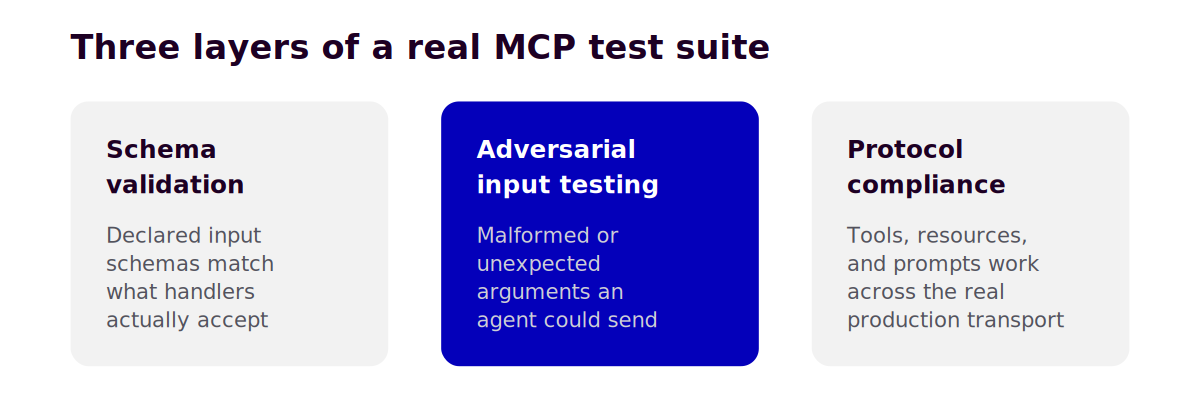
- Schema validation, confirming every tool's declared input schema actually matches what the handler accepts, since a mismatch here is invisible until an agent sends a value the schema allowed but the code did not expect
- Adversarial input testing, deliberately sending malformed, oversized, or unexpected arguments to each tool, since a model can and eventually will generate exactly that kind of input
- Protocol compliance checks, using Inspector's CLI mode or a lightweight client built on the official SDK to confirm tools, resources, and prompts all list and respond correctly across the transport your server actually uses in production
None of this replaces functional testing of what the tool actually does once called. It is the layer underneath that, the part that keeps a broken schema or a stdout leak from turning into a confusing production incident that looks like the AI model is behaving strangely when the real problem is the server it is talking to. RCV Academy's Agentic AI for QA and SDET course covers building and testing the kind of multi agent pipelines that depend on MCP servers working correctly under exactly these conditions.
Frequently asked questions
Do I need to learn a new testing framework specifically for MCP servers? Not necessarily. MCP Inspector's CLI mode integrates into standard CI pipelines the same way any command line tool does, and the official SDKs let you write conventional test files in Python or TypeScript that call your server directly, so existing testing skills transfer more than the unfamiliar protocol name might suggest.
Is MCP Inspector safe to run on a shared or production network? Run it only on trusted local networks, and never expose its proxy port publicly. Even with the authentication fix in place, its documentation is explicit that it is a development tool, not something designed to sit on infrastructure other people can reach.
What is the single most common bug Inspector catches that a normal API test would miss? Stdout contamination, where a server accidentally writes debug output or log lines to standard output instead of standard error. Since MCP uses stdout for protocol messages, this silently corrupts every response the server sends, and it is a failure mode that simply does not exist in typical REST API testing.
RCV Academy's Generative AI and AI Agents for QA course covers MCP hands on, including how to connect an AI agent to a real MCP server and think through exactly the kind of testing this post describes.
Categories: : Agentic AI, AI, AI SDET, AI Tools