What Is an SDET in 2026? Role, Skills, and How AI Is Reshaping It
 Software Testing Mentor and RCV Academy
"What an SDET actually does in 2026, real salary data, the core skills companies want, and how AI is changing the role day to day."
Look up SDET salaries across four different sites and you will get four different numbers, sometimes $50,000 apart for what is supposedly the same job. That is not bad data, it is a real symptom of the title itself. SDET means something different depending on which company posted the job, which is exactly why so many people asking "what is an SDET" are really asking "should I care about this title at all." The short answer is yes, and here is what it actually means in 2026.
What the title actually means
SDET stands for Software Development Engineer in Test, a title Microsoft popularized in the 2000s to describe someone who writes production quality code whose entire purpose is verifying other code. The distinction that actually matters, an SDET does not just execute tests, they build the infrastructure that makes automated testing possible in the first place, frameworks, CI pipelines, test data generators, internal tooling.
The inconsistency shows up because companies use SDET, QA Automation Engineer, Software Engineer in Test, and Quality Engineer somewhat interchangeably, with real differences in scope hiding behind similar sounding titles. A useful filter when evaluating a role, ask whether the job expects you to design and own testing infrastructure or mainly execute tests someone else designed. The first is SDET work regardless of what the title says, the second usually is not, regardless of the title either.
What the work actually looks like day to day
An SDET's work spans both white box testing, which requires reading and understanding the actual application code, and black box testing, which evaluates behavior from the outside the way a user would experience it. In practice that means building and maintaining automation frameworks, writing tests that plug into CI/CD pipelines, creating realistic test data, and often reviewing code alongside developers rather than after them.
The technical baseline companies expect includes a programming language, Java, Python, and JavaScript or TypeScript are the most common, a UI automation tool like Playwright or Selenium, an API testing tool, and working knowledge of CI/CD systems like Jenkins or GitHub Actions. None of that is new to 2026. RCV Academy's Playwright course covers the automation half of that baseline directly. What has changed is what gets layered on top of it.
What it actually pays
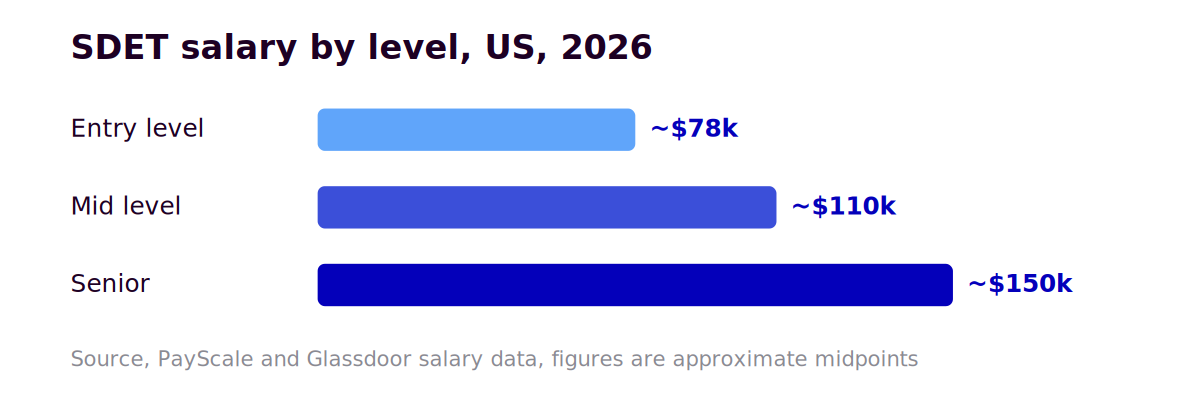
Salary estimates for SDET vary more than most tech roles, partly because of the title confusion described above and partly because sample sizes differ wildly between sources. PayScale puts the average SDET salary at $96,678, based on 92 self reported responses. Glassdoor puts it considerably higher at $125,679, based on a larger sample of 216 salaries.
A reasonable planning range given both sources is $95,000 to $130,000 for a general SDET title in the United States, with senior and staff level roles regularly clearing $150,000 to $190,000 at larger tech companies. Take any single number you see online with real skepticism and treat the range, not the average, as the useful data point.
How AI is actually changing the role
This is the part that has shifted meaningfully in the last year, and it cuts in two directions at once.
On one side, SDETs are adopting AI tools themselves. Writing a first draft of a test framework, generating edge cases from a user story, and debugging a flaky test are all tasks where an AI coding assistant genuinely speeds up the work an SDET was already doing.
On the other side, SDETs are increasingly responsible for testing code that AI wrote, not just code a human wrote. Sonar's 2026 State of Code report, based on 1,149 developers, found that 96 percent do not fully trust AI generated code is functionally correct, and only 48 percent always check it before committing. A separate 2026 survey of 300 QA engineers found that 65 percent now work with development teams using AI to generate code actively, and 52 percent report bug volume has increased as a result.
Put together, that means the SDET role increasingly includes a skill nobody wrote into job descriptions five years ago: judging the reliability of AI generated code and AI generated test output critically, rather than assuming either is correct by default. That skill sits alongside the traditional automation toolkit now, not instead of it.
Frequently asked questions
Is SDET the same thing as a QA engineer? Not exactly. QA engineer is a broader term that can include manual testing with little or no coding. SDET specifically implies you write production quality code and typically own test infrastructure and framework design, not just test execution.
Do I need a computer science degree to become an SDET? No, though many SDETs have one. What matters more is demonstrated ability, a working automation framework, contributions to test tooling, or a portfolio project, since that is what most SDET interviews actually probe for.
Is the SDET role at risk from AI automation? The data points the other way for now. AI is changing what SDETs spend their time on, more judgment and verification, less repetitive script writing, but someone still has to decide what needs testing, build the infrastructure that runs those tests, and catch the kind of subtle logical error that AI generated code produces at a higher rate than experienced developers expect.
If you are building toward this role from a manual testing background, RCV Academy's AI Augmented QA roadmap sequences the exact skills covered here, automation, API testing, and the AI evaluation judgment now expected of SDETs, into a structured path rather than a scattered list of things to learn.
Categories: : Agentic AI, AI, AI Tools, SDET